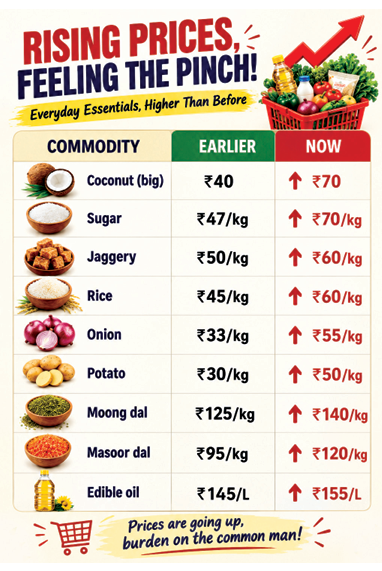
Coconut prices have climbed to as much as Rs 60-Rs 70 a piece in mar kets across the State, sugar has touched nearly Rs 70 per kg, jaggery is selling at around Rs 60, while pulses, rava, veg etables and other kitchen essentials have also become costlier, leaving families staring at a steadily mounting grocery bill. The price surge comes at a difficult time for families, with Ganesh Chaturthi approaching on September 14 and demand for coconuts, sugar and other ingredients expected to rise as households prepare traditional sweets, snacks and offerings.
At Ponda market, coconuts are currently selling between Rs 40 and Rs 60 depending on size, with small coconuts available at around Rs 35. Larger coconuts are fetching Rs 60 or more. In Margao the larger coconuts were selling as high as Rs 70 a piece. Vendors attribute the increase to higher festive demand, reduced production and diseases affecting coco nut trees, besides the absence of adequate new plantations. Sugar has emerged as another major pressure point. Retail prices have risen to around Rs 70 per kg, com pared to around Rs 47 earlier in Margao, according to in formation from a Sahakari Bhandar. Jaggery is selling at around Rs 60 per kg against Rs 50 earlier, while rava has risen to around Rs 42 from Rs 38.

For families preparing traditional delicacies at home, the increases quickly add up. Dalda ghee is around Rs 150 per kg, chana dal around Rs 100, toor dal around Rs 140, peas around Rs 96 and 5-kg atta around Rs 314. In the Margao market, green peas are selling at around Rs 130 per kg, moong dal at Rs 120, masoor dal at Rs 97, urad dal at Rs 148 and kabuli chana at around Rs 190. Vegetables have added another layer to the squeeze, with onions selling at around Rs 45 per kg in Margao, potatoes at Rs 55 and beans at nearly Rs 80. Vegetable vendors said prices of several vegetables have been rising for nearly two months, although they reported no major shortage that would justify such a sharp escalation. “The prices of essential commodities have gone up con siderably, and this is putting an additional burden on the common man,” said housewife Geeta Khandeparker, point ing out that the impact is particularly severe during the festive season, when household expenditure on food and other necessities rises. Vegetable vendor Kamala Mahale said, “Prices of several vegetables have been increasing over the past two months. The rise had initially been gradual but has accelerated in recent weeks. Currently, there is no major shortage of veg etables, just a sharp escalation in prices.” The pressure is not confined to festival shopping. Con sumers say the cumulative increase across the grocery basket is eating into incomes that have largely remained stagnant, particularly for private-sector employees and families dependent on fixed salaries or pensions. “We cannot stop buying rice, vegetables, cooking oil or other essentials. These are basic requirements. When their prices go up, there is very little scope to cut expenditure.
We simply have to buy less,” said consumer Perina Dias. “For people with a fixed salary or pension, there is no way to increase income when prices rise. We have to adjust our expenses. Ultimately, it affects the quality and quantity of food we purchase,” said Eliza Fernandes from Nuvem. Another consumer, Uprita Naik of Cuncolim, said the problem was the cumulative effect of repeated increases. “Every time we go to the market, there seems to be a new price. Even if the increase in one item is small, when five or six items become expensive, the total bill increases consid erably,” she said. Another resident, Shrikant Naik, said families are now being forced to carefully calculate every purchase. “Earlier, we could buy vegetables and groceries with out thinking too much. Now we have to check the price of everything and decide what we can afford. Salaries are not increasing, but prices keep going up,” Prerna Gaonkar said. The impending festival is making the coconut price rise particularly sensitive.
Coconut is not merely another kitch en commodity during Chaturthi — it is used extensively in prasad, mahaprasad, nevreo and sweets, while the fruit it self forms part of the Ganesh puja. According to Vallab Naik, if around three lakh families celebrate Ganesh Chaturthi; three lakh coconuts could be required just for the Ganesh puja itself. With celebra tions lasting anywhere from one-and-a-half days to several days—and in some households up to 21 days—the overall requirement is substantially higher. “These politicians hand out Rs 500-Rs 1,000 per vote during elections, but once the elections are over, they squeeze the voters many times over for the next five years. The government has little concern for the hardships faced by the common man. People should remember this when they go to vote in the upcoming elections,” said Prasad Amonkar, a resident of Ponda. Housewife Nayan Naik said a family celebrating the fes tival for five days could require between 40 and 50 coco nuts, adding that the rising prices could make traditional celebrations increasingly difficult for lower-income house holds. “Ganesh Chaturthi is celebrated in a majority of Hindu households, and consumption increases during the festi val. The government should import more coconuts and sell them at affordable rates so that market prices remain sta ble,” said Vishal Fadte, who also recalled that the Horticul ture Department had last year imported coconuts and sold them at subsidised rates of Rs 40 and Rs 45.
Fadte said both coconuts and sugar should be made available at reasonable rates during the festival and urged the government to step in before prices rise further. Consumers are now seeking precisely such intervention, including increased supplies of coconuts from neighbour ing States and sales through Horticulture Department out lets and ration societies at subsidised rates. The demand is also exposing a deeper supply-side prob lem. Vendors at Ponda Market Yard said coconut harvests have declined because of diseases affecting trees, while monkeys and squirrels damage tender coconuts. Some old coconut trees in bagayats have also died, they said, without sufficient new plantations replacing them. Vendor Mangaldas Naik said the government needed to address the problem beyond short-term festival interven tion by protecting coconut trees affected by disease, en couraging farmers to plant new trees and preventing the conversion of coconut bagayats for construction. The question, meanwhile, is not only whether prices are rising but whether the government is doing enough to en sure consumers are protected from further escalation. Consumers in Margao and Salcete have called for inten sified market inspections during the festive season, includ ing checks on prices, weights and measures, and mandato ry display of price lists. Some alleged that weighing scales are kept inside shops, making measurements difficult for customers to see, while price lists are not prominently dis played in some establishments.
They argue that consumer-protection rules mean little if enforcement remains weak. “We voted for the government, but today we feel cheated. Prices are going up almost every day, and there seems to be no effective control. The common man is the one who is suffering,” said Rodney Rodrigues. Riya Naik echoed the frustration, saying, “We voted with hope, but now we feel cheated. Everything is becoming ex pensive while our salaries remain the same. How are ordi nary families expected to survive?” For households already struggling to stretch fixed in comes across food, rent, education, transport, electricity and other expenses, the festival is therefore becoming a test of purchasing power. (With inputs from Marcos Gonsalves, Shyam Zambaulik er and Santosh Naik)
We cannot stop buying rice, vegetables, cooking oil or other essentials. These are basic require ments. When their prices go up, there is very little scope to cut expenditure. We simply have to buy less – Perina Dias
For people with a fixed salary or pension, there is no way to increase income when prices rise. We have to adjust our expenses. Ultimately, it affects the quality and quantity of food we purchase – Eliza Fernandes, Resident of Nuvem
Every time we go to the market, there seems to be a new price. Even if the increase in one item is small, when five or six items become expensive, the total bill increases considerably – Uprita Naik, Resident of Cuncolim
Earlier, we could buy vegetables and groceries without thinking too much. Now we have to check the price of everything and decide what we can afford. Salaries are not increasing, but prices keep going up –Prerna Gaonkar
We voted for the government, but today we feel cheated. Prices are going up almost every day, and there seems to be no effective control. The common man is the one who is suffering –Rodney Rodrigues