Vivek Menezes
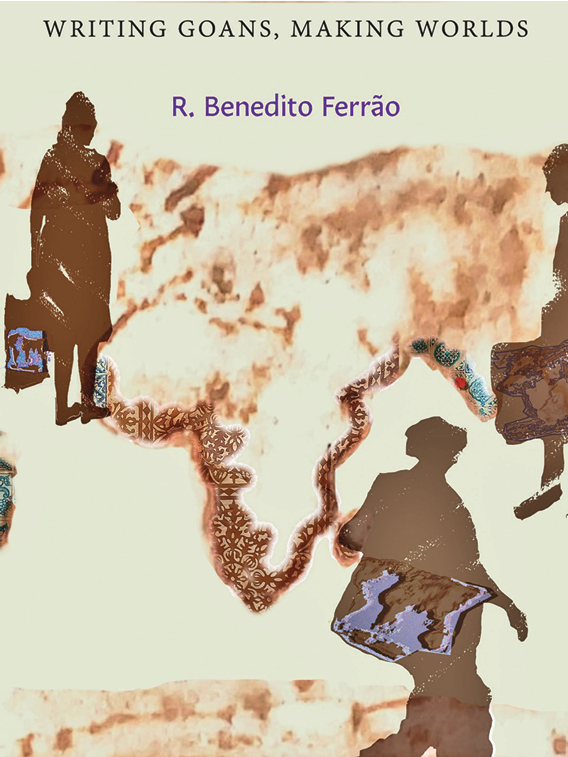
Across Continents: Writing Goans, Making Worlds is the title of the new book by Prof. R. Benedito “Benè” Ferrão of the College of William & Mary in Virginia (it is the second-oldest institute of higher learning in the USA and amongst the oldest in the Anglophone world) but also serves as an ingenious summary of the making and motivations of this star young scholar. He grew up in Kuwait, got his PhD at Birkbeck College at the University of London, with one post-doctoral fellowship at Latrobe University in Australia, plus another couple of fellowships at the American Institute of Indian Studies and the Bayreuth Academy of Advanced African Studies, with teaching stints at University of California, Los Angeles, BITS Pilani Goa, and Hankuk University of Foreign Studies in South Korea. Last month, in addition to his regular duties as an Associate Professor at W&M, he was named 2026-27 Thomas Tam Visiting Professor at Hunter College of the City University of New York. All the while, throughout these impressive peregrinations, he has remained admirably focused on his ancestral roots in Goa. “The research for this book has occupied me for the better part of two decades,” shared Ferrão on social media last month, “so I am grateful to share news of its impending release with you.

Across Continents: Writing Goans, Making Worlds is the first study of literature about the multicontinental displacement of minoritized subjects due to Portuguese colonialism. In it, my focus is Goan characters whose movements connect Asia, Africa, and the west in 20th and 21st century fiction. Although an academic study, this book also mirrors my own family’s history for which reason it is dedicated to my parents.” That is important – after all it is the author’s first proper monograph – but when I finally got his book earlier this week, I found that it starts off with another nine pages of extensive acknowledgements, and what he accurately describes as “an atlas of gratitude.” Ferrão writes that “a book like this on pluricontinentalism in fiction would not be possible were it not for friends, colleagues and research partners in many places around the world” and proceeds to credit an extraordinary number of people and places for blessing and aiding his intellectual journey. Here is my rough tally of the latter alone: Sharjah, the USA, the Philippines, England, Australia, Bavaria, Beirut, Zanzibar, Kenya and Palestine. It was in the last of these scattered locations some years ago, he says, “that visit changed everything I thought I knew about coloniality despite having been a scholar of it for years. This book has been shaped by that visit and the belief that a person must be given their due.” Across Continents in its own words “employs Goan literary subjectivity as epistemology to critique a specific limitation of postcolonial thought, one that does not account for the situations or afterlife of Portuguese colonialism. [The author] considers the relationship between Portuguese and British colonialisms through the displacement of Goan characters betwixt Asia, Africa, Europe and North America.
The experiences of these figures in dealing with the processes of nation, statecraft, and political intrigue at various historical junctures offer a comparative understanding of the tumultuous conditions of postcoloniality in the making of marginalized subjectivity across continents. In examining the mobility and diversity of Goan experiences in works by Salman Rushdie, M. G. Vassanji, Roger King and Margaret Mascarenhas, this book calls into question limits of citizenship, nationality, and notions of belonging. Ferrão centers seemingly minor figures to exemplify the effects of colonial and postcolonial changes that connect diverse geopolitics.” I appreciated how Across Continents often returns “close to the bone” to its author’s own life story, which imbues his literary/cultural arguments with an unusual emotional intensity. Partly no doubt because this book has been published in the African Perspectives list of the University of Michigan Press, he begins his introduction by outlining how “because of my own family’s history, I had grown up knowing that Goans lived in Africa, but what came as a surprise to me later in my youth was that there also existed Africans in Goa.
The passages of both these groups across continents was mainly due to colonialism, both British and Portuguese, I would discover. Shortly after beginning graduate school, I travelled to Kenya for the first time. In a Mombasa cemetery not far from the lighthouse, the Kenyan groundsmen helped my family and I locate the last resting place of my maternal grandmother, Felicidade, whom I had never known. After they were married, my grandparents journeyed from Portuguese Goa to British East Africa where my mother and siblings were born in the first half of the twentieth century.
The end of British colonialism saw an exodus of the family from postcolonial Kenya, one that took them to different parts of the world, much like the characters in the novels this book is about.” Across Continents is an important contribution to our contemporary scholarship about Goa and Goans, with many significant insights and propositions that are worth debating. For example, Ferrão says “the national identity of the Goan is malleable, lacking fixity even” and he believes the “conspicuous expansion of Portugal’s citizenship rights beyond its borders developed as its colonial power dwindled across the globe in the face of the growth of the British empire.
This also became the reason why many Goans sought opportunities beyond Goa, parlaying their colonial rights as citizens to move beyond the remit of Portuguese India. That Goans can still access Portuguese citizenship subsequent to the illegal annexation of Goa by the post-British Indian nation-state in 1961, demonstrates how Portuguese colonialism, even after its demise in South Asia, continues to have an impact on the lives of contemporary Goans. As I will come to argue in more depth [and he does so a few pages later] their navigation of coloniality made Goans postnationals, a status that continues to evolve in an era of globalization and neoliberalism.