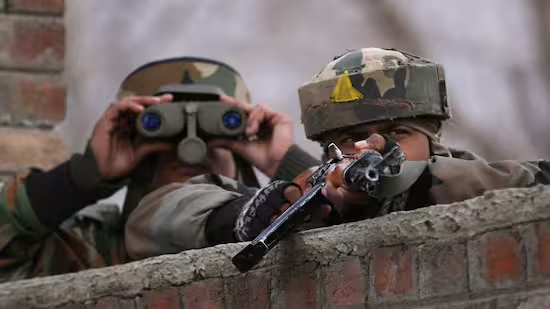
Ten years ago, the Uri terror attack marked a turning point in India’s response to cross-border terrorism. What followed was a series of military operations that progressively changed the geography, methods and scale of India’s response — from the 2016 surgical strikes across the Line of Control to the Balakot airstrike in 2019 and Operation Sindoor in 2025.
THE TIMELINE
SEPTEMBER 2016 — URI ATTACK
Nineteen Indian Army soldiers were killed in the Uri terror attack. The attack became the immediate backdrop to a major change in India’s approach to cross-border terrorism.

SEPTEMBER 28–29, 2016 — SURGICAL STRIKES
Indian special forces targeted multiple terrorist launch pads across the Line of Control in Pakistan-occupied Kashmir. The government publicly announced the operation, making it both a military action and a strategic message.
FEBRUARY 2019 — PULWAMA ATTACK
Following the Pulwama terror attack, India prepared a response that would take its counter-terrorism operations beyond the geography of the LoC.
FEBRUARY 2019 — BALAKOT AIRSTRIKE
India carried out a pre-emptive airstrike on a Jaish-e-Mohammed training facility in Balakot, Pakistan. The operation marked a further expansion in the geographical reach of India’s military response.
APRIL 2025 — PAHALGAM TERROR ATTACK
The Pahalgam terror attack became the trigger for another major Indian military response, further extending the approach that had emerged after Uri.
MAY 7, 2025 — OPERATION SINDOOR
India struck nine terrorist sites in Pakistan and Pakistan-occupied Jammu and Kashmir. The government described the action as focused and measured and said Pakistani military facilities were not targeted.
2026 — TEN YEARS AFTER URI
A decade after Uri, the evolution can be traced through changes in the methods, weapons, targets and geography of India’s military responses. The progression described in the source is Uri → Surgical Strikes → Balakot → Sindoor.