Vivek Menezes
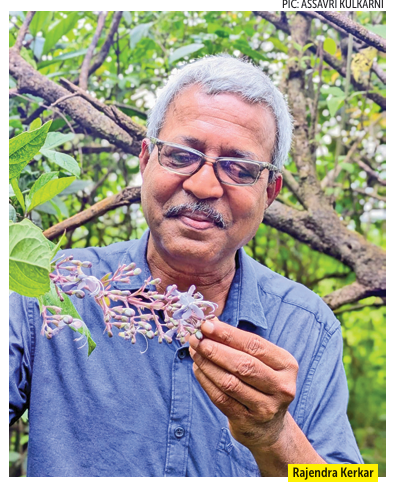
India’s smallest state is becoming rapidly buried in disinformation, propaganda, falsehoods and fraudulent marketing, so its true nature is rarely revealed to visitors, while increasingly scarce for Goans as well. That makes Natural Wonders of Goa by Rajendra Kerkar an important and timely intervention, with its wide-ranging list of 38 historical- ecological-cultural highlights spanning all spheres with admirable catholicity. Flora, fauna, artifacts, cultural practices: all of these are singled out and described by the noted environmentalist, and secretary of the Mhadei Bachao Abhiyan, who is a state treasure in himself (and long overdue an appropriate Padma award recognition). I loved his list of things to explore, including several that have previously escaped my attention. Natural Wonders of Goa reached me via the corporate trainer and community stalwart Pravin Sabnis, one of the trustees of Green Ray Foundation, which was set up in 1990 by the late Maria Claudette Pinto, to whom this publication is dedicated.

Another trustee is Willy Goes, the multi-talented former principal of Goa Art College, who did the book cover design, while the organisation is headed by veteran tiatrist and former Speaker of the Goa legislature Tomazinho Cardozo, who told me their duties include looking after an extensive forested patch of the founder’s ancestral hillside in Verem. Sadly, she was “found dead” in Dona Paula some years ago, after setting aside an impressive corpus of funds “with the sole aim of protecting, preserving, and promoting the environment of Goa.” Educational intent is clearly evident throughout this book, which is influenced, no doubt, by Kerkar’s long career with the Vivekanand Vidhya Mandir school. In addition, Sabnis told me, “I initiated the book primarily to create basic resources for primarily high school students. We organise an environmental quiz every year for school students. Henceforth we will organise an online preliminary open to all high schools in Goa as we have sent copies of the book to 433 of them in the state.
The book deals with the environment and the heritage of Goa which provides first hand experiences about various natural wonders that exist in the state of Goa with accurate documentation and makes the reading highly interesting with attractive photographs of each and every wonder.” In his Foreword, the versatile Dr Pradip Sarmokadam (he is both Member Secretary of Goa State Biodiversity Board and an accomplished classical music vocalist/ composer) writes that “Rajendra ‘Bhai’ Kerkar is one of the most popular, soft-spoken, virtuous, and most sought-after personalities when it comes to environment, culture, literature, folklore, and cross-cutting areas, including providing guidance to the public on several issues and aspects in Goa. His presence brings reassurance to many villagers while trying to understand the importance of their village from a historic or ecological perspective or while dealing with the local environmental issues.
I have often noticed during his speeches that people learn many facts about their own village for the first time, which makes them feel proud. Bhai makes things simple and objective. He is a connoisseur of living gems from society. He has chosen youth from various underprivileged backgrounds and has mentored them to successful careers. All of them are doing great work in the socioecological sector in Goa and across the country.” Sarmokadam explains how Kerkar’s “green brigade” represents “an extended family of people across all ages who follow him not only in Goa but across many states. His battle and participation in building public opinion on Mhadeyi, forest conservation, the conservation of the tiger, and other species that comprise the state’s rich biodiversity is well known.
He has personal connections with every village, and knows the traditional knowledge holders, authors, healers, genuine eco-warriors and activists. He is easily approachable, down-to earth, and respectful to everyone he meets. Any person who meets and interacts with him will be connected to him forever, Hismagnetic field emits green flux, making everyone think and act alike.” The bottom line is “creating awareness by sharing the most interesting and striking facts about Goa’s proud history and interwoven nature-cultural prosperity requires a mission-mode team effort [and] Rajendra ‘Bhai’ Kerkar is the name of that mission mode resourceful personality.” I found many intriguing marvels described in Natural Wonders of Goa that make me want to visit right away, like the Satre Limestone Cave on the Karnataka border, where “the continuous natural flow of spring water attracts wildlife to quench their thirst” and the “thumb shaped boulder of Gule” in Canacona where all those who see it “express awe and wonder about its creation.” Here, too, is the beautiful state bird of Goa, the Ruby throated Yellow Bulbul, the state butterfly Malabar Tree Nymph, the magnificent “world’s largest cattle species” Gaur (our state animal) and King Cobra, the longest venomous snake in the world. There are nice mentions of Dudhsagar, of the first Ramsar site of the state at Nanda Lake in Curchorem, the Khazan system of Raia, windowpane oysters at Chicalim bay, and the Bondvol reservoir of Santa Cruz.
Of course, many of these aspects of Goa’s splendid heritage are well known, but Kerkar’s blend of folklore, traditional knowledge and scientific enquiry adds delightful colour, despite often suffering from inadequate proofreading and editing, as illustrated by this passage: “though today some people love to relish on the meat of frog and every monsoon season, demand for its meat as the jumping chicken increasing on a massive scale, for which bags full with the frogs are transported in Goa from the neighboring regions on the buses, however inspite of it, once, immense respect and gratitude, these amphibians used to command from the locals. In Curchorem Cacoda Municipality, there is one ward, named as Bepquegal, where once moist, evergreen forested patch was protected as the breeding site, without causing any harm. In Priol, there lies the ancestral house belonging to Khedekar Karhade Brahmin family. In this house, one room is kept in honour of frogs, from where they are never forced to kick out, rather, their presence is welcomed.” It will not take much to clean up Kerkar’s text so it be read with ease, and I hope it is done for the next edition of this valuable little guidebook, because it is filled with useful nuggets of information and perspective, like this on Pirs as the guardians of Goa waterways: “Long before the birth of the Islam, the merchants from Arabia and other regions had frequented the ports of the West coast, using the monsoon winds. During the seventh century A.D. with the emergence of the Umayyad Caliphate, the Arabs trade got flourished. The Rashtrakutas developed friendly ties with the Arabs, through whom they conducted their maritime commerce.
The control over the profitable horse trade became a bone of contention between local rulers. With the introduction of the Sufism, the Pir had begun to play significant role as a spiritual guide, who is referred as Hazrat in Arabic and also as Auliya, Murshid. After their death, people visit their tombs or mausoleums (Dargah or Makbara). From the Southern to the Northern end of Goa, there are Durgah [sic] on the bank of the river or in vicinity of the waterways that connected with the erstwhile centres of trade and commerce. Both Hindus and Muslims adhere to the Pir.