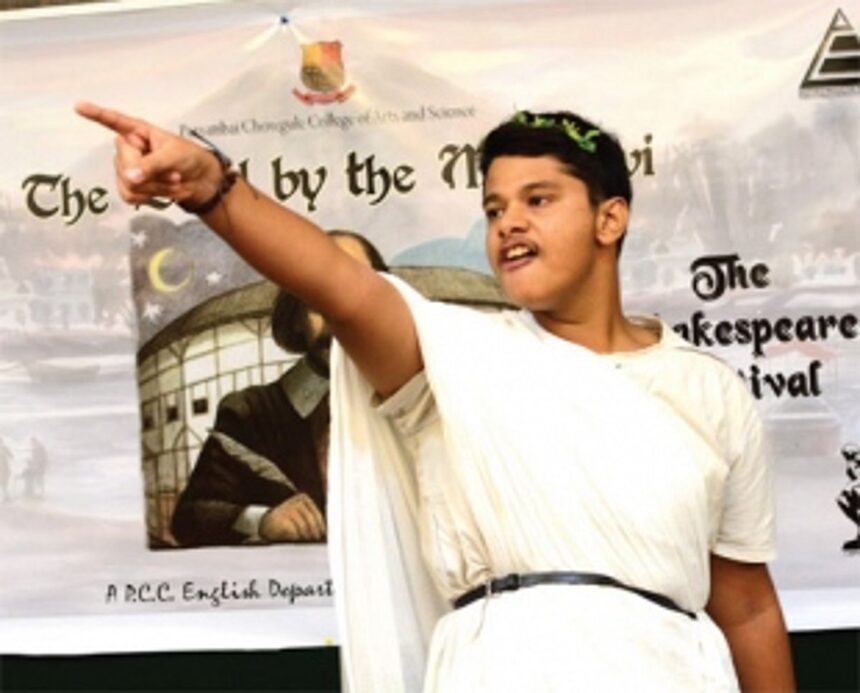
“All the world’s a stage, And all the men and women merely players; They
have their exits and their entrances, And one man in his time plays many
parts…” is a well known monologue from William Shakespeare’s play, ‘As you
Like It’. However, you should know more than just these lines, if you want to
be part of the seventh edition of the annual Shakespearean festival, ‘The Bard
by the Mandovi’. The response from various schools and higher secondary schools
from all over Goa is proof of the interest and curiosity that the works of
Shakespeare still command.
The English department at Chowgule College of Arts and Science
will be hosting ‘The Bard by the Mandovi 2016’, on September 14, 2016. This
year, the event, which will commemorate the 400th death anniversary of William
Shakespeare, will be organised by the First Year Autonomous Programme English
Major students backed by their Faculty in-charge, Asst Prof Andrew Barreto.
In its first year, the festival had received just three entries
from schools and higher secondary schools, but over the years, the popularity
of the festival has grown. “Last year, we received 18 teams as more schools are
encouraging students to read and learn about William Shakespeare’s works as it
does not feature in their syllabus. After Mumbai and Kolkata, this is the third
place in India where a festival is dedicated to William Shakespeare. We wanted
to introduce literature for the students of classes VIII, IX, X, XI and XII as
it gets difficult for college students to understand English literature with no
proper background,” says Prof Andrew.
The invites are sent out to various schools and higher secondary
schools in Goa who participate in the day-long festival that comprises seven
events, namely, ‘Steal A Scene’ (adapted play performances), ‘Friends, Romans,
Countrymen’ (presentation competition), ‘The Bard’ (poetry recitation competition),
‘The Shakespeare Soliloquy’ (dramatic monologue competition), ‘Mozaic!’
(painting competition), ‘Bedtime Shakespeare’ (Shakespeare children’s storybook
creation) and ‘Diorama Drama!’ (modelling a scene from Shakespeare’s plays).
“Last year, we saw over 250 students compete in the competition;
we are looking forward to the same enthusiasm this year. The event is managed
by the students of Parvatibai Chowgule College of Arts and Science as it helps
them learn about event management,” says Prof Andrew about his team.
Padmashree Josalkar, Director of the School of Drama at Kala
Academy, says that Shakespeare’s plays have had a huge influence on its drama
students right from the first year of the school in 1987. “The students have to
learn about Shakespearean plays as part of their curriculum. The present term
of the three year course has a total of 29 students; they performed the play
‘As you Like It’ in May this year,” informs Padmashree.
Shridhar Kamat Bambolkar, a well known artist and theatre personality,
directed the play ‘Sood Jagor’, a Konkani translation of ‘Hamlet’. “The
response to the play was fantastic and it had 21 shows all across Goa. Though
it was a translation of the Shakespearean play, it was written in an Indian
style in the Jagor form of theatre. The original is a western story
while we changed it to an Indian one with folk songs and dances. There were
many foreigners who specially came in after reading the reviews in the local
dailies and were quite impressed. The play was directed by me and it was a Kala
Academy Production; the cast included members of Rangmel, which is the Kala
Academy repertory group, and folk artistes from Priol and Mangueshi,” says
Shridhar, who hopes to direct a play on ‘Othello’ in the near future. He is also
working on ‘Prem Jagor’, a play by Pundalik Naik.
So then, it’s all’s well and ends well.