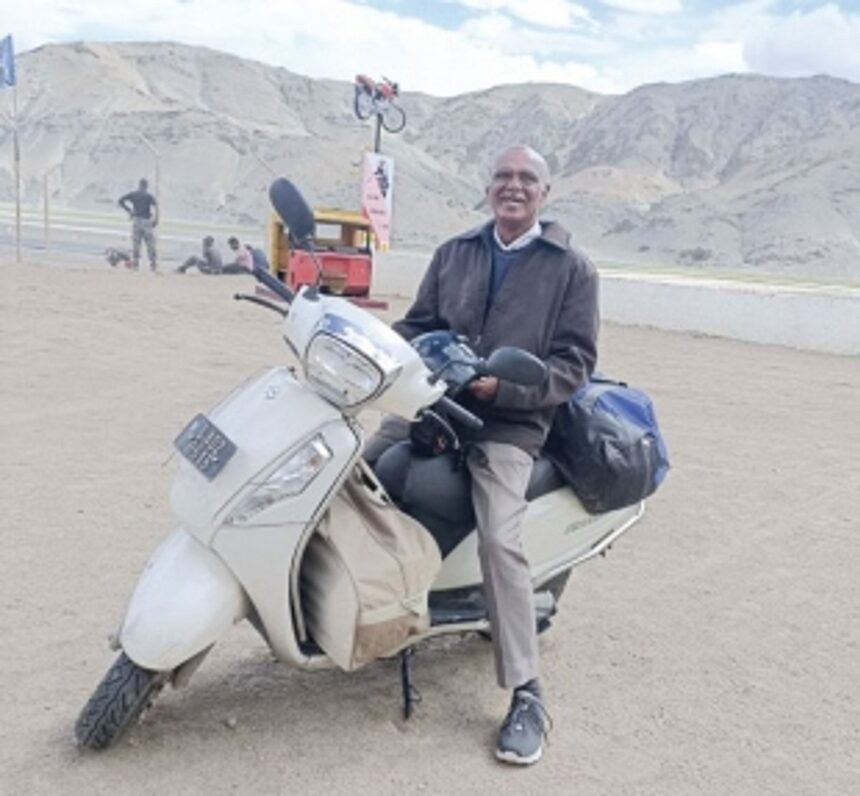
A non-geared two wheeler with a small wheel base, three ten litre gallons of petrol, a small backpack with bare necessities and a strip of tablets for mountain sickness, these were the only things that gave Dr Mohideen Wafar company as he rode up to Uming La Pass. Surrounded by barren terrain, chilling wind and slight rain, he covered the lonely road with joy and fear too.
Originally from Tamil Nadu, Dr Mohideen has called Goa his home for over four decades and loves the opportunities the state offers to enjoy outdoor adventurous activities. A retired senior oceanography scientist at the National Institute of Oceanography, Dona Paula, Dr Mohideen got the first experience of the majestic mountain range when he travelled to Zoji La Pass as part of the team that was going on the expedition to Antarctica in 1985. “For the first time in 1985 we climbed up to Zoji La Pass to get acclimated for the conditions in Antarctica. In 2004, I travelled by flight to Ladakh with my family and travelled by car. That’s when I decided to come again with a bike. Everyone goes by car uncomfortably and bikers go as a group but I wanted to do something different as there is no charm if I do like others,” says this Covid survivor.

An avid bike rider, he has been riding since the 1980s and used to travel with a Lambretta and then a Yezdi before shifting to other non-geared bikes. He often travels to Belgaum but travelling to the North of India is a whole different ball game.
“Riding two wheelers on the roads of Ladakh is a dream of most bikers because these roads are among the toughest in the world and traverse forlorn and desolate landscapes where one is lucky to see a human being or a village for dozens of kilometres at a stretch, save for occasional army camps. The riders, of course, ride in powerful bikes, and in groups, often with a mechanic. A small incident like a tyre puncture can leave them stranded on the road for several days if they were riding alone. I first undertook the ride in 2018 at the age of 69 when I travelled solo to Khardung La, located in Ladakh, above Leh, at 17500 feet. I crossed over 1800 kilometres of Jammu and Kashmir, from Jammu to Leh passing through Zoji La and Kargil, and to Manali and Chandigarh on return leg, crossing many passes above 4000 metres height,” says Dr Mohideen, who became the oldest person to ride solo to the top of the world in a low-powered two wheeler (110 cc) at that time.
However, this time, he outdid himself as at the age of 74 years, he rode solo from Leh to Umling La, a pass still higher at 19,024 feet, which holds the distinction of highest motorable road in the world now, at a height higher than the base camp of Mount Everest. Umling La lies at 385 kilometres to the northeast of Leh, close to the India-China border.
Dr Mohideen reached Leh on July 24 and was hosted by the Chief Conservator of Forests (CCF) of Ladakh in the army camp till July 27 so that he could get well acclimatised as well as rent a bike and service it before taking on the daring journey. From Leh, we rode to Hanle, a nearly eight hours journey before he stopped for the night. The next day, he covered 220 kilometers to Umling La and back to Hanle before sundown. On the third day, he travelled back to Leh.
“The last 100 kilometres of the trip either way were the toughest because the sector between Hanle and Umling La lies in the most desolate part of Ladakh where only two isolated military posts are the sole civilization one can find. Not a single soul, or vestige of any shelter, on the road. You have to carry fuel as there are not petrol stations on the way and in the worst scenario, I thought I would leave the bike there. On the way to Hanle, there are small settlements with a population of less than 100 people. Kairi has a military camp, Chumathang has a geothermal setup, Nyoma also has a military camp, Loma also has a military camp and Indian Astronomical Observatory situated in Hanle. After that for 110 kilometres there’s nothing except a small military post with few people at Photi La Pass at 18,124 feet then another military camp,” explains Dr Mohideen, who travelled with a puncture kit.
Besides the road less travelled, is the harsh weather, no network for cell phones and high altitude temperature. Fortunately, Dr Mohideen didn’t have any bike issues. He skidded over the gravel and had a fall which resulted in a wound on his palm. But there were few people working on the roads and they immediately came to his aid. “Otherwise I would not be able to lift myself up with the scooter. I could not hold the throttle properly after the injury. My major fear was breathing. I was a heavy smoker for three decades, lungs were affected and then I had a fungal infection of the lungs. Then, my wife, Sayeeda, who is also a retired scientist at NIO, and I got Covid during the first wave. We both miraculously survived and I am diabetic too. My worry was my health will fail me but fortunately nothing happened,” says Dr Mohideen with a smile.
While it is monsoon in Goa, this is the perfect time to travel to Ladakh as it is summer and the only time it doesn’t snow. He says, “July-August is the best time and till mid-September you can do the ride. These routes are not frequented. The speed limit of a non-geared bike has to be 20-30 as there are a lot of hairpin turns. I have been a part of an all India group of travellers who visit Ladakh, RoadRagas and they keep posting travelling tips and updates. When it comes to the bike, the main stress is that it should not go off. Riding at that height, the bike can start getting cold and due to starvation of oxygen the air filter cannot pull oxygen. I changed the air filter before the start of the journey and also carried a new air filter.”
After retiring from NIO, Dr Mohideen was working as a project consultant for King Fahd University of Petroleum and Minerals in Al Khobar in Dammam, Saudi Arabia for seven years where he was instrumental in setting up a marine chemistry laboratory. Post his recovery from Covid, his outlook towards life changed, “I decided that I will do only the things that I like to do. Now, I do carpentry, travelling to different places including Tamil Nadu and of course, riding. If you don’t have courage to change your life, you will never change. When you retire at 60, you at least have a chance to live life. There is no charm in life. I don’t know if it is blind courage or blind boldness, but I wanted to do something different and challenging,” concludes Dr Mohideen, who proves that age is just a number, there is so much more to achieve.