Team Café: Why did
Luosphone consider holding this exhibition?
Dr Aurobindo Xavier: (a)
The ‘Voyage to the East in the 19th Century’ (Voyages) – These photographs were
taken between 1884 and 1894 with the earliest techniques. The exhibition
includes many photographs of Goa with some pictures of historical buildings
that no longer exist, for example, the Seminary of Chorão or the Convent of
Saint Paul. This is an extraordinary collection of photographs from the time of
earliest photography techniques. It traces the passage of time from Lisbon to
Timor, crossing the Suez Canal and passing through Egypt, Mumbai, Goa, Daman,
Nagar Haveli, Sri Lanka and Indonesia.
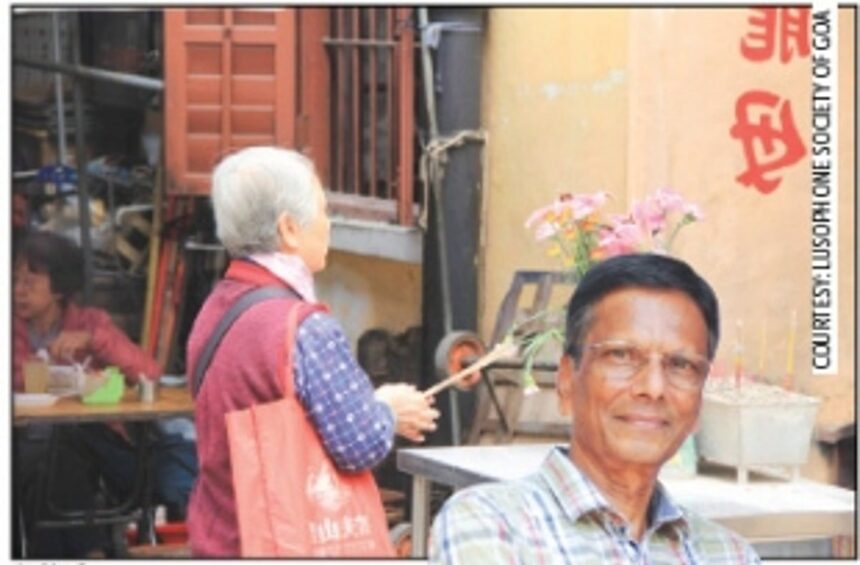
(b) ‘A Glimpse of Macau’
(Macau)
We are aware that modern
pictures of Macau have not been exposed publicly in Goa in recent years. But
Goa and Macau, who have a long common history during the Portuguese colonial
epoch, should come closer to each other via Lusophonia. This exhibition is a
contribution of the Lusophone Society of Goa for this approach between Macau
and Goa.
TC: Are these from
private collections or various photographers?
AX: (a) Voyages – These
are from different photographers like the French Hyppolite Arnoux, Italian
Antoine Beato or Adolpho Moniz (probably from Daman). They were collected by
the Museum of Lamego (Portugal) from the private collection of the very
traditional Portuguese family Mascarenhas Gaivão, based in North Portugal close
to River Douro.
Of the 39 photographs in
this section, a major number are in black and white, while some are manually
coloured.
(b) Macau – These were
made in 2013 by Margarida Fernandes. All the 34 photographs here are in colour.
TC: What do these
photographs focus on?
AX: (a) Voyages – these
photographs were made by the authors to supply the Europeans with photographs
of Africa and Asia. People in Europe, especially those well-off families, were
at that time very keen to have such ‘exotic’ photographs. Therefore there are
several types of photographs in this collection – the local people, historical
buildings, etc. A lot of them are related to the former Portuguese colonies in
Asia, as also those of Goa, Daman or Nagar-Haveli.
(a) Macau – gives us a
good perspective of the daily life in Macau.
TC: On whose initiative
have these exhibitions been brought to Goa? Will they also be shown at other
cities?
AX: The exhibition is
organised by the Lusophone Society of Goa (LSG), in collaboration with the
Directorate of Culture North, Museum of Lamego (Portugal), Directorate of Art
and Culture (Goa), Goa Tourism Development Corporation and Fundação Oriente.
Specifically (a) Voyages
– was brought to Goa by the LSG with the support of the Cultural Directorate
North Portugal – Museu de Lamego. This exhibition was showcased in Lamego,
North Portugal in 2014. After Goa, the next exhibition is likely to be held in
London.
(b) Macau – was brought
to Goa by the LSG with the support of the author of the photographs, Margarida
Fernandes.