The famous proverb ‘a little knowledge is a dangerous thing’ is an appropriate description of how many people in the State react when they encounter a snake or have to rescue someone who has just been bitten by a snake.
These reactions, based on myths and misconceptions, are not limited just to Goa but can be seen across the country and such actions have in many cases had tragic consequences where a life that could have been saved was lost. Be it the life of the person who got the snake bite or the life of a snake when it’s attacked out of fear.
All of this was discussed at a ‘Snakebite awareness and Mitigation Program’ that was organised at the Chandor Club by the Ganv Bhavancho Ekvott (GBE) in collaboration with the Chandor Club, Guirdolim Club and Chandor Seamen Association.
The guest speakers for this well attended interactive session, included three wildlife rescuers based in Goa, namely – Alex Carpenter, Benhail Antao and Aaron Fernandes – and two Emergency Medicine Doctors from Kasturba Medical College, Manipal, namely Dr Freston Marc Sirur and Dr Vrinda Lath.
The aim of the session was to educate the public on the different types of snakes that are found in Goa, which are venomous and which aren’t and more importantly the essential do’s and don’ts in case someone gets bitten by a snake and the immediate steps a first responder needs to take in such a situation.
To offer perspective at the risk involved in such situations, Aaron Fernandes showed videos to show incidents where a snake bite victim was not given the proper aid or taken to a hospital to receive the much needed anti-snake venom and succumbed to death in such instances. From receiving wrong advice from a tantric on how to heal a person who got a snake bite to the wrong technique in catching and holding a snake that led to a snake bite, Fernandes was able to demonstrate why snake bites have to be taken very seriously and the right medical care has to be given as soon as possible.
Earlier in the day, a video was shown to the public so that they could identify the big four venomous snakes – Spectacled Cobra, Common Krait, Russell’s Viper, and Saw-Scaled Viper – as well the non-venomous snakes so they are aware of what they should do if they come across such snakes.
Alex Carpenter, who lives in the forest, spoke about how two leopards pass his house every week and there is no absolutely no problem or threat to each other. He used this example to speak about how snakes never attack a human being and that this fear people have is unwarranted. He also lamented that with the size of forests reducing, the snakes and other animals are losing their natural habitat and thus there is a greater concentration of snakes etc in urban spaces with human settlement and rapidly increasing construction activity. Carpenter spoke about how the presence of rats in and around residential areas starts attracting snakes.
This conversation led to the wildlife rescuers describing various calls they have received by people to get rid of snakes in their backyard. Here, they emphasised that not all snakes need to be rescued or thrown out and that registered wildlife rescuers and the forest department need to be contacted for rescue attempts.
An interesting observation was made from a person in the audience who sought advice on how to deal with lynch mob mentality when trying to rescue and protect a snake given that the crowd wants to kill the snake.
Here Benhail Antao shared his own experiences and said the first thing they do is try and naturalise the tension and see that any object, such as sticks etc that people in the crowd want to use to kill the snakes are laid on the ground. Thereafter, the members of the crowd should be asked to step back for their own safety and the safety of the wildlife rescuer too before they attempt to rescue the snake.
Responding to queries, Antao further listed all the wrong notions that exist such as people trying to suck out the blood of a victim in the hope of removing the venom.
The people in the audience at Chandor were also told that snakes do not want to come and suck the milk of lactating mothers, that snakes do not drill a hole in a person’s skull, that snakes do not crawl the night waiting for revenge, that snakes have a head at its tail too and so on.
While there were a lot of humorous exchanges while going over these common false impressions, it was interesting to note that people in general have wrong ideas on what actions a first responder should do.
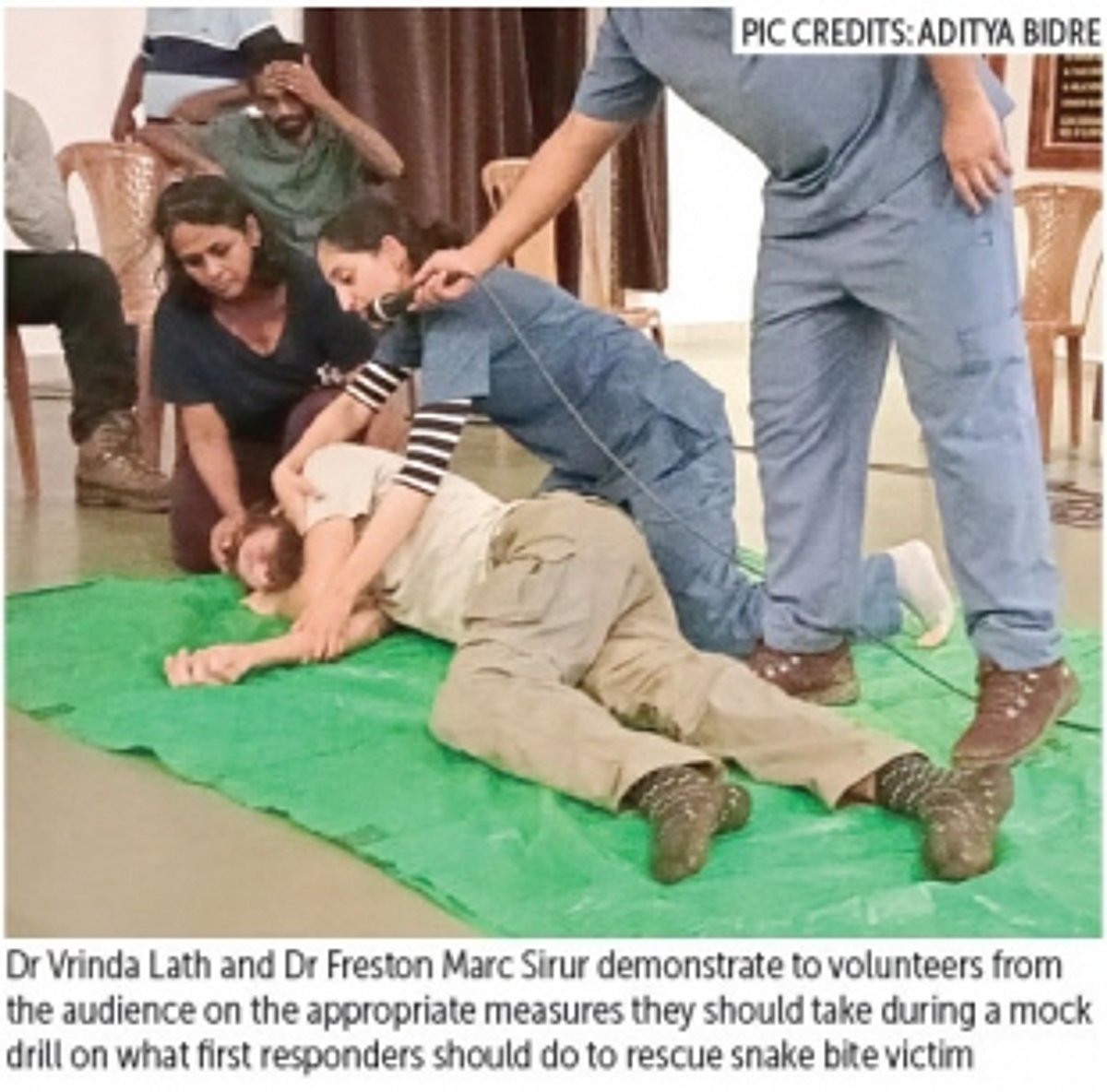
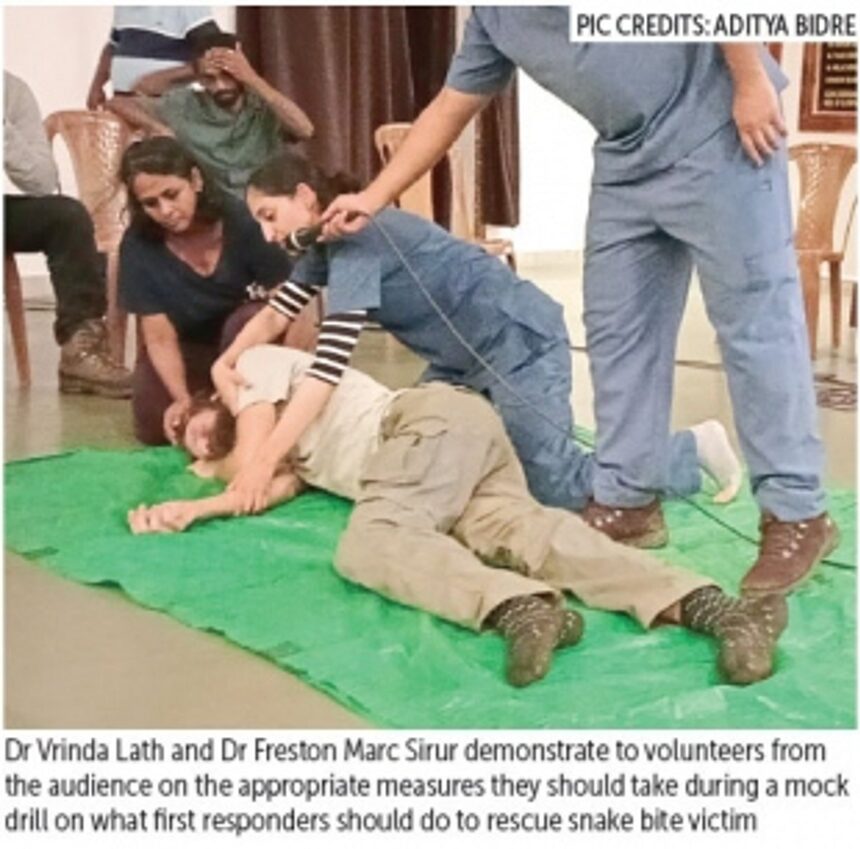
Dr Freston and Dr Vrinda listed out what should not be done such as tie ligatures around the wound, cut or burn the wound and instead focus on immobilising the affected lean and rushing the patient to the nearest hospital.
Members in the audience were then shown how to give first aid help as well as carry out appropriate supportive measures like ensuring that the victim has clear airways, is getting enough oxygen and that there is proper circulation of blood. While the audience tried these emergency response measures for better learning and securing the scene and the victim, they were also explained about performing simple steps like calming the person down and checking for any other injuries the victim may have are equally important.