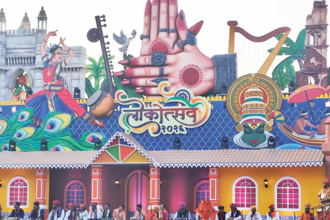
Serendipity Arts Festival focused on interdisciplinary explorations in music,
dance, performance and the visual arts, reinventing dissipating art forms from
various parts of the country, platforming folk arts, and artisan crafts, whilst
also pioneering innovative new creative practices and artistic interventions
that each respond to and address the social, cultural and environmental issues
in Indian society.
For starters, there was a poetic performance
with Afro-Asian influences–‘The Insurrections Ensemble’. The Insurrections
Ensemble aimed at creating a musical-poetic performance around the idea of the
lament, as shaped by voices and instruments in different times and places. The
lament is the musical form that traces centuries-old connections between
different segments of Afro-Asia. The three kinds of laments that were worked
with are those of the lover, the slave and the exile. They focused on a musical
performance that brings into focus Kerala, Gujarat, Ethiopia, Zanzibar,
Southern Africa, Al-Andalus, Persia and Arabia. “We find that these are useful
ways of organising the rich historical and creative material that is available
that reveals connections from the 6th century onwards,” said the organisers.
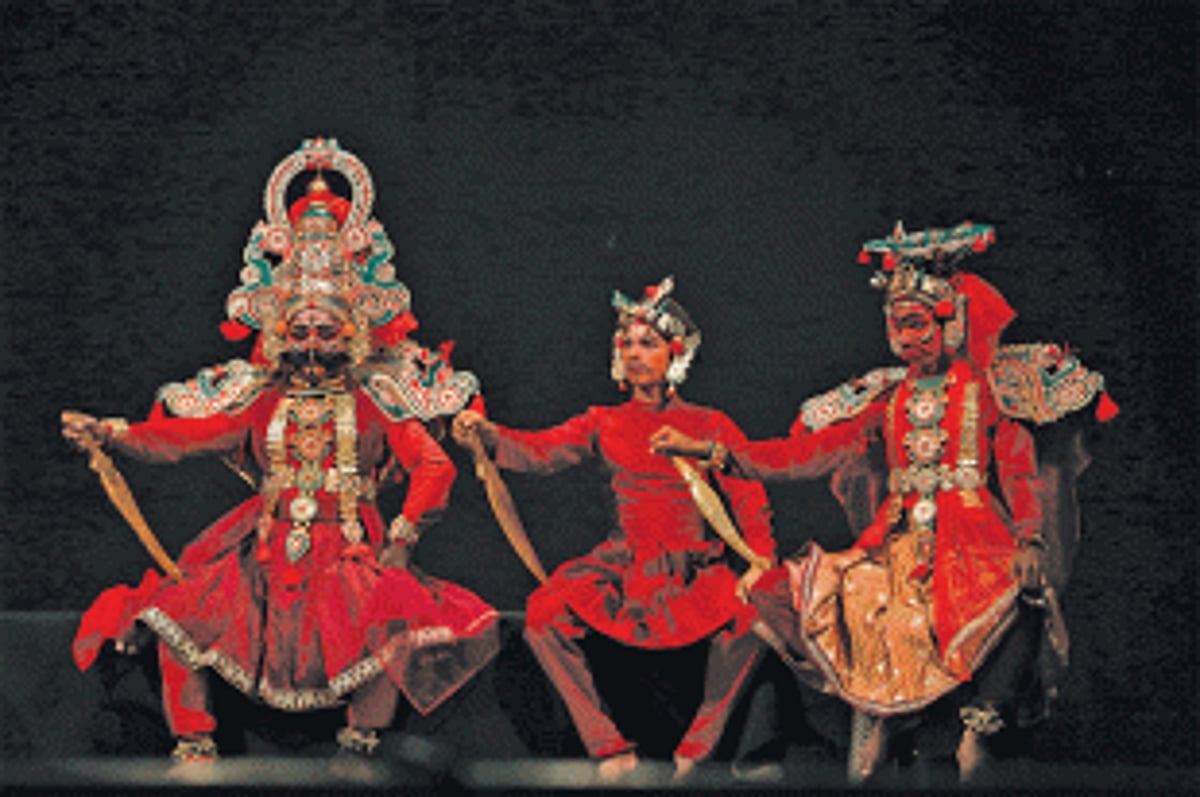
There was also a unique collaboration of
Karnatic music and Kattaikkuttu theatre- ‘‘KarnaticKattaikkuttuKarnatic’. “This
is probably the first time that Karnatic music and Kattaikkuttu will meet on
equal terms to explore what they share, where they differ, and how they ‘speak’
with each other. The coming together of two artistic minds—a Karnatic vocalist
T.M. Krishna and Kattaikkuttu actor, director and playwright Perungattur P.
Rajagopal— has resulted in an exuberant collaborative performance that is truly
interdisciplinary,” the organisers added. In an exhilarating exchange of
repertoire elements from both forms, Karnatic and Kattaikkuttu performers
presented excerpts from the all-night plays, ‘Disrobing of Draupadi’ and ‘The
Eighteenth Day’. Karnatic music and Kattaikkuttu theatre intertwined in the
performance, reinforcing and commenting upon and transforming each other.
The audience at the festival also enjoyed
BandishAntaakshari – a performance-based game.
“Bandish, loosely translated as composition,
acts as the seed-idea for melodic and rhythmic elaboration in various genres of
vocal and instrumental Hindustani music. It is one of the tangible elements
that not only represents the aesthetics of different gharanas (literally
household) or traditional schools of music, but in fact forms a vital part of
the body of knowledge handed down through generations in an essentially oral
tradition,” the organisers added. BandishAntaakshari, portrayed compositions
from the Hindustani art music tradition using Antaakshari, the popular and
engaging recreational pastime that has usually revolved around Indian film
songs. BandishAntaakshari not only followed this conventional format, but also
highlighted Hindustani musical forms like khayal, thumri, and dadra, composed
in various raags or melodic structures and set to different taals or rhythmic
cycles.
Elsewhere, those who were interested in
checking out what the craft discipline at the festival had to offer, the
project ‘Charpai’ stood out. “The project aims to explore the charpai from a
historic and cultural point of view, and simultaneously carry it into the
future by inviting leading thinkers and designers to interpret the charpai, and
present it at the festival. The thematic extension of the charpai is achieved
by placing them in multiple locations, positioning them in creative ways,
thereby encouraging use as well as recognition of the charpai as furniture that
is relevant and unique to India,” said the organisers.
The Serendipity Arts Foundation projects
continued to impress, notably with ‘Young Subcontinent: Sightlines’ -a
continued expansion of artwork emerging from South Asia. “An art project like
Young Subcontinent is, in essence, a struggle against monolithic culturalism
and narrow nationalism based on othering, and one that argues vehemently for
the coexistence and celebration of pluralities that constitute South Asia, its
societies, identities, politics, economy and culture,” the organisers
explained. With this in view, the Young Subcontinent project expands points of
contact, explores sightlines of common struggles and aspirations, looking at
the reassertion and reinvention of geographies, facilitating conversations and
narratives of peaceful coexistence and democratic aspirations.
And
at the fascinating theatre discipline at the festival, one got to see ‘Love
Prufrock’ – an interpretation of T S Eliot’s literary masterpiece. T S Eliot’s
The Love Song of J Alfred Prufrock examines
the disillusionment of a man with the times he is living in. Derived
from this literary masterpiece, the performance usedthe inter- play of the
human body to understand the poem’s protagonist and the structures surrounding
him. In the attempt to find Prufrock inside the performers’ bodies, residing
alongside their own anxieties, the performance ends up creating multiple
Prufrocks. “All cramped inside this overwhelming world of ours, the fractured
narrative is threaded delicately by swift movements through urban landscapes,”
said the organisers.
One also got to check out – ‘The Lost Wax Project.’ “Four bodies
trace a trajectory of thought within a circular space, moving to feel the
negative space around each other as much as the space within the intention to
move. Every time they move, they reach out towards something, constantly
creating different relationships with everything around, constantly seeking to
reinvent themselves,” the organisers explained.
There
was something for parents and their young ones, too at the ‘Sensorial Pedagogy
Workshop ‘- a workshop that aimed at teaching the importance of theatre for
toddlers.“The emphasis is on the importance of theatre as an educational tool
for toddlers,” added the organisers.