Fernando Monte da Silva
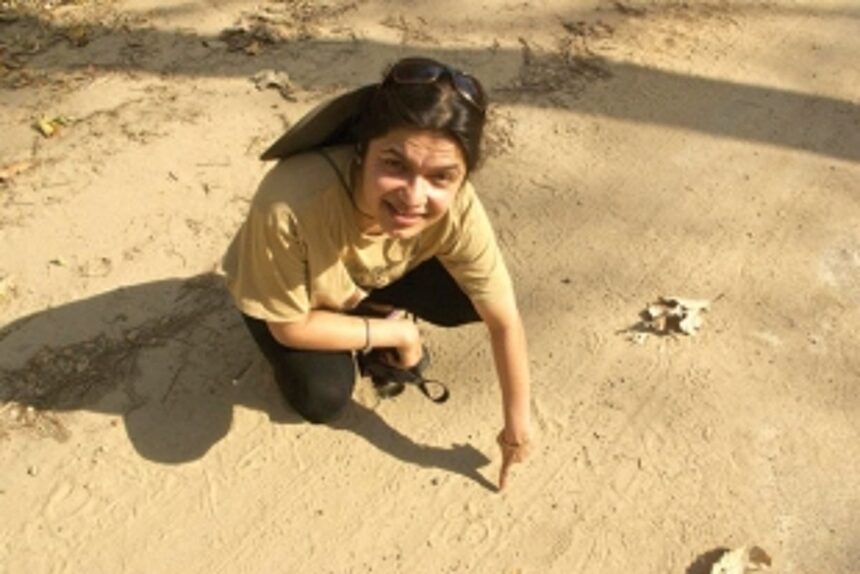
To quote her own description of herself, ‘when Prerna Bindra goes AWOL,
you would likely find her in the remotest corner of India watching elephants or
fighting for a forest that needs rescuing’. Accompanied by her constant
companion of the canine kind, Doginder Singh, who she rescued from the streets,
she lives in Gurgaon. She believes that her heart, however, resides in the
forest.
With her roster featuring working for publications such as The Asian
Age, The Pioneer, The Times of India, India Today, The Week and Tehelka, over
the years, it is little surprise that her passion for writing and wildlife
alike would veer her off the course of page 3 and writing glitzier pieces and
onto something closer to her heart. Prerna has authored over 1,500 articles on
nature and wildlife in mainstream media and has also written a book titled ‘The
King and I: Travels in Tigerland’, as well as edited an anthology on
contemporary wildlife writings, titled ‘Voices in the Wilderness’. However, it
is Prerna’s recent work titled, ‘The Vanishing: India’s Wildlife Crisis’ that
is of greatest intrigue. The Vanishing highlights one of the primary causes of
India’s wildlife crisis, which is none other than the deliberate destruction of
natural habitats.
Speaking on her latest volume and all it stands for, Prerna says
“Globally, wildlife is in crisis—we are losing, by some estimates, 150 plants
and animal species annually and India is also experiencing this ‘Sixth Extinction’.
But first, I must say that India has done a remarkable job in conservation.
India is looked upon as a global leader in conservation having pioneered
initiatives to protect tigers and other rare species. We’ve got the maximum
number of wild tigers; the maximum number of Asiatic Elephants; the largest
number of the gharial, a member of the crocodile family; India is
also the custodian of species that are extinct—or found only in very low
numbers elsewhere; like the Gangetic Dolphin — over 80 per cent of the global
population of which inhabit the Ganga-Meghna-Brahmaputra river basin. All of
that stemmed from political will, essentially, during the regime of Indira
Gandhi, who played a visionary role in protecting wildlife. The strong laws to
protect environment and forests, and cultural respect for life (for instance,
the worshipping of elephants and snakes), helped India retain much of her
wildlife. However, it is fair to say that over time, that same political will
has slipped, if not collapsed. The same laws have been diluted, and we have
many large projects that are destructing fragile ecosystems — even some of our
finest protected areas — like river-linking which will submerge a chunk of
Panna Tiger Reserve (Madhya Pradesh). The book focuses mainly greatly on loss
and fragmentation of habitat, particularly how the current path of
‘development without breaks’ with its huge infrastructure projects, mines ,
industry are destroying forests, wetlands and rivers. It highlights the
spectacular side to nature, and then shifts the focus to the crisis at hand,
talking about why it matters, and the way forward.”
Prerna refers to this book as a representation of the work of a
lifetime- the nearly two decades that she has been a conservationist and
writing on wildlife. In this span of time, she has visited the remotest of
forests—from those in Chhattisgarh and Jharkhand which lie in the ‘red
corridor’, to those in the north-east like Manas Tiger Reserve and
Dibru-Saikhowa National Park in Assam. The journey has taken her to Dachigam
National Park in Kashmir and the cold desert in Ladakh. She has visited the
Desert National Park in Rajasthan, and many forests along the Western
Ghats-starting from Mhadei in Goa to Bhadra in Karnataka to Annamalais in Tamil
Nadu to Periyar in Kerala, besides of course, visiting the incredible Terai
forests especially in Uttarakhand (like the Corbett landscape), and the Sal
forests of Central India.
But as is the case with many pertinent issues, one only truly tends to
sit up and take notice when an issue comes home to roost; and Prerna points out
that ‘The Vanishing’ is of critical to the state that many of us call home.
“The book is extremely important from the Goa perspective: it is a tiny,
beautiful state nestled between the sea and Western Ghats and has a diversity
of eco-systems-from the coasts, to mangroves, rivers, mountains and evergreen
forests; and all of it is threatened by the many projects that are in the
pipeline. Let’s take the Mopa airport project, for instance. It has been
earmarked in the Barazan Plateau, which is rich with wildlife. During my visit
there, I saw signs of rare species like otters, gaur, great hornbills etc. It
is also a very fertile landscape, and abutting it are the forests of
Tillari–Dodamarg–Chandgad – recognised as an important habitat and
Eco-Sensitive Area by the Bombay High Court. Importantly, about 40 perennial
streams flow from Barazan, feeding the people and fields downstream. Such
massive disturbance on this plateau threatens the water security of Goa. Goa is
also home to resident breeding tigers — which is a matter of pride, but
instead, the state is shying away from acknowledging the tiger presence in the
state, and declaring Mhadei and other adjunct sanctuaries as a Tiger Reserve.
More worrying is the move to make Goa a coal hub, which will not just hit the
marine life and environment, but also impact the health and livelihood of the
fishing community, farmers and the tourism industry. Goa is at the epicentre of
the debate being discussed in the book,” the author adds.
As the seemingly constant development-versus-environment debate rages
on, Prerna’s book reveals how the ‘growth at all costs’ model threatens our
ecological and economic security. Her immersion in the heart of the subject
matter itself aids her to give an eyewitness account, and an insider’s view of
India’s rapidly disappearing natural heritage. A sharp and stirring read about
today’s desperate scenarios, and the quest for hope for a wild India, The
Vanishing tackles issues that are closer to home than one may initially
realise, and is a must read, if we are to take cognisance of how what has been
lost, is still far less than what we could lose still.