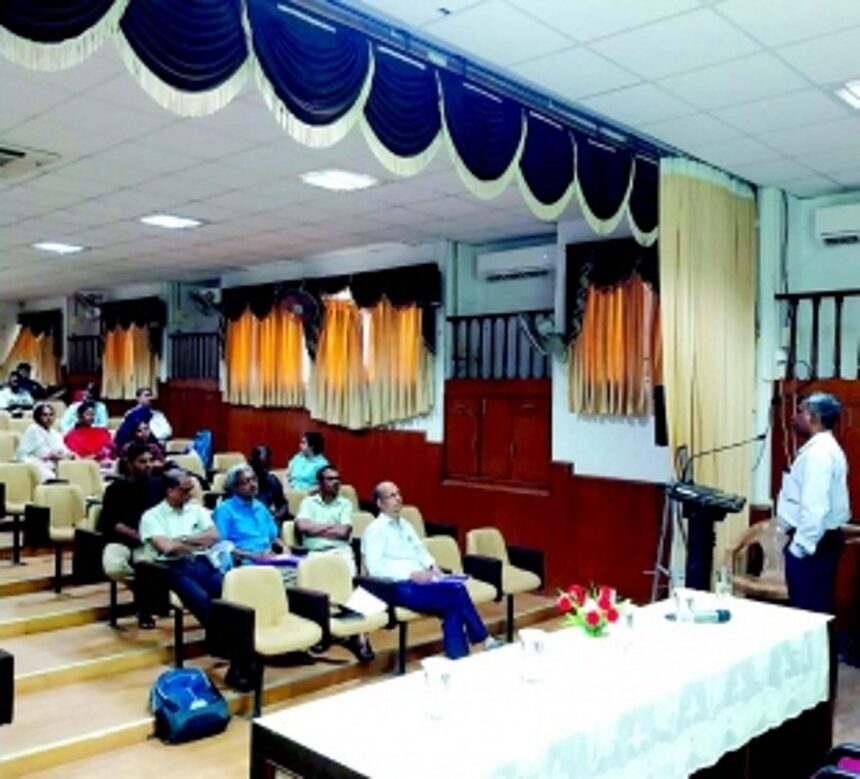
The two day workshop on ‘Mhadei: A Multidisciplinary Exploration’, organised by the Multidisciplinary Cluster on Mhadei (MCM), Goa University, concluded with a call for close collaboration between the government, experts and the civil society in Goa in order to generate greater knowledge base and action on protecting and preserving the river. Around 30 speakers threw light on new aspects of the river and suggested what would work best for the protection of the river.
The first day of the workshop, inaugurated by Advocate General, Goa, Davidas Pangam, included presentations on the scientific and technical dimensions of Mhadei River, particularly those pertaining to the proposed diversion. The study done on the Mhadei watershed by Dr Manoj Ibrampukar pointed out that diversion will lead to reduced water discharge during both monsoon and non-monsoon seasons, affecting preservation of dry water flows and reduction in sediment load. The paper by Dr Vidyadhar Atkore, on impact of proposed diversion on fresh fish water diversity pointed out that some endemic species of fish have lost their critical habitat due to the Kalsa Bhanduri diversion project. A preliminary study on geomorphic trends in Mhadei by Disha Karapurkar reveals that the river is susceptible to both natural and anthropogenic influences and would require conscious policy decisions to conserve and protect the integrity of the river.
Dr Nitin Sawant in his study on the biodiversity impact of proposed diversion, listed out the endemic species of plants and animals dependent on freshwater sources in the region and pointed out that the change in the flow of the river could deeply impact dependent species, in turn affecting human populations. A preliminary study by Heena Gaude and Sweta Bhonsle focusing on the economic impact of Mhadei on people’s lives, sought to analyse the relationship between watershed delineation, agriculture index and recharging of wells using GIS mapping techniques. Sara George from Living Waters Museum spoke about her digital initiative which has been documenting, curating, communicating the rich traditions of water heritage in India, and the ongoing project on Goa Water Stories.
Tahir Noronha’s paper proposed grant of a legal status to the rights of river Mhadei, in the context of global ‘Rights of Nature’ movement and national examples such as Ganges being given legal status as per the High Court judgment, protecting its right to flow freely. Ravaji Gaunkar spoke of the role and responses of village communities, which are often caught between issues of livelihood around Mhadei and the ‘Politics of Mhadei’. Prof Rahul Tripathi, in his presentation questioned the role of the state as well the civil society in not being consistent in appreciating and understanding the larger context of Mhadei issue and in the process hampering Goa’s case for protecting the river. He urged on filling the knowledge deficit on the issue to overcome the political deficit and creating spaces for dialogue within and beyond the state.
Prof SY Prabhu, from Belgaum, spoke of the possibility of the grave threat to the entire ecosystem of the Western Ghats and the potential impact on the monsoons in the region if the river flows in the basin are not left undisturbed. Rajendra Kerkar, spearheading the Mhadei Bachao Abhiyan gave an in-depth presentation on the serious impact of the diversion project from ground zero and underscored the necessity of declaring Mhadei as a Tiger Reserve as the only way to protect the river. Dr Prakash Parienkar highlighted the diversities of species as well as practices that mark the region and the need for further work on the eco-anthropological aspect of the river. Paresh Parobo, Assistant Conservator of Forests, spoke on key aspects of wildlife protection and management through scientific, legal and community based efforts and called upon the researchers to bridge the knowledge gap by scientific research that would help wildlife managers. Rajan Ghate, social activist made a strong case for protecting the tiger in the Mhadei basin with a pro-active role by the government being the need of the hour.
Nirmal Kulkarni said that we need to invest more time and efforts in children and youth to bring pride for Mhadei and the forests, which are the catchment area of the river. Parag Ragnekar emphasized on science based data driven decision making as the key to long term conservation. Prof Pratima Kamat discussed the Mhadei riparian eco-culture from a historical perspective, tracing it to the Kadamba period where evidence points out that the Khanapur Halsi-Belgaum region was a thriving centre of both commerce and culture which was linked,through Sattari, with the ports of Goa.
Manisha Govekar from the Directorate of Museums spoke about the significance of developing onsite museums across the Mhadei region, where villages like Mauxi, Guleli, Zarme are sites of rock carvings and sculptures. Utkarsha Shetkar, spoke on the mythological identity of rivers and provided a feminist perspective on Mhadei, where she emphasised on the need for free flow of the river as central to its fullest realization.
The conference concluded with a call for greater community engagement at the grassroots level both in terms of creating awareness and connecting with the people on the field, who are going to be directly affected due to the proposed diversion. The MCM proposes to publish the findings of the conference with further work on the papers presented. The participants also proposed that a dialogue between the immediate stakeholders in both Mhadei and Malaprabha Rivers be initiated, so that there is a better appreciation of each other’s concerns and joint steps could be initiated for protecting the rivers in their present forms.