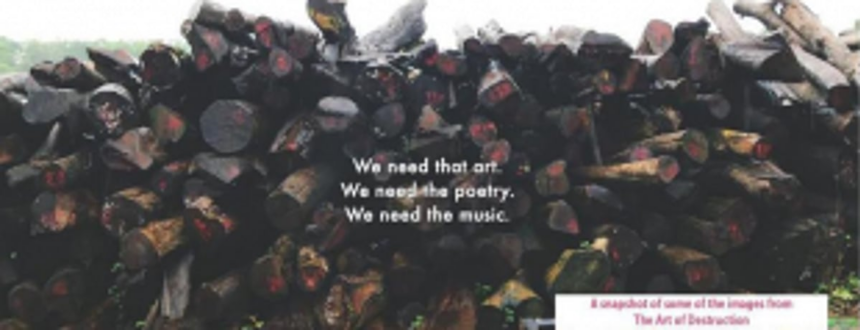
The opening shots show green
verdant forest a forest that is now under threat from the insatiable hunger of
man. A race that is always on the lookout for more. More wealth, more space and
more trucks to carry coal for steel plants. The Mollem forest is under
threat from three projects that will cut a swathe through it. Artists,
scientists, and other influential members of the lay public have expressed
their concern at the state of affairs and voiced their opposition.
A film made by Marc Francis and his team of the Living Heritage
Foundation Goa, called The Art of Destructionhas presented a
platform for everyone concerned about the project to state their respective
positions. This documentary film about this artist-led movement has united
various factions of Goa to stand up for forests at risk. Featuring some of
Goa’s prominent ecologists, environmentalists, architects, activists, artists,
and yes even government representatives, the film explores the conflict and the
fine balance between conservation and development.
The film takes into account the
issue and analyses it from various points of view. The film importantly adds
the narrative of the Chief Wildlife Warden who is only doing his job. Is he a
custodian for the forest or is he an employee of the government with orders he
must obey? The lines seem to blur. In fact, many who have seen the film feels
that the Wildlife department had actually facilitated the project which
actually goes against the mandate of wildlife protection. Marc said “We first heard of this
problem in June when we were working on a film on migrants. We then did not
have the time to devote time but learned it was an artists movement. We
realized that in such situations in the past, always one side of the argument
that is saved and protected. Right now, I am at home without electricity for
twenty fours hours and the people in the area want this problem sorted out. Now
art can change society and remembers artists can reimagine the future.

We had
interesting people participate. Someone like Dean D Cruz who is an architect
and an artist who has designed interesting structures had an interesting take.
It was 52 days of action”. The initiative was helped by the fact that everyone
gave their time for free which was helpful for a team which was self-funding.
The initial reactions he said were very interesting with people sending comments
thanking them for this initiative. Harshada Gauns a zoologist and
lecturer who was part of the film said it was very important to spread
awareness and get the maximum number of people on board. She said “The film was
a great initiative and will give a push to our initiative. We are in no way
saying we are against development but all we are asking is to do it
responsibly. We are writing letters to our environment minister and several
people are addressing letters to people at the centre too. It is a mass
movement and this documentary is a step-in increasing awareness”.
In the documentary the Chief
Wildlife Officer Santosh Kumar took a position stating that the projects were
ok since they were cleared by responsible bodies in the country. Harshada felt
that his hands were tied because he was a member of the government machinery.
She said “He has his own limitations; the government has decided to go ahead
with these projects and he will have to stand by that decision whatever be his
personal misgivings”.
Claude Alvares ,
an environmentalist was straight and blunt He said “His statements
have proved our point that these projects were not made for the consideration
of the benefit of wildlife but for human beings. The wildlife act clearly
states that no development can take place in these areas because they are meant
for wildlife. His argument that railways tracks laid in Bihar is welcomed
by the locals but in Goa, they are not which is ridiculous because these tracks
cannot pass through a wildlife sanctuary in Goa or in any other part of the
country”. He went on to say that by law he is
meant to make decisions for the protection of wildlife and he can’t say it is
for tourism because there is no connection between tourism and wildlife.
These three projects, Claude said were in total violation of the laws and if
Santosh Kumar is unable to say no and unable to do his job as per the
constitution, he should then request the government to transfer him to another
place. Claude also attacked his claim that it was a minuscule
number of people who were opposing the project. He said “The south is going to
come out in the open to protest double tracking. You can’t call that few. There
are around eighty thousand signatures protesting against the project. You
are supposed to protect the law, it looks like he has closed his eyes to all
opposition.” Svabhu Kohli who was one of the
first artists to voice his opposition to the project said the campaign was
aimed at informing people about the problems that could be caused by the
project. He said “There is very technical information which is now being
interpreted by artists so that people can understand the data. Development has
to happen but there has to be a way to go about it”. He said artists from Goa,
the rest of the country, and increasingly from the rest of the world were
sending in their works of art to highlight the campaign.
Marisa Simoes an advocate who was
part of the film said she was always passionate about the environment even as a
child. The decision by the government to go ahead with this aggressive move to
start these projects crossed her line so to speak and made her an aggressive
campaigner against the project. She said the destruction of nature was against
our culture and the trees once lost would take centuries to come back to their
original strength in terms of numbers. She said “It was important in the film
to show all the sides of the argument. We have to synchronize our efforts and
ensure that development happens and so does the protection of the environment.
The position taken by Santosh Kumar defied explanation. He was speaking on
behalf of the projects, as Chief Wildlife Warden he should ensure that nothing
is cut but then he seemed to be backing a move that flouts all the laws. This
government does not care about the environment, it has become commercialized it
has become a government for a few business cronies”. Harsh but true words
undoubtedly.
Another prominent participant was
Alex Carpenter of The Tribe Goa has stated similar sentiments against unplanned
development in other parts of the world. He said “It is a tragedy that
development and conservation are at odds here and in other parts of the world.
It does not benefit local businesses bit big business. The Western Ghats are a
real treasure trove for the country and has to be protected. With COVID
19 having brought the world to a standstill, we have an opportunity to ensure
things don’t go along the similar lines. Goa will suffer if that project comes
through”. One can only hope that does not
come true.
‘The Art of Destruction’ – – – – – httphttps:s://m.youtube.com/watch?v=UeuDpxm6l8I