“In the
mid and late 1940s, one could buy a packet of 10 slotted shaving blades for 12 annas, a raincoat for Rs 4,
an Emerson Radio (Model 517) for Rs 175. 1 pice (paisa) was equal to quarter of
an anna and 1 rupee equalled to 16 annas. With 4 -5 annas, you could buy a
lavender soap or go to the cinema halls for a movie; a newspaper would cost
about 10 to 13 pice. It was in 1957, that the anna got demonetised and Rs 1
equalled to 100 paisa. Today, it’s a different story, where money has no value.
In those days, you could live a comfortable life with Rs 100 -150,” says
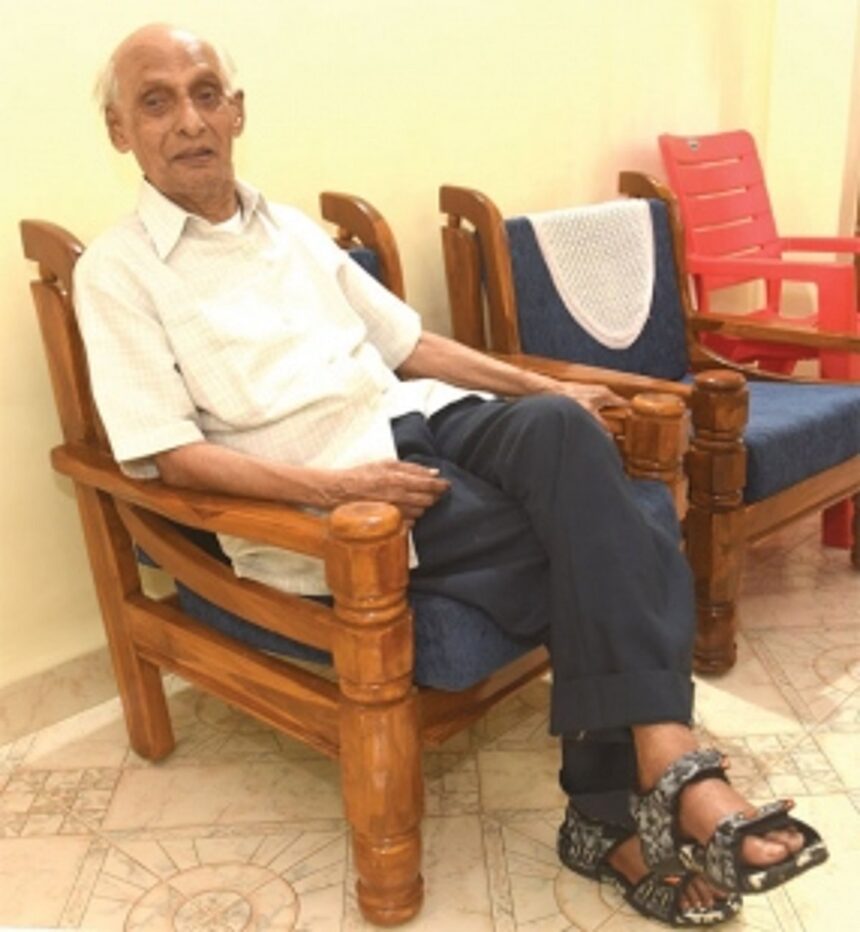
100-year-old Diogo Piedade Jose Simplicio Fernandes, as he paints a picture of
how much value money had then.
A lot more has changed over the last 100
years and Diogo, originally from Aldona, has seen these events unfold through
his life. Son of Francisco Fernandes and Maria de Souza, he moved to Kolkata in
his teens with his maternal uncle after the death of his parents. He married
fellow Aldoncar, Maria Pascoela Da Cruz, and has two sons and a daughter. He
has come for a holiday to Goa with his wife and his daughter, Beverly, and is
staying with his son, Ashley, in Caranzalem. Here he is enjoying his stay by
visiting Aldona and his daughter’s house, seeing the places he loved visiting
when he was young and enjoying good Goan food.
In the first 50 years of his life, he used to be a regular
visitor to Goa but since the last 10 years, he’s been postponing his visits due
to health reasons. He touched Goan soil once again on May 26, 2019 and on his
flight here, he was given a 100 years birthday card and publicly wished, as it
was the first time the airlines had a centenarian on their Kolkata-Goa flight.
His childhood was very happy during the 1920s, when Goa was
under Portuguese rule. “Village life was very simple and devoid of the luxuries
that we have today but there was a lot of bonding and fellowship between the
villagers. People kept their houses open as there was no fear of robbery,” says
Diogo, who studied at St Thomas Boys’ School, Aldona.
Diogo has lived his life in Portuguese-occupied Goa and
British-occupied India before independence. His experience during both periods
was good and had a positive influence on him. “The Portuguese taught me
discipline; their excellent record systems helped me later when I started
working. Their justice system was very contemporary during that period. During
World War II, Goa remained neutral like Portugal. However, the period from 1920
to 1940 was critical in Goan history. It was when the Goa National Congress was
formed. There was severe restriction in the exercise of civil liberties in Goa,
heavy censorship and banning of public meetings during Salazar’s dictatorial
rule. This discontent shaped the Quit Goa Movement,” he says.
Speaking about living in Kolkata under the British Rule, he
says, “Life under British India was truly memorable. There was growth in infrastructure
that came to define modern India like the Howrah Cantilever Bridge, highways,
bureaucracy, post and telegraph, lovely government buildings that we see in
Dalhousie Square, the Victoria Memorial, Fort William, museums and the trams.
During the 1940-50s, cars were symbols of prosperity. Going to the movies was
one of the biggest forms of entertainment in the late 1940s. Calcutta’s
pre-eminence as the Mecca of Indian street food had a lot to do with the
British and the World War II, where Calcutta played an important role in allied
military operations with a lot of American GIs and British troops.”
He adds, “The not too good memories would be the Bengal Famine
of 1943; daily seeing the unimaginable sight of emaciated people in search of
food, be it garbage cans or street corners, to get anything that was eatable.
Then there were the communal riots in 1946 also known as the Great Calcutta
Killings, which killed thousands of people during the four days, August 16-19,
1946. In 1947, when India gained independence and the partition of Bengal took
place, Calcutta became the capital city of West Bengal.”
In Kolkata, Diogo was an Honorary Consul General during a
sensitive period from 1953 to 1958, when India achieved its independence and
Jawaharlal Nehru was looking at liberating Goa from the Portuguese. His duties
included issuing of permits for Goans out of Goa to come to Goa, promoting
trade with Goa from Kolkata and with Portugal, helping Goans who faced problems
during the Independence period in Kolkata with documentation related work,
attestations etc. He continued working to keep himself busy till the age of 85
years.
During the last 10-12 years, he has been mostly indoors with
visitors regularly coming to see him. “I am still very particular about having
my meals on time and my bedtime morning and evening prayers. I can walk without
using a walking stick though I need a little support,” says Diogo, who loves
his bebinca, doce, pinaca and dodol
He
is truly the link between two places, people, communities and cultures which
are diverse yet similar. And of two countries which have had the closest and
longest link with India, Britain and Portugal.