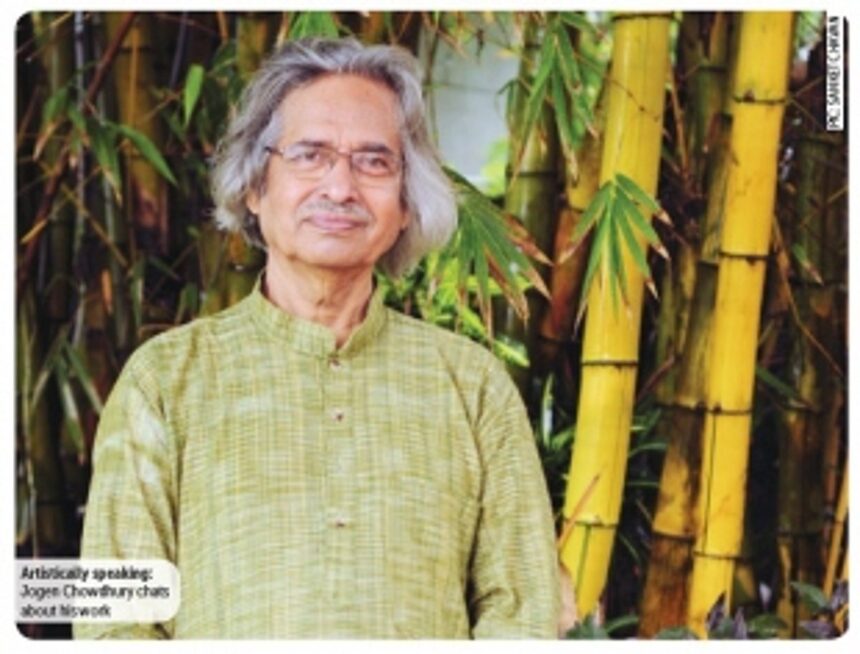
His silver hair is akin to the silver lining
his paintings enjoy today, but Jogen
Chowdhury’s success has much to do with
the trying circumstances and influences
in his early life. For a Bengali who lived
and witnessed the vagaries and crises of
the partition at close quarters, the scars
run too deep. It is one that has inevitable
spilt over into his artistic work. “There
was distressing upheaval on every front
– political, social and cultural. There was
too much suffering. In fact, personally, we
were also deeply affected by the partition.
Our family was from East Bengal, but we
had to shift to Kolkata. The suffering has
not diminished now. I am still unhappy
with the situation in India today,” says
this professor emeritus, Visva Bharati,
Santiniketan, who has been investing
his experiences to bring about an ideal
society that Tagore envisaged.
His iconic black line drawings, which
have been exhibited the world over, has
its genesis in this period. “I recall we had
no electricity when I was in Government
College of Art and Craft. I would work at
night in front of a hurricane lamp. I could use
only black in this light and it has continued
to dominate my work,” reveals Chowdhury
while elaborating that his strong life-study
practice in college, his stint as designer on
the Handloom Board and his innate sense
of rhythm have all been instrumental in
cultivating this further. “It is very easy for me
to draw a single outline in one continuous
stroke without erasing, but I make it more
realistic with tones. I am capable of lots of
toning,” explains this artist who works with
all media.
Studies in Paris and Europe broadened
his perspective, yet Chowdhury has been
influenced by the traditional Indian arts.
“I am very fond of traditional Bengali
art liked the rolled pattachitra paintings
and terracotta relief sculptures. These
influences have been automatically
exposed and infused in my work,” says
Chowdhury whose work combines a blend of traditional imagery with the zeitgeist of
contemporary painting. In 1966, he was awarded
the Prix le France de la Jeune Peinture, in 1986
an award at the Second Biennale of Havana,
Cuba and Kalidas Sanman by the Government of
Madhya Pradesh in 2001.
His expertise was sought as curator at the
Rashtrapati Bhavan for 15 years. The political
atmosphere here once again had an impact on
his paintings. But Chowdhury’s work was to find
its true meaning at Santiniketan where he has
spent 28 years, first as Principal and Head at the
Department of Painting, Kala Bhavana and now
Professor Emeritus, Visva Bharati. “The culture
of Santiniketan gradually influenced me and my
work,” says Chowdhury who admits to being
enriched by the close inter-personal way of
teaching there.
As a newly appointed member of the Rajya
Sabha, he has been making a more fervent case
for art, protesting the reduction in financial
support for arts and pushing for the cause of
cultivating village architecture.