War hero, Major General Ian Cardozo stressed the need for increased unity and diversity for a stronger, more united India in his soul stirring keynote address at the inauguration function of 11th Goa arts and literature festival at the International Centre Goa (ICG) on Thursday evening.
Citing the example of the Indian army’s practice of unity in diversity, the General said that the army built places of worship belonging to different faiths all under one roof. “I remember visiting a Hindu temple first, every Sunday morning, as it was the faith followed by my soldiers. Only later, did I visit a church, as it was my religion,” the General said. According to the war hero, we need to follow the Indian army’s example to create a stronger, more united India.
Gen Cardozo also regaled the audiences with some charming anecdotes from his childhood visits to his ancestral village of Candolim almost 80 years ago. He spoke about memories of swimming in the sea, eating home-made pickles, bebinca, traditional hot-water baths, zero electricity and the presence of Mercedes Benz taxis in Panjim and Margao.
Major Cardozo who saw action in the 1965 and 71 war admitted at the start that this was his first ever keynote speech he was going to deliver. An author of several books, he smiled and said, “We in the army don’t have time for people who write. I started to write after I retired. So much to write in so little time.” He however added he was not a serious person by nature. He admitted to spending time thinking about what he would talk about and then decided he would talk about the Goa of old. The Goa of his times when he would visit with his parents from Mumbai every April and May. It was as he put it, a royal homecoming. The journey, he said, had to be done by ship. Guitars and Mandolins would come out on the deck and the evening would be spent singing songs from Goa. This could continue late into the night. The stay in Goa was always great fun. His home which was in Candolim like every other home in those days had no electricity. Lanterns called Pontios were used extensively. The breeze, he said, came in and kept everything cool. Food, he said, was cooked on chullas, which was always great though he made a face saying breakfast was always a disaster. Fish he said was plentiful and was also used as manure. It was, he said, a different Goa with great beaches and different aromas.
Getting serious for a minute, he said it was important to remember that belonging was at various levels of identity. Goans, he said, needed to break out. They need not confine themselves as just Goan. He felt they needed to identify as citizens of the country. He said “As an officer of the Indian army I learned to be part of the larger Indian family. Our needs came last. India came first”.
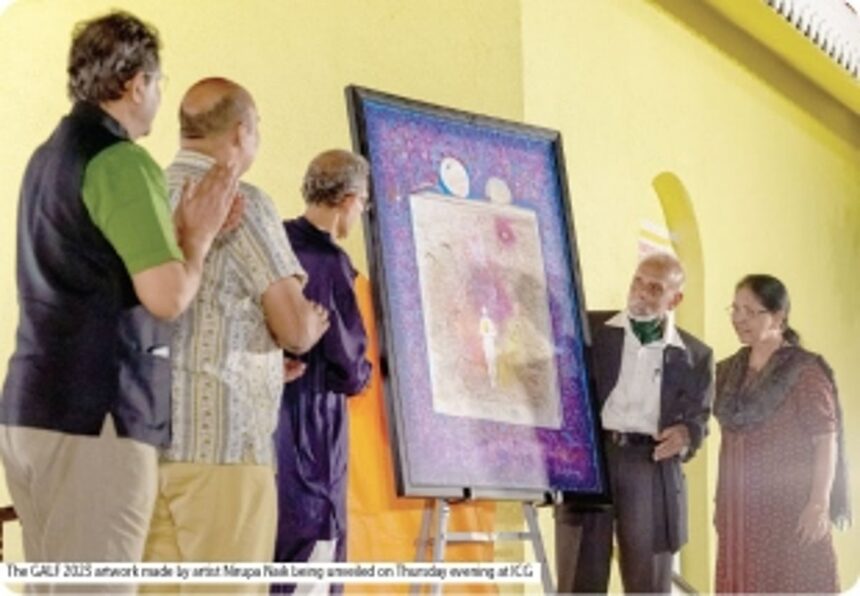
The exciting evening also saw the International Centre Goa felicitate Damodar Mauzo, Goa’s only second Jnanpeeth awardee, the release of a very interesting artwork based on the world of literature by Nirupa Naik and the release of Uday Bhembre’s Konkani novel, Vhodlem Ghor.