‘Padvo’ is a festival which worships
domesticated animals, especially those animals that partake in the farming
process. The festival reveres the mother of the universe, the sacred cow, an
animal which is close to the farmer’s heart, as it works with him, side by
side, year after year. According to Hinduism, the cow acts as the surrogate
mother, providing milk and thereby nurturing human beings throughout their
lives.
In Goa too, this day is celebrated with great
fervour. ‘Padvo’ is a way of being thankful to these docile animals for a good
harvest. There are two ‘Padvo’ festivals held in Goa, one in April, on the
first day of the New Year according to the Hindu calendar and the other is
celebrated today. More recently, with the drop in the number of cattle reared,
the festival is being celebrated in pockets of the state, gradually being
forgotten by the rest.
The day begins with the women of the house
preparing ‘pole’, fried pancakes made from thick rice flour batter, which is an
important part of the ritual. In the meantime, the men wash the cattle and
decorate them with rice flour batter, garlands and floral creations known as
‘gone’. The rim of a steel glass or a small pot is dipped in the batter and
then used to decorate the cow’s body. These impressions are decorative and
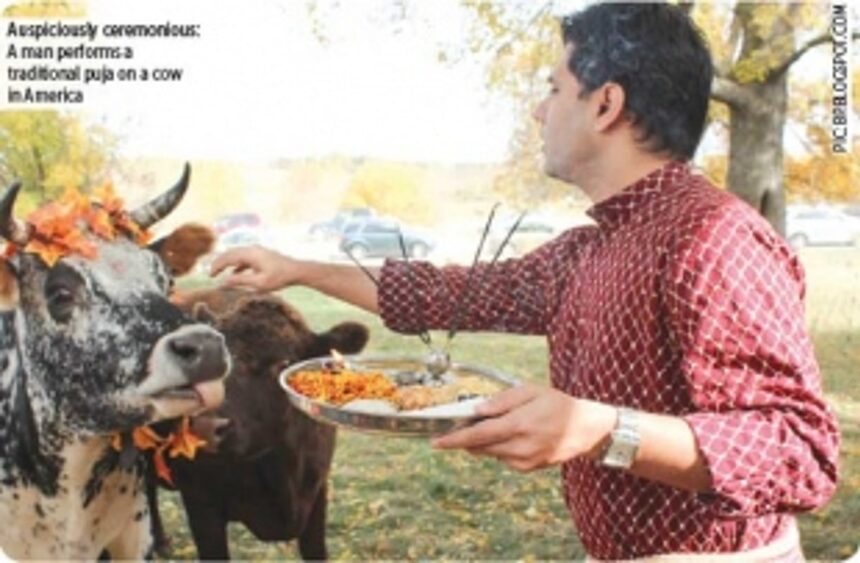
cover its entire body. A ‘tika’ is then placed on the cattle and the ‘puja’ is
conducted. It’s interesting to observe that the cow is worshipped in the same
manner that a goddess is worshipped. The cow is then served the ‘pole’. The
family can eat breakfast only once the cattle are served.
Vibha Nagvekar from Velguem explains how
the festival is celebrated in their village. “In the morning, the family
performs ‘puja’ of the Tulsi Vrindavan accompanied by ‘Dino’, a beautifully
decorated stick considered as the protector of the cattle. Along with this, a
small drawing of the cowshed is made using cow dung. The ‘pole’ is served to
the Gods first and then we take it to the hills to feed the cattle herders who
are working. In the olden days, every house in the village had cattle. Now,
there are hardly any cattle in the village. But we still head to the hills with
our small ‘bhutis’ (containers with food) and the whole village, comprising six
wards, meets there. It is an annual gathering to remember our cattle
herding days.”