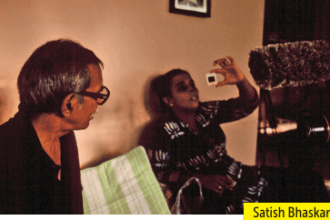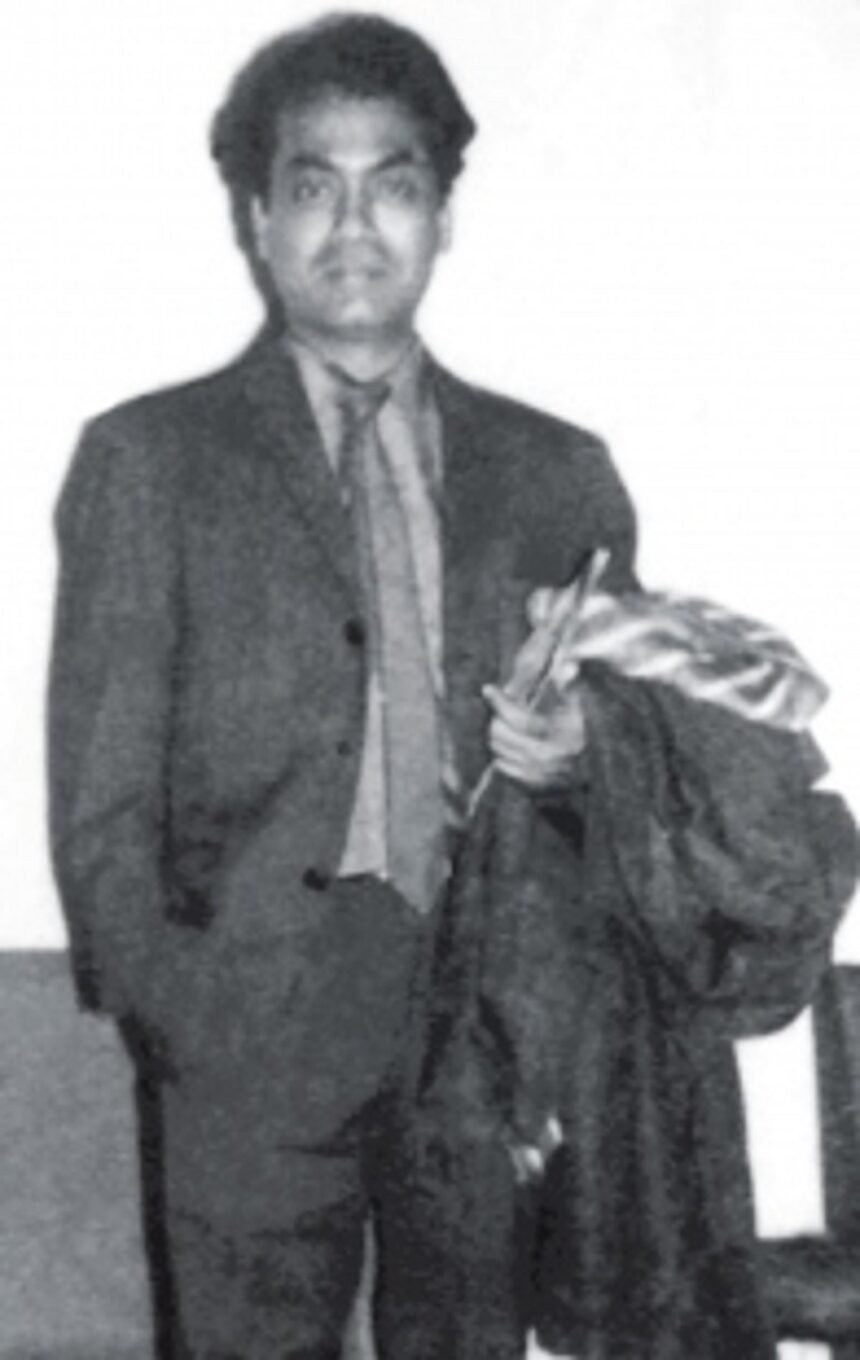
‘Vasudeo Santu Gaitonde — Sonata of Solitude’, is
a book authored by Meera Menezes, researched by
Jesal Thacker and published by Bodhana Arts and
Research Foundation on the artist who was known
as Gai to his friends in the world of art. However,
very little was known about this legendary record
setting artist.
HERALD CAFÉ: V S Gaitonde’s works are an
inspiration for artists in India. Can you tell us about
the book, ‘Vasudeo Santu Gaitonde – Sonata of
Solitude’?
Jesal Thacker: This book, which is the first in the
series of three books and a documentary, emerges
as a biography of the modern master Gaitonde by
eminent art scholar and author Meera Menezes.
‘Vasudeo Gaitonde — The Man and the Myth’, the
research is presented as the praxis of his life. Stories
known and unknown since his childhood to the
period of his formative years in J J (School of Art),
through his struggles to keep up expenses as well
as ambitions until leaving his family to permanently
settle in Delhi are well addressed and narrated
here. Meera, through her biography, effaces the
existing myths about the artist and successfully
attempts to produce a factual document on his life
and journey, keeping the emotive anecdotes at bay
while vehemently affirming the facts. The document
presents a history rather than a general story. Meera
Menezes has very deftly shaped a story from the
magnanimous archives we gathered together. The
narrative arc she has laid out in the following pages
from end to end reflects the unique persona of
Gaitonde — the Man and the Myth.
HC: Can you elaborate on his background with
regard to Goa?
JT: Gaitonde’s father belonged to the native place
of Uskai in Mapusa while his mother belonged to
Bicholim. The mural painting created on the walls of
Saraswati temple in Uskai influenced young Vasudeo
Gaitonde. The family shifted to Mumbai in 1929.
Affectionately referred to as ‘Bal’ by the rest of his
family, Vasudeo was the only boy wedged between
two older sisters, Manik and Hira, and two younger
sisters, Vijaya and Kishori.
HC: How valuable were the inputs by V S Gaitonde’s
sister, Kishori Das, since he had broken ties with his
family in Goa?
JT: There is a 20-year age-difference between
Kishori Das and Gaitonde. Gaitonde left for Delhi,
leaving his family and friends in Mumbai, in 1971.
However, Kishori still had fond memories of her
brother and her inputs have been very valuable,
especially since it gives an insight into the formative
years of the artist and also a deep insight into the
relations he had with his father. What particularly
interested me was how both father and son were
strong headed and they both had similar characters.
At the Gaitonde household, his father Santu’s word
was law. None of the other family members had
any say in the decisions that were made, and the
atmosphere at home could be suffocating in its
tyranny. When he was away, the family members
broke free from the shackles of paternal discipline
and the house would be filled with peals of laughter,
songs, dances and skits. However, as soon as the
patriarch returned from work, silence descended
and the atmosphere retained its repressive weight.
HC: What was the struggle to research for this
biography?
Meera Menezes: Ever since I first set my eyes on
Gaitonde’s paintings, I was keen to know more about
him. In a scene dominated by figurative work, here
was a man who was ploughing a lonely furrow of
abstraction. I had heard that he was a recluse and did
not meet anyone but I was determined to interview
him. As luck would have it, he agreed to meet me in
1997 for one of those rare interviews. Then in 2010,
Jesal Thacker approached me to write a book on
him, since she was equally passionate about his life
and work. We were like kindred spirits in this project
and worked together to bring this book to fruition.
JT: It was during my college years at JJ School
when I came across a painting in a catalogue that
drove my interest towards Vasudeo Gaitonde and
his paintings. I began to probe deeper as it was a
project assigned to us — to research on any abstract
artist. As my interest grew deeper in abstraction, my
knowledge of Gaitonde increased. I came across a
monograph by Dnyaneshwar Nadkarni on Vasudeo
Gaitonde by Lalit Kala Akademi that further triggered
my research into his life and art.
HC: V S Gaitonde is celebrated as one of India’s
highest selling artists internationally. What is the
target audience you are looking at for this book?
JT: The purpose of the book is educative as it serves
as history of an artist who was a part in pioneering
modernism in art in India. The target is not specific,
as it would be an element of interest to all those who
understand Gaitonde’s non-objective art and his
philosophy of life. We aim to reach out to all those
interested in art – students, collectors, critics and all
those who believe in the synchronicity art has to life
and spirituality.
HC: Will the book be available in bookstores in
Goa?
JT: Yes it will. I am planning a book release in Goa
and also releasing a similar book on Gaitonde in the
Konkani. It is now available online on the Bodhana
website (www.bodhana.org).