The games have commenced. India has won its first medal on the very first day of
competition. It is undoubtedly a great feeling. The Olympic Games is
undoubtedly the greatest celebration of the human spirit. The human’s desire to
reach longer, higher and do it faster is amplified at the games. Over the years
there have been several great performances that have dazzled the world. There
have also been situations that have been tragic. The massacre of Israeli athletes
at Munich was one such instance. Many people find different ways to commemorate
these occasions. Some do it on film, paintings, songs and even plays. And then
some do it in stamps.
In Goa, Dr M R Ramesh Kumar, President,
Goa Philately and Numismatics Society has been collecting stamps for decades.
He is continuing a fascination for stamps which started with his father. He
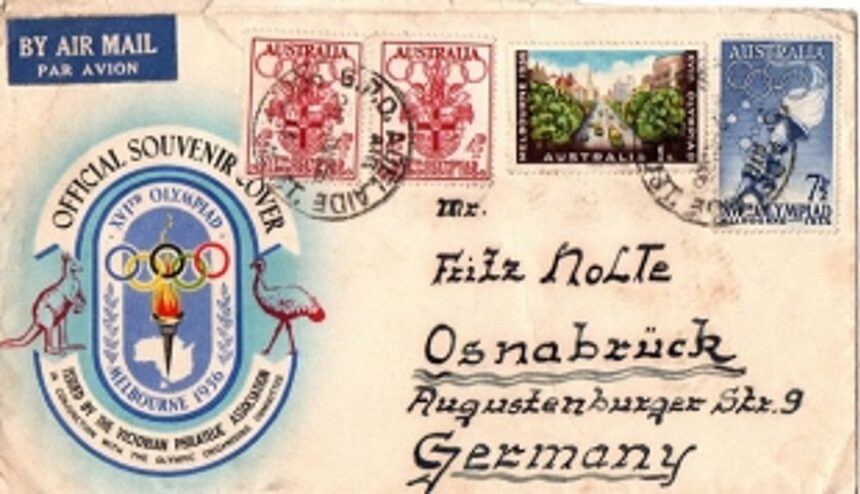
said he tried to include as many stamps, miniature sheets, special covers,
commemorative covers, first day covers, se-tenant stamps, sheetlets etc from
the period 1960 till 2016 in chronological order of the Olympic games (Mostly
Summer games with one Winter games one Para-olympic games) only. He said he
tried to include a few philatelic material of the host country as well as the individual
medal winners and also participating nations. Dr Kumar said “Some of the
Olympics were remembered for several incidents such as in the 1960 Olympics
where Cassius Clay, later came to be known as Muhammad Ali came into the
scenario. In 1964, the Tokyo Olympics was notable for its broadcasting
worldwide on television. The game of Judo was introduced for the first time.
The performances of the 1968 Mexico City games were affected by the altitude of
the host city. 1972 Munich (Germany) are remembered for the massacre of the
Israeli athletes by Palestinians. The most remarkable athlete of the 1972 games
was the swimming sensation, Mark Spitz.”
Asked how he went about acquiring these stamps and covers
released for the Olympics he said he noticed in his childhood that these stamps
sometimes came in interesting shapes and sizes. He said “The Hungarians had
release 8 stamps ion different shapes and sizes in the 50s’ which was very
interesting. The Olympics for me the supreme test of the human spirit and I was
excited to read about Milkha Singh, Mohammed Ali, PT Usha, Nadia Comaneci and
others”. He said he would barter stamps with friends in India and abroad. He
would also buy from philatelic dealers all over India. For the ongoing Olympic
Games he was getting it from Singapore and Japan. He said it would take a while
due to the virus but he was sure it would be in his hands. He said there was a
special cover released to mark the tragedy of the 1972 massacre in Berlin. He
said even when countries boycotted the games; they would release covers and
stamps to commemorate the event. This he said was evident during the 1980
Olympics which was boycotted by the USA and its allies and later in 1984 when
the then USSR and its allies stayed away. He said all these stamps were
available on E-bay India where he could place and order. He said it was
possible to get stamps of 1908, 1912 Olympics but they would cost an arm and a
leg. The Greeks he said had issued 12 stamps in 1986 to mark the centenary of
the games. He said he had them all and it always brought him great joy when he
looked at them. He ended by reiterating the fact that younger people ought to
get interested in this activity because it would bring them great joy and would
also help them learn so much.
One
can only hope more people acquire the habit of collecting stamps and of special
occasions because in time these will be the only mark of remembrance for these
events.