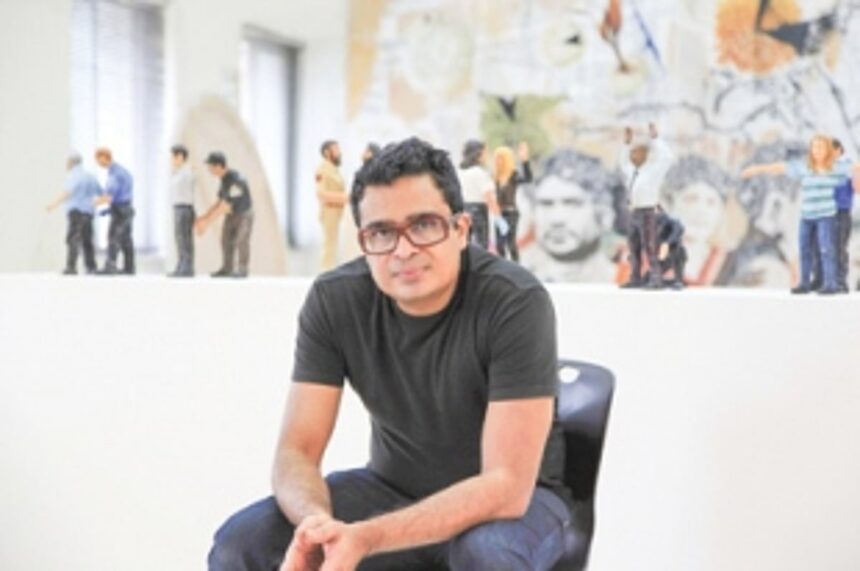
It is the welling of the inner being that has not only
defined Jitish Kallat’s creative energies, but has earned him a place as one of
India’s most prominent contemporary artists whose works have been showcased at
some of the most renowned galleries and biennales around the world.
On the physical level, he works with a variety of
media, which range from paintings, sculptures, installations, photography and
video art, employing a bold and vivid visual language that imbibes both Asian
and European artistic traditions. His most recognised art work yet is his
extensive LED installation, titled, ‘Public Notice 3’at the Art Institute of
Chicago (2010). On the more personal level, his work speaks of both the self
and the collective, characterised by contrasting themes of despair and hope.
“The themes come from one’s inner being and are questions that might fuel the
very purpose of life. Where is our planet going at 70,000 miles per hour and
how can we map the meaning of our existence to this larger planetary journey,
can be one such question. This question has also percolated the curatorial
fabric of the Kochi Biennale,” explains Jitish, who currently sits on the Board
of Trustees of the IFA.
Explaining the genesis of ‘Whorled Explorations’ of
the Kochi-Muziris Biennale of which he has been appointed artistic director
this year, Jitish points out how two chronologically overlapping but unrelated
historical episodes in Kerala during the 14th to 17th centuries became parallel
points of departure for the exhibition. “Drawing from these episodes, allusions
to the historical and the cosmological recur throughout the exhibition like
exaggerated extensions to gestures we make when we try to see or understand
something. We either go close to it or move away from it in space, to see it
clearly; we also reflect back or forth in time to understand the present.
‘Whorled Explorations’ draws upon this act of deliberation across axes of time
and space to interlace the bygone with the imminent, the terrestrial with the
celestial,” elucidates Jitish of the exhibition which is showcasing works in a
variety of mediums of Indian and international artists.
”The biennale seeks to invoke the latent cosmopolitan
legacy of the modern metropolis of Kochi, and its mythical predecessor, the
ancient port of Muziris and create a platform that will introduce contemporary
international visual art theory and practice to India, showcase and debate new
Indian and international aesthetics and art experiences and enable a dialogue
among artists, curators, and the public,” he adds.
By virtue of these aspects, the biennale which began
on December 12, 2014 has already drawn a large crowd. “Unlike several events in
the art world that are fortified by top-down support, this one rises
organically from the ground through the intent and imagination of artists. The
wide participation of the local community makes this biennale special. In less
than a month, more than 90,000 visitors have seen the biennale,” Jitish
enthuses.
Taking a break from Kochi to discuss the biennale with
renowned author Siddharth Dhanvant Shanghvi at the ongoing Sensorium, Jitish
will make a brief stop in Goa. “Siddharth and I will discuss the making of the
biennale, its deeper intentions and also its social impact,” reveals Jitish.
(Jitish
Kallat@Sensorium in conversation with Siddharth Shanghvi will be held at
Sunaparanta, Altinho on January 11, 2015 at 7pm)