International Translation Day is celebrated every year on 30 September. This day is observed on
the feast of St Jerome, who is best known for his translation of most of the
Bible into Latin and is hence considered the patron saint of translators.
Through translation, literature of different forms that was once bound to one
language, is opening up to a wider audience.
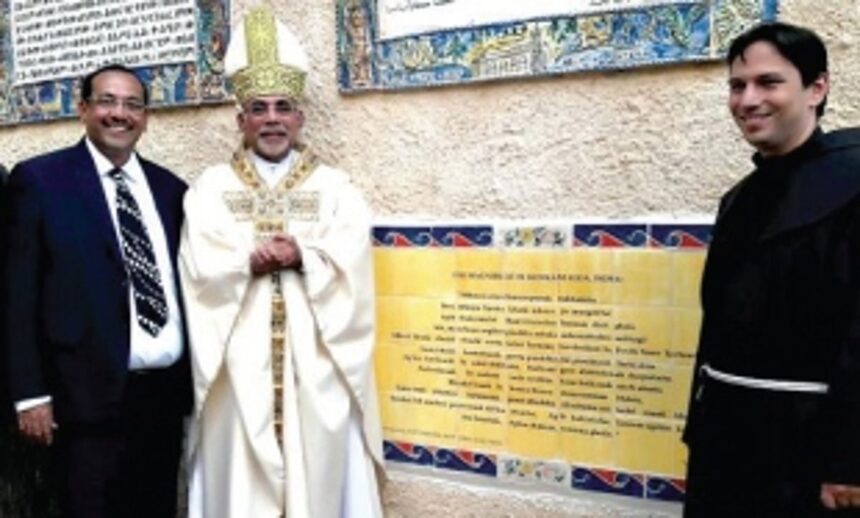
Recently, Most Rev Filipe Neri Ferrao,
Archbishop of Goa, Daman and Diu, unveiled the plaque of ‘Magnificat’, also
known as ‘Mary’s Song of Praise’, in the Konkani language at the famous Church
of Visitation in the Ein Kerem area of Jerusalem. This was done in the presence
of Fr David Grenier, Secretary of the Custos, Fr Ladislavo, Superior of the
Franciscans of the Visitation Church, Fr Eric Rodrigues from Canada, Fr Luis
from Goa and Paul Sequeira of Zion Tours.
“We have been planning this for the last
three years and we are glad that it all worked out. The Custos gave us the
permission and the Archbishop of Goa said he would attend the inauguration in
Israel. The Konkani version was taken from the Bible as it was given to me by
Fr Loyola Pereira, the secretary of the Bishop. It was so well organised that
the Superior of the Franciscans of the Visitation Church remarked to our
Archbishop that over the last seven years, they have installed plaques in four
languages but this was the first time that it was done so well. This is a proud
moment for Goans around the world,” says Paul of Zion Tours, Goa, who installed
and sponsored the plaque.
Isabel de Santa Rita Vaz, who is known for
her English plays in Goa through Mustard Seed Art Company, translated a
Portuguese play into English (‘No Flowers, No Wreaths’). The original play was
written by Orlando da Costa, the late father of current Portuguese Prime
Minister Antonio Costa. She personally presented her translation to the Prime
Minister when he visited Goa. “The idea interested me as it was a play and Goa
University approached me to translate it. Translations are wonderful for plays
and literary works as the works are made available for other languages and to
readers outside the state and country,” says Isabel.
Her English play ‘Spectacles of Peace’ on Mahatma Gandhi was
translated into Marathi and won the drama competition in Goa. Another play,
‘Harvest of Gold’, was translated into Romi Konkani, and the latest play, ‘On
The Edge’, which was staged earlier this year, was translated into Konkani.
“The play was translated because a young man from Chinchinim was interested in
staging the play in Konknai in tiatr form for young audience,” adds Isabel.
A variety of books touching on different themes have been
translated in Goa over the years, these include books that are not in the
reading sphere anymore and that would probably be forgotten if not translated
into a global language. Oscar de Noronha is instrumental in bringing these
books to a new audience. To his credit are ‘The Book of Confidence’, a French
to English translation of a book by Thomas de Saint Laurent, and ‘Tradition and
Modernity in Eighteenth Century Goa’, a Portuguese to English translation of a
book by Maria de Jesus dos Martires Lopes. Oscar’s own book, ‘Of Divine
Bondage: the Epic Life of St Joseph Vaz’ was translated from English to Konkani
(‘Bhag Juze Vaz: Jezucho ani Moriecho Gulam’) and was edited by Fr Mausinho de
Ataide.
“Translations ensure that everyone is a winner. Not only do
regional literatures get wider exposure but rich foreign cultures also get to
open themselves up to smaller regions. This contributes to world understanding.
The difference that translation makes is incalculable as the readership
expands,” says Oscar, an associate professor in English.
Damodar Mauzo’s novel ‘Karmelin’ is proof that good literature
in any language will always find readers. His book was awarded the Sahitya
Akademi Award in 1983. “There are two sides to translation. Firstly, it takes
literature across linguistic borders and readership as ‘Karmelin’ was
translated into 12 languages. Readers and writers from outside the state can
know about Goa and learn more about the community through its writing. Once
they go through the literature, they are bound to change their perspective of
Goa,” explains Damodar, whose books ‘Tsunami Simon’, ‘All my Children’,
‘Teresa’s Man and other Stories from Goa’ and ‘Mirage’ were translate from
Konkani to English.
He
further adds, “Secondly, literature has to have an internal audit and an
external audit. Criticism in the original language plays an important role as
an internal audit while the external audit is when the translated version is
judged by the people. They won’t read the original but treat the translation at
par with the literature standard in that language.”