Over the year, little girls have been
customarily told, that they need to be good wives, home-makers and such. Or so
it was. Then, before they ‘came of age’ they would be sent to institutes that
would train them in the art of all things feminine, which would in turn empower
them with the skill they required to blossom from girls into women. That,
apparently, was a bygone era. Finishing schools, as per the stories shared by
some heads of institutions, are far from still being all the rage.
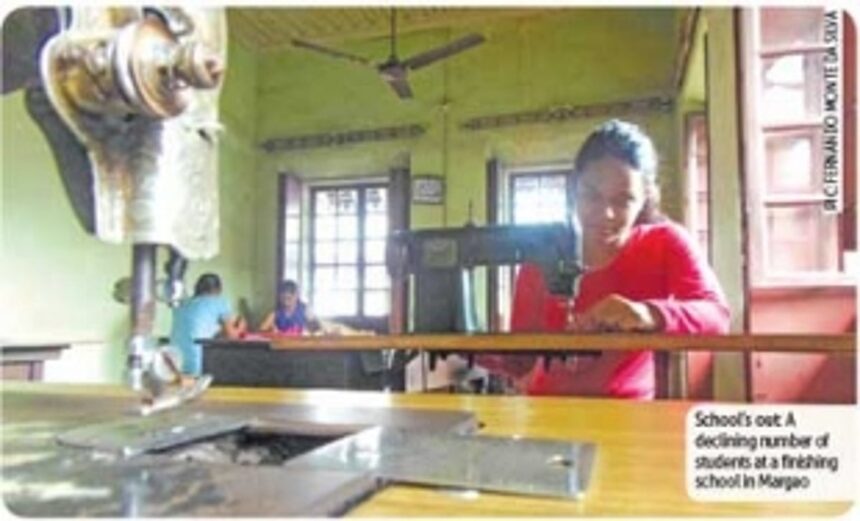
It was on October 3, 1954 that Helena Barbosa Noronha
Furtado opened the doors to Instituto das Artes Femininas in Margao. The
institute taught everything from tailoring to painting and embroidery. Run with
the assistance two of her daughters, Helena ensured that it was an entirely family-run
unit. Over the years, things have not changed much, as the centre is now run by
the deceased founder’s son Paulo. Sharing his views on the state of affairs
both past and present, he says “The popularity in the past was so overwhelming,
that in the summer, my mother would lay mats out on the porch in order to
accommodate the additional number of girls that wanted to enrol. We would,
especially during the summer, have batches of up to 50 people at least twice a
day. This popularity is on the decline now and at best, we may have a batch of
maybe 20 people.”
In similar vein, another such school in Margao, called
Mastercraft is no longer operational. Run out of the Lourenço family home, the
centre that dealt in the art of flower making had much appeal, which died out
over the course of time.
Further north in the state, a native woman of Arambol made
it her business to play the Professor Henry Higgins, the trainer from My Fair
Lady, as she sought to convert girls into suitable marriage material. Joaquina
Matos, set up shop at the base of the slope that links Siolim to Mapusa, where
for many a year she ran her now defunct institute with a little board that
merely said ‘Ladies Classes’. The view of this stalwart is that urbanisation
and the 21st Century has reduced the need for ‘conventional training’. “In
modern times, training in the area of computer literacy is the most important
thing. I find that many parents focus on that most and as such, the popularity
of finishing schools has taken a hit. I have experienced this first-hand and
when it was no longer profitable to run my little school, I shut shop,” she
says, speaking from her little cottage in Arambol.
That the popularity of these schools is waning, there can be
no doubt. The few institutes that continue to run are on their proverbial last
legs, the numbers suggest. Yet, for those that run them, the ideology remains
that these skills are imperative to all-round development. Perhaps the wisdom
of these teachers believes that for the perfect woman, be it regular cloth or
the fabric of their homemaking lives, a stitch in time may indeed always save
nine.