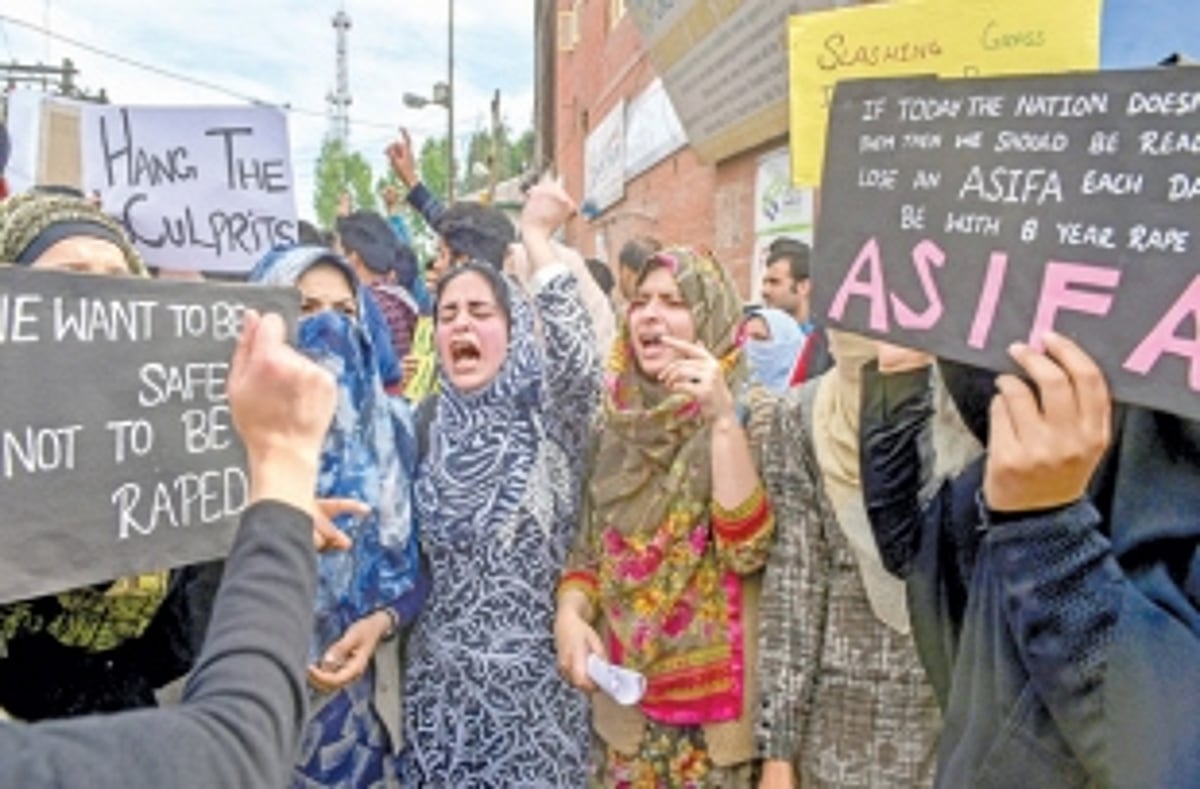
Even as citizens across got together to express their anger with the current
state of affairs and to protest against the Kathua and Unnao rape cases; the
country continues to reel from horror stories involving horrific crimes against
women and children.
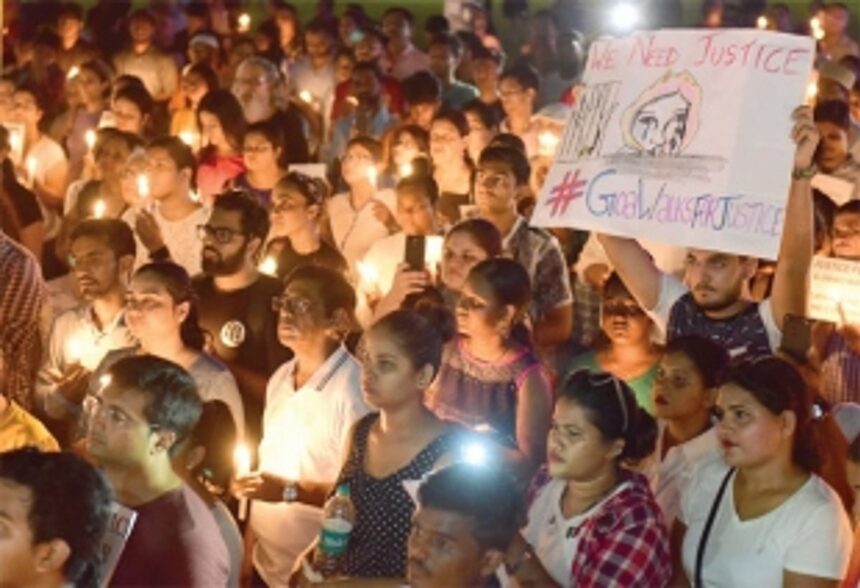
Joining a wave of protests that are being
held across the country, the Goan public, through their ‘walk for justice’ have
managed to ensure that sexual violence and related issues are being discussed
in the public space and not being swept under the carpet.
“Goa’s young people organised an amazing
set of protests on Sunday evening to make their point, and battle against the
mindset and [even political] tolerance that allows brutal rapes of young
children to happen and sometimes get justified in India,” says Frederick
Noronha.
The response was extremely overwhelming
and a friendly reminder that all hope isn’t lost . The youth was given a
platform to share their take on the matter and place our opinions beyond the
realms of social media. . There was music, poetry, pledges, and a union through
a singing ‘we will overcome/ Hum honge kaamyab’ as a way to unite voices. The
crowd was filled with people of different ages, genders and professions. The
addressing of the crowd was entirely left to the youth and that is what made it
special. The people of Goa were a part of something that they believed in, and
they walked for a movement that doesn’t stop here. A fight for justice and
basic human rights is what we have to work for everyday,” adds Gretchen
Barreto.
While Gretchen was speaking about the Panjim rally that was
powered by youth and one that saw the crowds walk from Miramar circle to Azad
Maidan, groups had converged at Margao and carried out a walk around the Margao
garden.
“ At the Margao Walk, we also had an art installation to make a
strong statement and there was a signature petition where got close to 600
signatures,” said Althea Fernandes, whose group released a statement at the
rally.
“We call upon all political groups to put an end to the
horrifying politicisation and communalisation of the crime; as well as to stop
the harassment to the family of Asifa. As women, we are extremely shocked and
appalled by the manner in which incidents of gender oppression are appropriated
by patriarchal mindsets within and outside the corridors of power to subvert
justice and even rob the victims of their victimhood. We also call upon the
government to ensure that investigations by the Crime Branch are fast-tracked
and are fair to be followed by a fast track court trial so that justice can be
dispensed. Let’s stop discriminating, “Victim of Sexual Violence”, based on
gender, age, caste, class, religion, region, colour, occupation, situation and
behavior! “ said the YWCA Goa, which organized the rally.
Against this
backdrop, the protest held outside Carmel College Nuvem and the march from
Saligao panchayat to St Alex’s
Church in Calangute, was
a clear indication Goans from all parts of state have been demanding justice
for the young rape victim.
With the momentum there have been calls
for these kind of efforts, an important first step and that the walk for
justice leads to a movement for not only justice but a change in the mindset
and the attitude in the country to such kind of incident.
Cafe speaks to citizens who speak about what more can be done
and what’s the next step
(The art installation at the Margao rally was made by artist
Katharina Karkar, ironically at the time of the Nirbhaya rape case and is
called December 26, 2012). “The installation refers to the Nirbhaya case and
sadly enough now for the Asifa case. Rape is about power and silencing and the
underlying cultural issues need to be addressed. Rape is a universal issue, but
why do such violent gang rapes happen repeatedly in our country? We need to
start to reflect how we raise our boys and girls, why we differentiate between
the respectable woman and “the other”, and why there is so much fear of
independent women who demand a right of their own body.”
KATHARINA KARKAR
“I attended the #JusticeForAsifa march
from Miramar to Azad Maidan. It was wonderful to see so many people come out to
show their support. But what stunned and excited me, even more, was the number
of young children and teenagers in the mix. I even overheard a conversation
between 4 teenage boys discussing the number of rapes that have happened in the
last few years and months. While they didn’t seem to have all the details, they
still knew quite a bit and spoke intelligently. All I can say is, gone are the
days when kids were unaware. It’s a good thing they are paying attention. This
is their safety that is at stake. While we are fighting for our women, we are
also fighting for our children. Religion and politics can go fly a kite. Things
have to change or we are best off, obliterating the country from the globe.”
KARINA DE G PINTO
“The recent spate of gangrapes around the
country is horrifying. The worst thing is that it happens with impunity and
continues unchecked. In Goa it happens in tourism locations where teenage
girls, migrant girls and single women are abused but are too afraid to complain
lest they be ostracised. There is an urgent need for preemptive consciousness
building and stringent punitive measures.”
ROSELLE SOLOMON
“I don’t see the march as the ‘first step’
in the movement. It can be called a catalyst, but marching in silence is not
going to help. The real first step is education. But I feel that the damage
done to the mind-sets of some societies is irreversible, at least for several
years more. The most that we can do is try to correct people in our immediate
circles; to induce a better mind-set into people going off track. There’ll be
activists, NGOs doing as much as possible. But I feel that the difference all
this is going to make is minimal.”
DECLAN PEREIRA
“This march was the result of students
getting riled up against the inhumanity of the situation. Honestly, I can’t
give you a next step to this. It was something the people needed, for their
belief in humanity to be restored. So, everyone showed up to support each-other
in this national grievance. I think, to make a difference, each person has to
start on their own – we must remember that despite our differences, the one
thing that brings us to one level is that we’re human. Each person must do
their part to be human, and influence others to be human too.”
SONIA SABNIS
“The candle march was the first step
toward making a national statement, since it happened across the country. I
think the next step is for the Government working on stricter laws about the
rape crisis. What we as individuals can do is continue to have more peaceful
protests till we have those laws in place. But I am not sure if that will get
us what we want, so maybe find a way to work within the system to get this
done. I think with better education, the Government taking some hard but needed
decisions, and people changing their mindsets, we might be able to get
somewhere.”
SILVERIO SOUZA
“How do these perpetrators find the guts
to commit crimes like these without worrying about the consequences? They find
the guts because there are no consequences. Court cases take years and years.
How many times have we heard of FIR’s not being filed by the police because
ministers have not allowed them to do so, ministers using the police force to
legally behave like goons and have used the force as their private armies,
honest cops being transferred again and again to obscure posts because they do
not fall in line with corrupt politicians? When are we going to stop being
superficial and find a remedy that fights to attack the problem at the root and
not just cut of the twigs at the top? What we as a country need to do is come
out on the streets and force the central government and the opposition to
change policy right at the top. What we need to do is select a President and
Governors of each state who are absolutely not tainted even with a single court
case and not affiliated to any political party. I’m sure we can find 29 people
among 1.2 billiion that fit the bill.”
LESTER RODRIGUES
“The march is a part of a movement that
doesn’t stop here. For the future, with respect to the utilities at hand, a
petition can be signed, nationally demanding stricter laws to not only punish
crimes through capital punishment, but more importantly to prevent the
occurrence of such monstrosities (among other much needed reforms). The government
needs to understand that you can only abuse a nation for this long. It won’t be
a while before patience isn’t an option anymore and people become as merciless
as you were when you protected the men that killed our brethren. We need more
workshops, more syllabus changes, more talks to increase the understanding of
the opposite sex, we need to start treating sex like a normal thing and not
something so shameful that the very norms that prevent us from acknowledging
the fact that yes, people have sex. Actors and actresses holding up hashtags
will only do close to nothing. If they really want to do something, then should
say no to doing item numbers and stop being a part of an industry that moved
from showcasing strong women shows like ‘Shanti’ and moving to a depressing
line of televised dystopia of submissive women.”
GRETCHEN BARRETO
“I had the honour of walking all those kms
(for the Panjim rally) with an 80 year old lady! Wow! Sometimes it is the
people no one imagines anything of, who do the things, the things that no one
can imagine. The turnout reflects how many of us want change and justice. This
is a call to break the mindset and to bring justice for Asifa.”
ANEESH GERA