Goa is a state that is very welcoming. No, this is not an excuse to hide behind such trite cliches. This is to state the fact that Goa is home to a large number of birds. 450 species to be precise. And no we are not even talking about the migratory birds that come from all over the world. Fears have been expressed of late about the fate of the birds as the human species goes ahead with the aim of expanding its civilisation. Goa is the second state in the country to start work on a Bird Atlas. The collected data will now be analysed by the research division, paving the way for accessible bird atlases for the public and stakeholders. Kerala inspired the State being the first to have such an atlas.
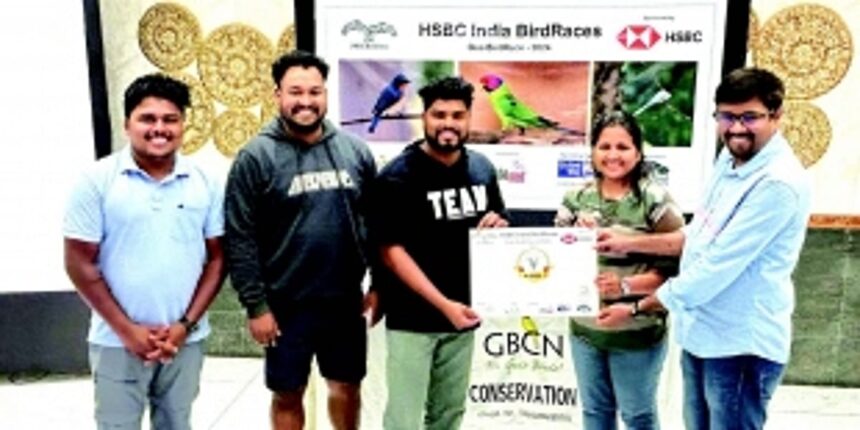
On Sunday, four members of the team called Falcons started off very early in the morning with the important task of bird watching. The team of four who are passionate in their interest of bird watching have been doing this for the past four years. There was a gap of a year due to the Covid-19 virus. It started at 6 in the morning. The rule to be followed during such exercises is that you need evidence or you have to be able to explain certain species which are uncommon.
Jalmesh Karapurkar said, “We started early in the morning in the forest. We started from Surla, Sattari since it was located at a high elevation which meant we could see some forest species not seen in lower regions. We saw some night birds since it was dark. We could get the nocturnal species. We saw the Sri Lanka Frogmouth, Brown Wood-Owl and the Barn Owl. After that, we started hearing chirping of the birds.” They started off by identifying the birds by the sounds they were making since they could not be seen in the dark. Once sunlight came through, they started looking for other birds. They counted around 50 species. They saw some species that people like to see but are not common. They saw the Common Rosefinch and the Square-Tailed Bulbul to name a few.
The group of four then moved out to the Anjuna Reservoir region. In that area, they spotted some common forested species like the Gray Wagtail, Emerald and the Flame Throated Bulbul, which is the state bird. Finally, they moved to Morlem to conclude the inspection of forested species and some human habitation related species.
They then focused their attention on wetland species and visited the Navelim Wetland, Carambolim Wetland and later in the day, the Maimollem lake and the Handi Khuris wetland. The team of four also included Arshada Gauns, Shubham Rane and Shayesh Pirankar, all of whom are passionate bird watchers.
After the wetlands, they visited a field to find Finches, Pipits and Larks. With several other associated species. After completing this bit of the visit, they then visited the Agassaim mud flats for shore birds. They ended up sighting Gulls, Terns, Plovers and other Waders. Jalmesh said, “This was our plan, we wanted to cover all the inhabitants in Goa and count as many birds as possible in a day. Since agriculture and wetland shorebirds can be seen throughout the day, we were focusing on forested species in the morning. That was our tactic”.
Shubham Rane, who was part of the group of four, said he was introduced to bird-watching by the group and got really interested in the activity. He said, “I was curious on Sunday. I decided to join to see how many birds can be documented in a day. We followed a strategy. It could not be done in a random fashion. If it was done in a haphazard manner, we would not be able to see so many species. We visited different habitats at different times of the day.
I feel we have good diversity of birds but it requires continuous dedicated efforts to ensure it stays that way. “
The only woman in the group Harshada Gauns was quite satisfied by the work done on Sunday. She said there were 490 species in Goa and on Sunday the group saw 215. Considering the ratio, she said, it was quite good. Since the migratory season was almost over, they were not able to see them but otherwise it was satisfactory.
One only hopes the efforts of such groups are not wasted and the society at large ensures Goa continues to play host to such creatures either local or migratory. Their absence would be a loss to everyone.