Sahil Naik from Ponda
has been inspired by stories that he has been listening from the original
inhabitants of Curdi. To keep these stories alive, they should be shared and
what better way to start a conversation then showcase a glimpse of the life
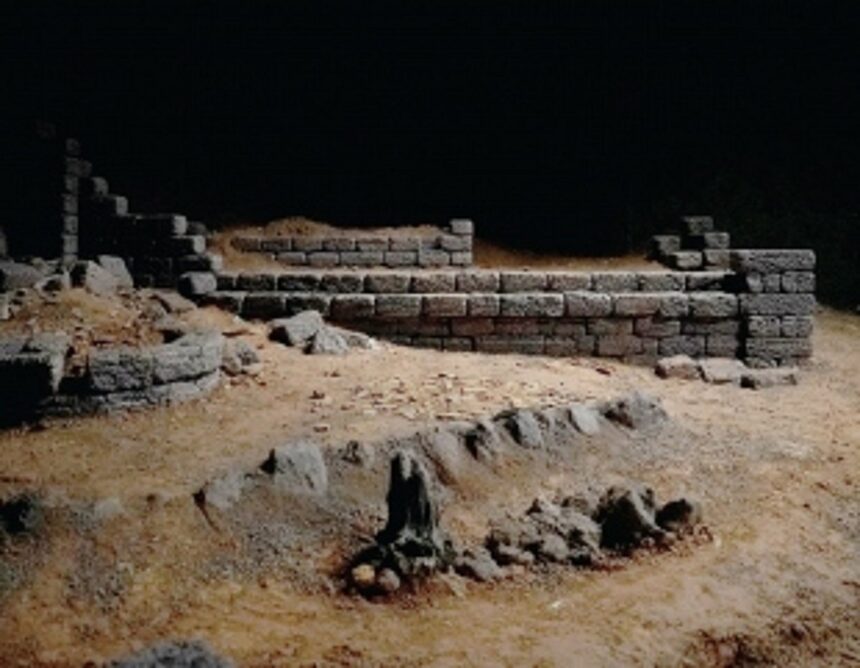
that was in Curdi. Sahil worked on his installation, ‘All is water and to water
we must return’ for which he recreated the remains of the village just like the
walls of the houses that have been withered under the water.
Curdi is not just a spot for Instagram
influencers but was an actual agriculture based village which was flourishing
with nearly 3000 residents and 450 families back in the 1980s. They were
relocated to higher grounds in the villages of Vaddem and Valkinem but they
still long to see their home or just their boundary wall or the foundation of a
temple and cross that can be seen in the summer.
After completing his graduation from Goa
College of Art, Sahil continued studying for his post-graduation in Sculpture
at Maharaja Sayajirao University of Baroda, Gujarat. Here, he was exposed to
meeting architects and working on the finer details of architecture. This
experience made him look at Curdi as not just a site but to define the life it
once had. Visiting the place for more than nine years, he has forged great
friendships with the residents who return to Curdi to share their stories.
Curdi first inspired Sahil’s installation at his debut solo show
in Kolkata, ‘Ground Zero: Site as Witness/ Architecture as Evidence’ followed
by ‘Haze: Contemporary Art From South Asia,’ curated by HH Art Space and Mario
D’Souza in Milan, Italy in October 2022. Kochi-Muziris Biennale marks his third
exhibition but this most extensive installation measuring 70 feet by 30 feet.
Using stones that resemble the building blocks of the homes in Curdi, as one
enters the exhibit, one can witness a broken down house with just a few stones
standing strong. Moving further is an open space with parched land portraying
the scorching heat that has dried the later leaving behind cracks in the soil
and then another broken down house which shows the haste in which the villagers
might have left their beloved home leaving behind heavier objects like a
circular grinding stone, half submerged in the soil and enough the trees next
to the houses which are now dead barks.
“For this installation, I have been mapping the site and was in
search of a similar stones with the same texture. Recently, there was Old
Portuguese Era Bridge that collapsed in Ponda. I managed to salvage a few
stones from there which had the same texture. The rest of the stones are
created using mud and plaster as I needed a big number of stones. The pattern
in the soil was created using halogen light. I had three months to work on the
installation and I had a strong support team which includes Kalpit Gaonkar,
Sanayvi Naik, Rajaram Naik, Pritesh Naik, Anup Naik, Akheel Kavlekar, Vidhyesh
Kavlekar, Girish Naik, Gaurang Naik, Divesh Gadekar, Dattaraj Naik and Shivam
Salgaonker. However, the most important role is played by the villagers,” says
Sahil. The installation will be on display till April.
What makes this installation even more emotionally appealing is
the background music that plays at the exhibition. These are songs of the land
sung by the women who would have once sang it in their temples for Dhalo or
Fugdi. The same songs were written by Saiesh Poi Panandikar, Hemant Aiya and
Brijesh Shet Desai and composed by Laxman Naik with music by Mukesh Ghatwal.
Three Konkani compositions expressing the pain of Curdi are
played on loop with the voices of the women to still feel the emotional connect
to their home. “The songs are the main aspect of the installation. There were
folk songs that existed like so many other villages of Sanguem and based on my
interaction with the villagers and their personal stories, the songs are
entirely remade by these noted songwriters. The women sing of their village and
how these songs transfer history is amazing. It helps the younger generation in
understanding their heritage and people may pass away but these songs will
continue to tell the story for generations,” explains Sahil.
Over
the years, Sahil has formed a close relationship with the people of Curdi.
Different generations visit the place and continue telling their tales for the
next generation. Unlike the Goan diaspora who are struggling to maintain their
roots in Goa, these youngsters are very much in tuned with their love for their
land. “Curdi provided water to so many villages, yet the same residents who
sacrificed so many were facing water problems in the first few years of their
rehabilitation. It is important to document these stories and songs,” says
Sahil. Using photogrammetry, archival images collected from people, press
clippings and Archaeological Survey of India data, as well as
computer-generated imagery and photographs, he has been developing the
landscape bit by bit.