If you stare at the seashore long enough, you are bound to see poetry in the patterns in the sand.
Like the waves that leave a mark on the sand only for it to be wiped away as
the next wave crashes again, the sands of time have seen the fisherfolk carry
out the same activity again and again since time immemorial.
The landscape of Goan beaches and its
surroundings have changed but the traditional still ramponkars descend on the
white shores at the first break of dawn, ready to heave and push their boats
into the sea together. If these boats could tell you stories as they caress and
cross the sea, they would tell you about fishermen’s songs, nets loaded with
fish and the sweat adding to the salt to the ocean.
For artist Dr Subodh Kerkar, these stories
of the ocean,as master and muse for fishermen, have been fascinating and
inspiring. He spent his childhood walking on the beaches with his artist
father, Chandrakant Kerkar. These walks consolidated his relationship with his
father and with the ocean.
A Konkani poem written by his late sister-in-law, Madhavi Sardesai,
about the relationship between salt and the ocean being one irrespective of its
size, as well as one by Rabindranath Tagore about how waves write poetry on the
sand, have influenced Subodh’s work.
Subodh’s work has certainly been poetry on sand. He creates his
installations using thousands of mussel shells, pebbles, palm leaves, boats,
sand and even fishermen. Through temporary installations on the beaches of Goa,
he captures ephemeral poems on the sand, which he then photographs, freezing
them in print.
The ocean is both inside and outside his works, and he creates
large works on the seashore, his latest one being infused with history and
human lives. “The ocean waves don’t just leave patterns in the sand, they carve
out sculptures. History of civilisation dissolved in oceans,” says Subodh,
while explaining how he precipitates that through this project.
Through his own personal observations and interactions with the
fisherfolk community, many of them being his old patients, Subodh narrates
their stories and the bond they share with the ocean. In this new body of work,
he explores how the lives of fishermen are inseparably connected to the sea,
how their lives are anchored at the seashore.
“The ocean is their life itself. For the fisherman, the waves just
don’t rise and fall. For him, the ocean breathes. The ocean is the very breath
of his life,” says Subodh, who feels his installations erase the boundaries
between the creator and the created, the fisherman and the fish, the boat and
the boatman, using the magic wand of art.
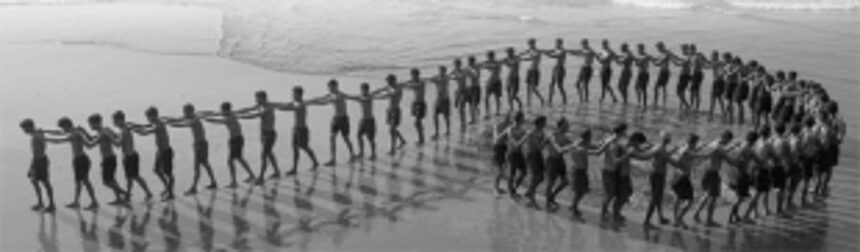
For this installation, the fishermen pose together in various
shapes, forming the fishbone, the boat and also performing various seafaring
rituals where they walk in a line, akin to a procession and stand along the
shoreline to receive the blessings of the vast ocean.
While these black and
white photographs started receiving praise from all quarters, it caught the eye
of acclaimed filmmaker Bharatbala Ganapathy, who spotted this immersive visual
at the airport in Goa when he was attending the International Film Festival of
India (IFFI). Part of IFFI’s steering committee, Bharatbala has been visiting
Goa over the last few years, but he was so moved by what he saw in this
photograph that he made it a point to include it in his own personal project.
Bharatbala is documenting or as he says “uncovering untold stories” throughout
the country and this will be one of them. These short films of ten minutes each
look at a wide array of what the essence of our country is and for the Goan
project, he was looking at documenting contemporary art.“When I first saw it, I
felt this was creativity at its simplest form. You do not need to be an art
connoisseur to understand it. Anyone can relate to it,” says Bharatbala.
Marveling at how each element is interwoven, Bharatbala was mesmerized by the
live installation and felt it was artistic, imaginative and that it offered a
perspective on the fishermen’s understanding of the sea and how their lives are
affected by the sea
“I was looking at the timeless relation between man and the
ocean. For instance, the imagination and expectation of the fisherwomen, is
standing on the shore looking to the sea, as she waits for the fishermen to
return with the catch and what follows then. The kind of anticipation these fishermen
experience as they are about to head out to the sea, “adds Bharatbala
Shot over four days at Morjim beach, Bharatbala says he wants to
tell everyday stories of human lives through his poetic interpretation. “It was
amazing and an honour to have such a great filmmaker visit us and make a
documentary about this installation. The shots from the film are fantastic,
“adds Subodh.
While
the collective pan India project will continue, Bharatbala plans to start
releasing these films later this year, perhaps twice a week, and Subodh’s work
could be one of those films released. The filmmaker hopes to pique the interest
and build the curiosity of his audiences, especially the youngsters.