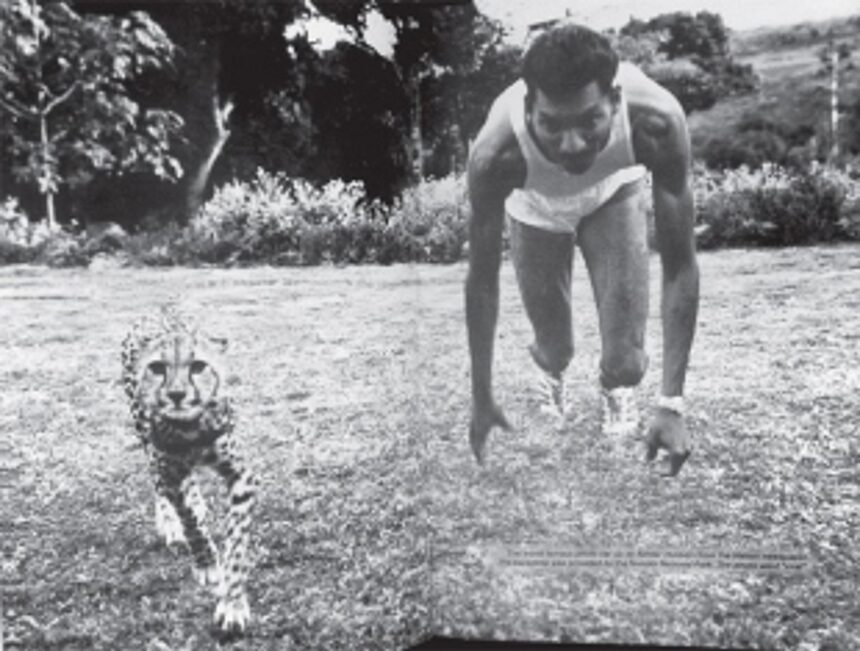
Did you know that Kenya’s first gold medallist was a Goan? Seraphino Antao was a double gold
winner at the 1962 Commonwealth Games in Australia, becoming Kenya’s first gold
medallist. “Seraphino was traditionally the greatest and the only Goan double
sprint gold medallist. There are generations who have grown up listening to his
story and I wanted to write, in a few words as possible, about what he was like
and his tenacity. Albert Castanha was the greatest Goan all round sports star.
The sportswomen were sensational too, like Astrid Diana Fernandes and Mitelia
Fernandes Paul, whose father encouraged them to take up sports. With their
sibling rivalry, they went on achieving the highest honours in hockey,” says
Cyprian Fernandes, who has recently written his second book, ‘Stars Next Door’.
Cyprian ‘Skip’ Fernandes is settled in Australia, and was the
Former Daily Nation (Kenya) journalist who started his career as a sports reporter
before moving on to general news and politics. Living in Kenya, Uganda and
Tanzania, Cyprian has watched these athletes and musicians who are featured in
the 258-page book. With over 100 black and white photographs sourced from the
family and friends of those written about in the book, the stories are a
reminder of the lives they lived and how they enriched the Diaspora with their
talents.
“I have been collecting information for the past 6-7 months and
the pieces written by me are straight from memory. It took me 3-4 months to get
in touch with some writers as I wanted to give them a voice. Many athletes and
musicians have written their own stories so that their voices could be heard –
how they felt and lived their lives – in their own words. Instead of a
journalist painting a picture with a journalistic view, I wanted them to tell
their stories,” says Cyprian. The book features literary pieces by Hilary
Fernandes, Astrid Diana Fernandes, Mitelia Fernandes Paul, Edmund Silveira Max
De Souza, Theresa Alfonso Tucker and Terence Pinto.
The beauty of these personalities was their humble nature. “If
you met them in this day and age, they would be superstars. But it was no big
deal in those days. I learnt about the game from them. I used to listen to
Hilary Fernandes and Oscar D’Souza, who educated me in the game of hockey.
Seraphino’s coach, Ray Batchelor, was my tutor in athletics and they all
provided robust and in-depth discussion about the sports,” adds Cyprian.
Speaking about the musicians who lived and entertained in East
Africa during the 1950s and 60s, he says, “The first Goan musicians to travel
go back to 1894, when they went to work for the Sultan of Zanzibar via Oman.
They were personal musicians but other musicians came in later when they joined
for clerical work and used music to entertain themselves, slowly following
bands. Almost 80 to 90 per cent of them were self taught while there were few
classical musicians. The reputation of these musicians grew among not just the
Goan community but other communities as well and they also performed for
British colonial functions.”
While there are many unsung heroes whose families live on with
their memories, Cyprian is certain those stories will motivate him to write a
second edition to the book. “Certain people will come out of the woodwork and
tell me to write their stories. There will be a second edition,” he explains.
The
stories in the book are so fascinating that it makes you wonder how life must
have been in East Africa when Goans were winning such honourable laurels. The
book, published by Goa 1556 with the design by Nisha Albuquerque, is available
in countries like Canada, United Kingdom and Australia. In Goa, the book is
available with Frederick Noronha, the publisher. “This book belongs to anyone
who has anything to do with the book. I especially dedicate the book to
Frederick because the help he gave was sensational,” concludes Cyprian.