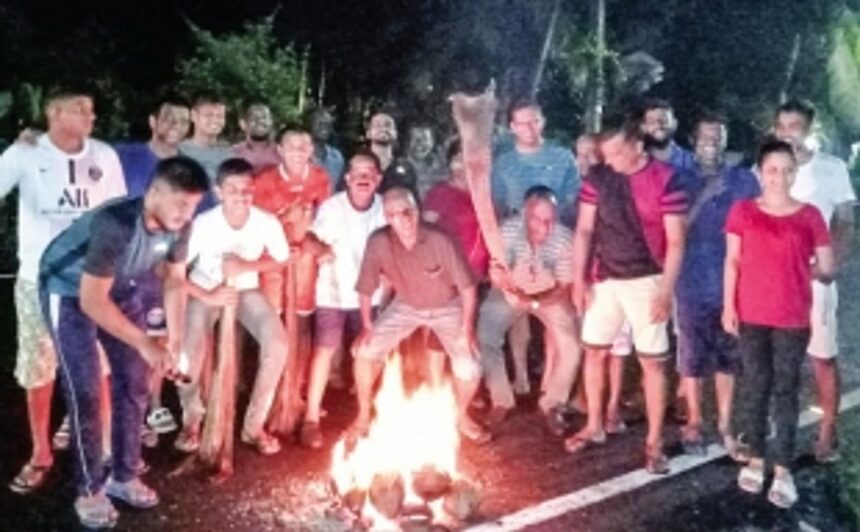
On Friday morning, June 23, the villagers of Chapora and Siolim will be busy collecting ‘pirdde’ – stalks of coconut frond. It is a vital part of a traditional festival of Judev, which is celebrated on the eve of Sao Joao. There are no elaborate costumes or floats but there is a bonfire that is lit in every house that has to be put off using only ‘pirdde’.
A tradition started by the forefathers that is still followed religiously by the residents of Chapora, Judev is an effigy that has to be carried from house to house. The young boys are busy searching for old clothes, hay, newspapers and even adding a few firecrackers to make the ultimate Judev. This effifgy is the masterpiece for the evening. After sunset, the villagers of all age groups gather at the Holy Cross Chapel in Chapora. After reciting a prayer, they head to the first house to light the bonfire, circle around it while chanting the words, ‘Sao Joao Sangodd, Kurpecho Duvor, Judevacho Gobor’ and put the fire off by hitting the ‘pirdde’ on the fire. “We all look forward to this celebration in the village. We keep hay or newspapers or dried wood ready for the boys and men who come to light the bonfire. Only the men can light and put off the fire. After the third chant, they shout ‘boddoi, boddoi’, which is real fun. They are then served snacks and wine,” says Jovita D’Souza, a resident of Chapora.
Joe D’Souza, 58, reminisces his childhood days of celebrating Judev. “We have grown up following Judev and the traditions have changed too. Earlier, we were served biscuits and Chivda and a drink in a ‘cotti’, a coconut shell. It used to be very difficult to light a fire in the pouring rain but we used a lot of petrol as it was compulsory to light a bonfire in every house. Now, it is only wine that is served by the families. The night ends with the burning of the effigy by creating a ‘Xim’ using the wine for demarcation of a line. The group is divided among those living in Mounem Vaddo and Chapora Boys. Once the line is drawn, they can’t cross over. The effigy is burnt in the center of the line and we sing songs till the fire goes off,” says Joe.
He further adds, “The next day is Sao Joao where we play the ghumott, kasalem and trumpet as we celebrate the feast by visiting each house. Earlier, we used to dress like different characters like in a drama and look forward to meeting at the Chapora jetty to head to Siolim for the boat parade.”
Chapora also represents an important part of the Sao Joao celebrations in Siolim. The villagers decorate two boats that flow down the river to head to St Anthony Church, Siolim, for the festivities. “This is a very old tradition where the boat would cross through Chapora, Zor, Badem, Guddem-Siolim and reach the Church. We compose heart-touching songs which has won competitions at the Sao Joao in Siolim. We are always the last to arrive and this year, nearly 42 members will board both the boats,” says Felix D’Souza, also a resident of Chapora.
In Siolim, Judev is celebrated in a few wards and is a little different from the one celebrated in Chapora. There is no effigy of Judev that is carried around but the villagers follow the same tradition of going house to house and lighting a bonfire. Judev is celebrated in D’Cruz Vaddo, Noronha Vaddo, Bamon Vaddo, Pereira Vaddo and Fernandes Vaddo. Besides Judev, Siolim is excited to host Sao Joao, one of the biggest monsoon festivals of the year.
Anthony Fernandes, a resident of Noronha Vaddo, says that according to legend, Judev represents the people who were against St John the Baptist and eventually led to his execution by beheading. “Judev is a community celebration as members of every house joins in the celebration. We start at 8 pm from the Noronha Vaddo heading towards D’Cruz Vaddo, covering a total of 30 houses. We pass through Our Lady of Seven Sorrows Chapel on the way where we solemnly say a few prayers before heading to the remaining houses. We only light the fire, say the words, ‘Sao Joao Sangodd, Kurpecho Duvor, Judevacho Gobor’ and put the fire off. Once we complete all the houses, we have a community meal at the last place with a night of songs and music,” says Anthony.
Gilbert D’Souza, a resident of Fernandes Vaddo in Siolim has been celebrating Judev since his childhood. The true colours of the season shine through the festival of Sao Joao in the village as the residents of Fernandes Vaddo and Pereira Vaddo gather at the St John the Baptist Chapel in Fernandes Vaddo and then head to all the houses. “There are nearly 60 houses in both the wards and it is quite a distance to cover all the houses. We light the bonfire in each house, chant the words, ‘Sao Joao Sangodd, Kurpecho Duvor, Judevacho Gobor’ three times and then put off the fire with the ‘pirddo’. But the energy is the same from the first house onwards till we end the day. Families offer us snacks and bottles of liquor, which is used for the Sao Joao celebrations the next day,” says Gilbert.
The next day, the feast of Sao Joao, the wards are all in celebratory mood as they gather at the St John the Baptist Chapel and celebrate the feast along with residents of Bamon Vaddo in Siolim. “The feast unites Catholics and Hindus as they also play the ghumots as we perform the ‘Ghodde’ dance by wearing coconut leaves, ‘chuddtio’. This year, the water level is low but we will be jumping in a few wells to celebrate the festival,” adds Gilbert.