Impossible is nothing, Prasun Sonwalkar proved it. His triumph over diabetes is a profound journey of self-discovery, achieved through the power of running. This victory signifies a personal accomplishment for him and also serves as an inspiration for everyone. The son of Goa, he went to Ajuda Convent, Ribandar; People’s High School, Panjim and Dhempe College of Arts and Science, Miramar. His father, Prabhakar Sonwalkar was a music producer in All India Radio, and wrote a book in Hindi on Goa titled ‘Goa: Dil Ka Tukda.’
“You need a trigger to make a major change.” During a routine appointment with his doctor in London in June 2016, Prasun received life-altering news. Having been diagnosed with pre-diabetes back in 2012, he hasn’t taken it seriously for years as it hadn’t affected him noticeably. However, during this particular visit, his doctor delivered a revelation: his HbA1c reading was alarmingly high at 10.9. It was a moment that jolted him into reality. The mere mention of the word ‘insulin’ and the prospect of daily injections sparked a sense of urgency and concern. It served as a red flag, indicating the critical need to take his health seriously and make lifestyle changes to avoid the necessity of insulin therapy.
He knows that central to any effort to deal with Type 2 diabetes is losing weight by regular exercises and changing food habits. The change began the same day with baby steps: for the first time in decades, he walked briskly for an hour and set himself the target of returning home every day drenched in sweat, even when London is quite cold in winters.
“After some weeks of brisk walking, I wondered if it might be possible to jog slowly for about 100 meters, from this house in the lane to that – how bad could it be? It turned out to be so painful in the calves and the right ankle that it needed a visit to a podiatrist and change of shoes,” says Prasun.
As the days passed, Prasun was on a journey to improve his fitness. He started by incrementally increasing the distance and duration of his slow jogs, progressing from one landmark to another—a set of traffic lights, a gate, a parked car—to gradually build his endurance. Despite experiencing discomfort in his legs and quads, he persisted, managing to sustain a slow jog for a continuous five minutes during his walking hour. Over time, this dedication led to progress, with his jogging sessions extending to 10, 15, and eventually 30 minutes within the hour. His efforts were tangible, as evidenced by his phone app registering a total of eight kilometres covered during one session.
Despite any initial awkwardness, Prasun found solace and joy in the world of running. Although the early days were marked by pain and discomfort, he persevered, and with time, the discomfort went down. This journey underscored a crucial lesson for him: the adaptability of the human body surpasses one’s expectations; he understood the intricate interplay between physical endurance and mental fortitude.
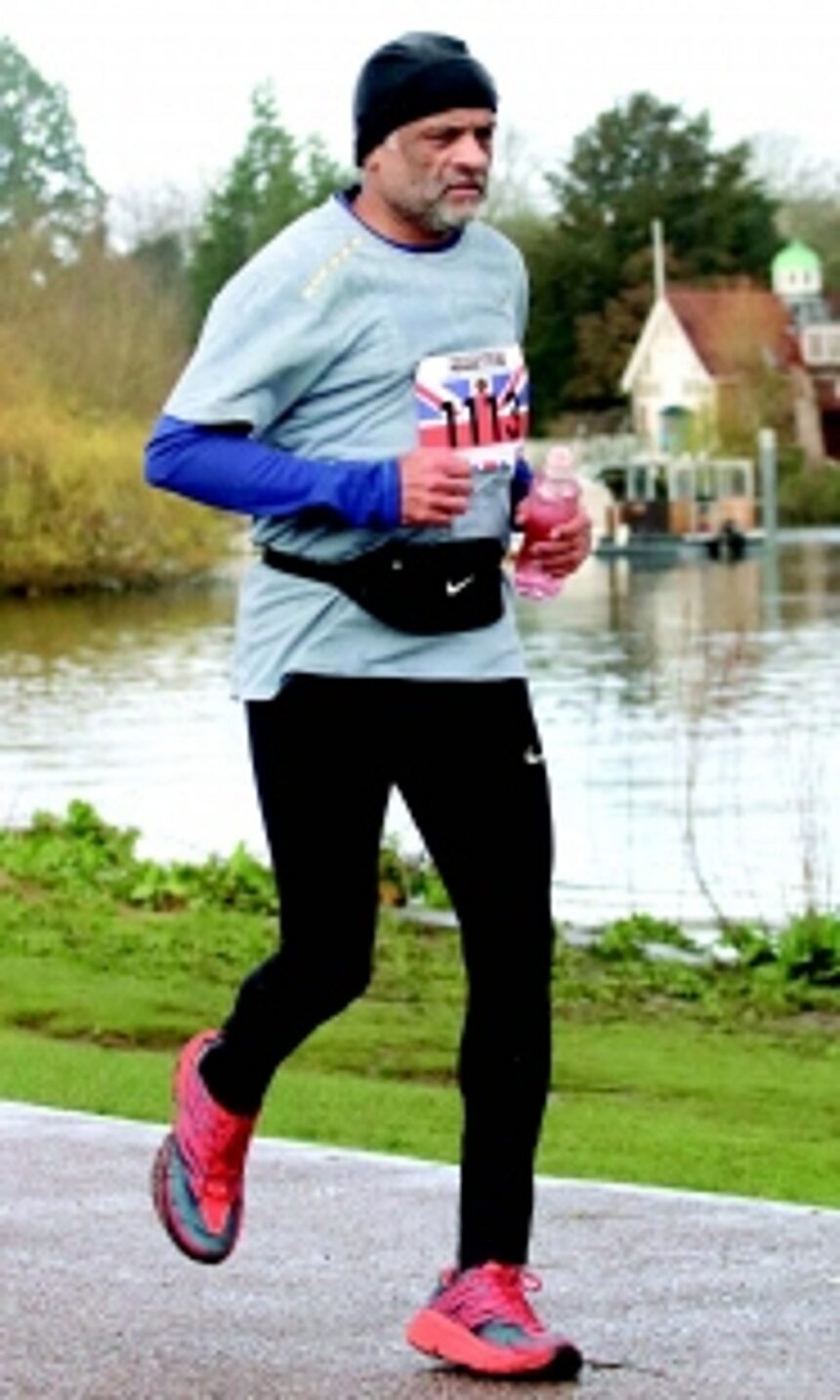
“By 2018, I was doing more than 9 kilometres per hour daily, immensely enjoying the daily runs along sylvan spaces along the Thames, when one evening on a wild impulse while surfing the net, I registered for my first half-marathon (21 kilometres) in Windsor.” That was the beginning of his passion for running. Now he had already ran 10 full marathons (42 kilometres each), and usually run half-marathons on weekends and been off medication for the last four years.
He reminisces about the first marathon that standing at the starting line, the realization of the task hit as older, fitter participants surrounded him. Eager to match the pace for the 21 kilometres challenge, he pushed through the initial 5 kilometres, only to crash and stop, understanding the magnitude of the task. Encouragements from experienced runners sustained his attempts to jog-run-stop until exhaustion set in at 15 kilometres. Struggling to take another step, a fit elderly lady, empathetic to his plight, sternly yelled, “Keep going, Keep Going.” Her voice echoed his high school English teacher, Laura Pinto. Drawing on unknown reserves, the frozen legs propelled him to finish the half-marathon in 2 hours and 9 minutes, a sign of the inner strength.
Transitioning from brisk walking to daily runs of 10 to 15 kilometres, coupled with dietary modifications, has significantly impacted Prasun’s management of diabetes. He has been medication-free for four years, yet he remains cautious, understanding that ceasing his running routine could potentially lead to a resurgence of the condition. Rather than claiming reversal, he opt to acknowledge the ongoing presence of diabetes, motivating him to sustain his newfound lifestyle. Diabetes, he asserts, is fundamentally linked to lifestyle, necessitating a shift to combat it effectively. Recognizing the consequences of complacency, he emphasizes on the proactive lifestyle changes.
“The baby steps eventually added up. From the ‘very high’ HbA1c reading in June 2016, it dropped to ‘excellent’ in mid-2017 and remained there since, and the latest ones placed me in the ‘normal’, non-diabetic zone. My GP is rather pleased. Much has changed since the 2012 diagnosis, but the larger challenge is to sustain the running routine in the future.” He confidently mentions that running not only tackled diabetes but also enhanced overall health and altered his relationship with food. Despite the initial adjustment period, his body has adapted, evident in his weight loss from 93 kilograms at pre-diagnosis to 74 kilograms presently. Through disciplined running and mindful eating, he has reshaped his approach to health and well-being.
He advices “If you’re aiming for a healthier lifestyle or tackling diabetes, assuming you have no major complications, begin with daily brisk walking until you break a sweat. Gradually transition into slow jogging over short distances and assess how your body responds. Despite the warnings from friends and family regarding potential knee issues, after nearly six years of regular running, my knees remain in excellent condition. In fact, recent Western research suggests that moderate running can help prevent knee damage. Don’t let such cautionary advice discourage your pursuit of a healthier lifestyle and the goal of keeping medicines at bay. Remember, it’s crucial to tailor the exercise routine to your body’s capabilities and consult professionals for personalized guidance, ensuring a sustainable and effective approach to improved health.”
“A full marathon of 42km is a serious challenge and perhaps one of the best examples of the mind-over-body principle. The real test happens after about the first 25 kilometres, when energy reserves begin to dry up and pain takes over. By 30 kilometres you are in a different zone, beyond the pain barrier, with the mind trying best to ignore body pain and focusing on the finish line. Around 35 kilometres at every marathon I have vowed not to do another one, but the marathon’s magic is that as soon as you cross the finish line you are planning the next one!”