Food is a language of love. If it isn’t, then what else should it be?
The diversity of Indian culture lays in the foundation for diverse Indian
cuisines. Be that some mouth-watering chaat from our favourite chaat point to
our Maa ke haath ka khana (meals made by mom), or the spicy Dhaabe wala khana.
Food is not just a fuel for our bodies, it indeed is an emotion.
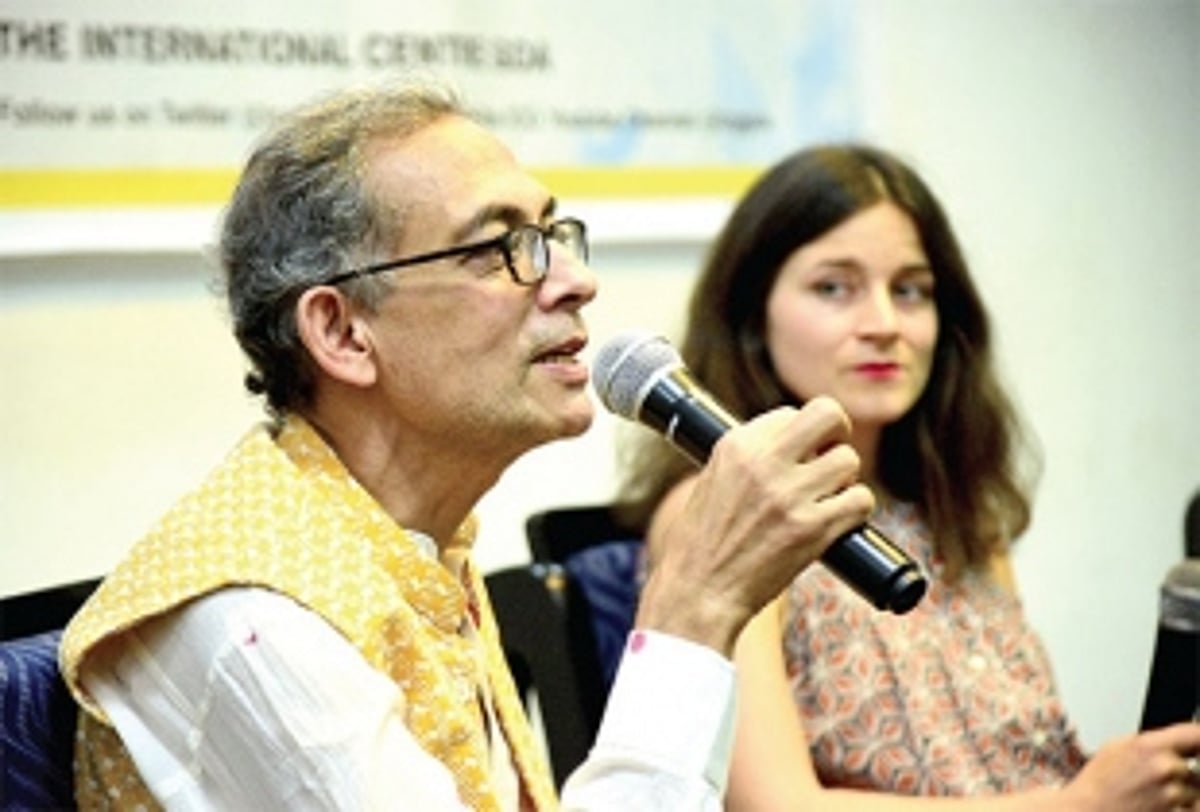
Being a Bengali-Maharashtrian, Abhijeet
Banerjee is one such example who stands for ‘Complex problems can be solved
with food, and over food. He launched his cookbook ‘Cooking to Save your life’,
with illustrations by Cheyenne Olivier at the GALF2023 (Goa Arts and Literary
Festival), held on 20th January at the ICG (International Centre Goa). The
delegate, economist, and a Ford Foundation International Professor of Economics
at Massachusetts Institute of Technology has previously been rewarded with
Nobel Prize in Economics (the Sveriges
Riksbank Prize in Economic Sciences) for his contribution to the development of
an innovative experimental approach to alleviating global poverty, along with
his fellow researchers Esther Duflo and Michael Kremer in 2019.
Indian food is one of the most flavourful, and nutritionally
balanced, and has a huge fan base in multiple countries. The reason behind this
lies in the spices, and the slow cooked, and well-seasoned vegetables, which
are paired with flatbreads or rice and sometimes accompanied with daal
(lentils), and even complimented with raita/salad. The basic meal is hence
properly nutritionally balanced. One of his favourites includes the classic
Maharashtrian ‘Ambat Varan’, and ‘Jowar Bhakri’, which he finds comforting,
especially when his mother makes it.
Opening about his Goa memories, he dates back to the year 2010,
when he wrote Poor Economics in August. According to him, “People can easily
learn and master cooking from a cookbook. It’s all about learning, and
innovating as you progress, and grasp the basics.” Banerjee narrated the story
behind the ‘COOKING TO SAVE YOUR LIFE’, and how it eventually turned into a
cookbook. He talked about his wife, Esther, and how her family, especially his
brother-in-law is fond of Abhijeet’s cooking. Abhijeet used to put down recipes
for every Christmas, which slowly gave him the idea, to put the recipes, and a
few of his experiences together, in the form of a cookbook. Cheyenne Oliver,
according to Banerjee was an au pair for his family for three years. Within a
year, she became pretty accomplished with cooking, including Indian food, as
she used to observe the family while they made raw preparations while cooking.
Now, they cook together, while they make around four courses for a typical meal
on weekdays. He describes this meal as a salad-y vegetable like koshimbir, or
chaat including vegetables or sometimes fruits, daal (lentils), or some protein
in the form of paneer, fish, or even meat.
Cheyenne being a vegetarian, had to face struggles growing up
for the same, as she grew up in Basque Country, where the meat had to be
prominent for the dish, which according to her was extremely radical. But now
she also does eat fish occasionally. Cheyenne describes Abhijeet as “He’s
pretty much of a planned cook, but sometimes it’s just something flew at the
last moment “when it comes to him planning his meals for a day, or prior.
Throwing us back to his childhood days, he expresses his parents as social and
popular, which made their household filled with guests, and getting used to
cooking together as a group. That also leads him to his analysis of men and
women having different approaches when it comes to cooking as well as cleaning
the kitchen. The Laureate said, “Men usually prefer making meat-related dishes,
where they would sometimes, just sauté, or stir the already made, or partly
made dish by the woman. But women, they’ll be preparing the other three courses
of the meal, and even cleaning the kitchen later on.” He later emphasized how
the constituents of dinner or a meal should be- Memorable but less expensive;
“The key ingredients of a meal should be affordable so that the meal can be
enjoyed by a comparatively larger group of people. That’s sustainable
affordability for me when it comes to food”, he added.
The author of the cookbook, is also a tea person, “I’m not a big
fan of hot milk, so I don’t like milk in my tea, or coffee. I’d always prefer
black tea, green tea, or any kind of tea. I grew up having tea the same way
since my childhood.” He also passionately talked about different fishes,
cooking them while adding them to a Bengali ‘Saag’, and the creativity of
different experimental flavours with different fishes.
While addressing his cookbook, he also talked about the
Minnesota Experiment, to regulate a pattern of eating due to restriction and
extreme dieting impacts an individual’s physical, social, behavioural, and
psychological well-being, which brings in the importance of a healthy mind, as
we ingest healthy food. Thus, also highlighting the importance of physical
exercise.
The event also covered the trends in food, prominently organic
food, and #Govegan. According to Abhijeet, “Ingesting such chemicals, is cruel”
he says. “Organic food is produced in small amounts, hence adding and spraying
those chemicals, yields a good harvest. Hence organic vegetables and fruits are
expensive.” Meat is a crucial source of protein in our diet, “I don’t really
have an opinion when it comes to vegan food. I feel it’s more of a choice than
to be someone’s opinion”.
The
professor also addressed other economical aspects, while he answered a few
questions from the audience.