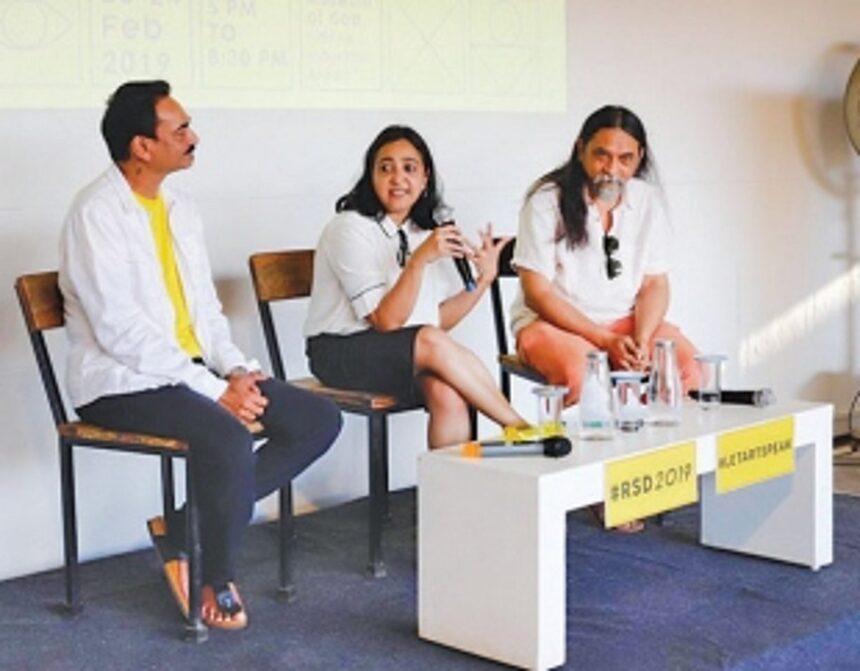
The first edition of Raza- Souza Dialogues, which was held at Museum of Goa (MOG), Pilerne recently, was
conceived to be an ideational exchange between eminent artists and scholars of
diverse disciplines. It held panel discussions between seemingly disparate
arenas of art and expertise, including contemporary visual art, literature and
performance art, among others. The Dialogues were opened by a formal
introduction by Dr Subodh Kerkar, Director- Museum of Goa, who welcomed the
audience and introduced the audience to the Curator of the Dialogues, Sabitha
Satchi.
The first dialogue, on Art and Design, moderated by the curator
herself, was headlined by the presence of fashion designer Wendell Rodricks and
graphic artist Orijit Sen. The conversation touched upon textile history,
supporting local craftsperson and indigenous traditions as well as working with
art and design collectives. Orijit’s work as a graphic artist and graphic
novelist, and Wendell’s writings, where art, design and writing intersect, were
also part of the discussion. Wendell spoke about his new venture, the Moda Goa
Museum and Orijit about his work being political and the various issues he
faces due to that. The student community present got to see the Mapusa Market
project of Orijit and were fascinated by the intricacies of the installation.
The second dialogue between Suresh Jayaram, an artist, art
historian and arts administrator, and Arundhati Ghosh, Executive Director –
India Foundation for the Arts, was moderated by Subodh Kerkar. The session on
Art Institutions came to life with a two-minute video presented by Suresh
Jayaram on 1.Shanthiroad. Being also the Founder, he had lots of stories to
share on the 12 years of his life at Shanthiroad. Arundhati spoke of her
journey from management institutes to starting at the IFA as a fund-raiser,
while adding with a bit of humour about being careful while around her, as she
manages to raise funds from almost everyone she meets. A conversation on India
Foundation for the Arts as a patron for arts and ideas and 1 Shantiroad as a
supporter of art projects and creator of archives followed later. Subodh, as
moderator, implied on the importance of art institutions that support experimental
work, community outreach and mentoring as well as the significance of
artist-driven contemporary arts-institutions.
Day two of the symposium started with Vishram Gupte moderating a
session between celebrated Konkani writer Damodar Mauzo and Marathi poet and
publisher Hemant Divate. Vishram, being familiar with both of the artists,
engaged the audience with a crisp dialogue on writing and regional languages.
The conversation touched upon the various aspects and of the relationship
between Marathi and Konkani literature. Bhai Mauzo, as he is fondly known,
connected his life as a shopkeeper and its limitations to why he writes in the
short fiction format. Hemant Divate talked of his role as a major publisher of
poetry in English and how he is managing to run the business with profit.
Vishram took the discussion to the importance of writing and publishing in
bhasha languages and the politics of bhasha literature. The dialogue was
concluded with a Q&A.
The Final Dialogue of the series was the much anticipated
discussion between the winner of DSC Prize for South Asian Literature Jeet
Thayil and the curator of the series Sabitha Satchi. Sabitha briefed the
audience of how and why the series was aptly titled Raza-Souza Dialogues,
keeping in mind the participation of Jeet and his work on the eminent artist
Souza for The Book of Chocolate Saints, his latest work. Jeet, taking the
conversation forward, introduced the audience to the life and the persona’s of
both F N Souza and S H Raza, vividly describing his experience with both while
interviewing them at length at various stages of his career. The dialogue then
moved to how Sabitha and Jeet have illustrious personalities as their fathers,
the acclaimed journalist T J S George and award winning poet K Satchidanandan
and their relationship. Sabitha interestingly mentioned about a poem she wrote
titled ‘My Father – Shade and Shadow’, which encompassed the views of the
panellist towards the topic.
While
moving on, Jeet enthralled the audience by reading the first sentence from his
book ‘Narcopolis’, which alone runs six pages. Later, Sabitha also presented an
AV clip from her collaborative project- ‘Insurrections Ensemble’ to which she
contributes through poetry and lyrics. The session well moderated by Sabitha
was truly the highlight of the series where-in the audience were captured with
the persona of Jeet while delving into the layers of both of their work as
artists in contemporary times.