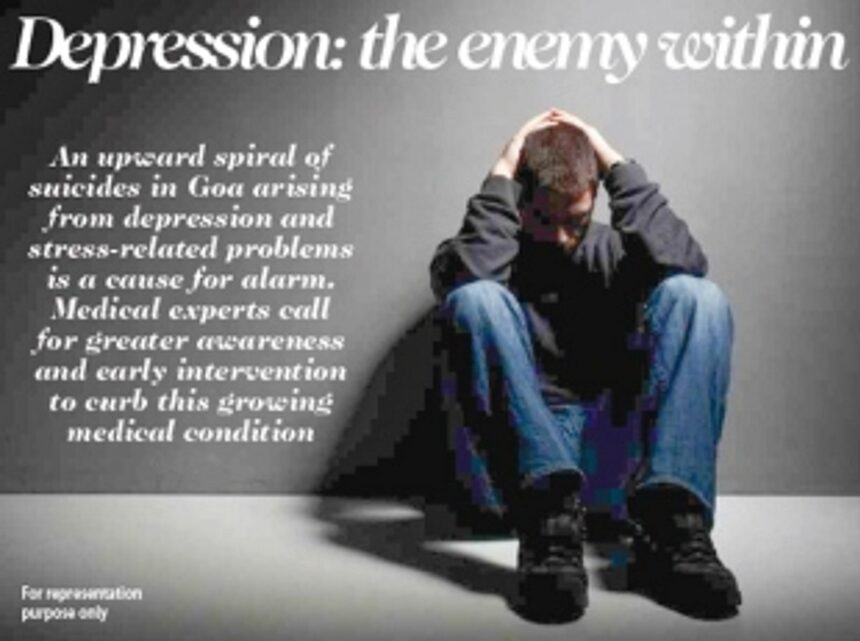
Suffering from depression and its crippling effects, Deepika Padukone recently went
public with her illness. Her primary aim, she explained, was to create awareness
and encourage early intervention. She has perhaps opened the doors to an illness
that is threatening to consume India. Goa is no stranger to this illness either, indicating
an upward spiral of suicides arising from depression and stress-related problems.
In fact, in a recent incident, the suicide of a prominent and popular restaurateur left
the state benumbed. It’s a malady that begs to be addressed urgently. “Depression will
account for 5.7% of the disease burden by 2020. Goa does have a higher rate of suicides
as compared to most other states,” affirms
Dr Peter Castelino, consultant psychiatrist,
President of Goa Psychiatric Society and
Director of COOJ Mental Health Foundation.
Describing depression as a disorder of
the mood and an incapacitating medical
condition Dr Castelino points out that it
differs from normal sadness, engulfing
one’s day-to-day life and interfering with
one’s ability to function normally. “It’s a
triad of intense helplessness, hopelessness
and worthlessness,” he explains while
indicating that depression can be caused by a
combination of biological, psychological and
social factors, with onset at any age. “Some
people have a pre-disposition to depression;
others do not have the resilience to deal
with the stresses of life. Biologically, it could
be an imbalance of the neuro-chemicals
in our brain. When the levels of a chemical,
serotonin, go down, depression sets in. Here
medication can help to restore its balance,”
he explains.
Seeking early intervention is the key to
recovery. “Early detection is very important
as that aids early intervention and recovery,”
maintains Dr Castelino. “The lacunae lies in
the fact that most people are either not aware
that they suffer from depression and if they
do, they are reluctant to seek help. But there
is no shame in it. It’s like any other illness.
People are perhaps unaware that many
chronic pain disorders/alcoholism can be a
manifestation of underlying depression.”
Stressing the need for parents to
teach their children how to handle
disappointment, anger, frustration and
other difficult feelings, Dr Nandita DeSouza,
Director, Sethu, says, “Stress and frustration
are part of life and things will not always
go our way, but our attitude comes with
experience and practice and this must start
in childhood. Children need time and space
to process difficult feelings and we have
to listen fully and show empathy. Finding
safe ways to express anger, sadness or
frustration is vital.”
As patients walk the turbulent path
battling depression, increased awareness,
early detection and medical help are the rays
of hope that make life worth living!