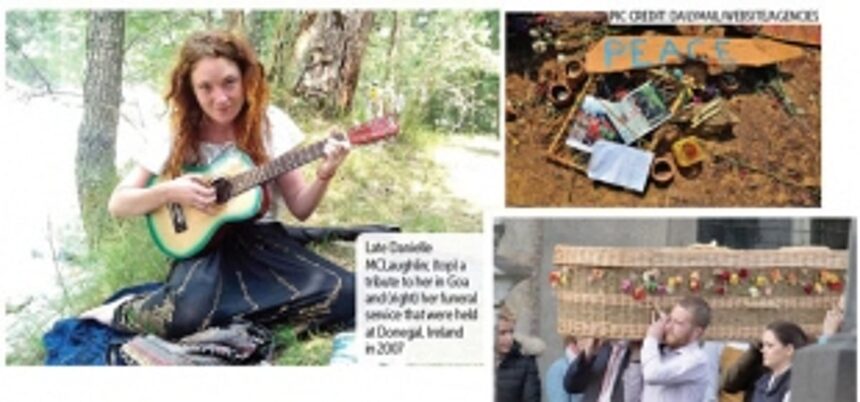
“She was just 28 that time and had the entire life to explore and experience”– Andrea Brannigan, mother of Daniel McLaughlin to Herald, from Ireland
Fear is the Key. In the four coastal police stations that have see the maximum number of deaths
of foreigners, 245 from 2005 to 2015, life still does go on. Short term and
seasonal holiday makers arrive, men and women, often single parents moving with
their children to live here; many move out of big cities to live and work
remotely giving a new profile of people across Assagao, Uccasaim. They meet,
attend functions together, eat out, go for walks, their children have play
dates in an adopted land that is their solace and refuge. Quite clearly, fear
should not be the key and yet if you scratch the layer of this very fine fabric
of peace and harmony, fear lurks.
In a discussion held at 6 Assagao on the uneasy link between
deaths of foreigners in Goa and the safety perception of the state, this
underlying unease emerged. The discussion was based and inspired by one of the
stories Café did last week on locals as well as foreigners. And some of the
voices that emerged underlined this unease. Vijay Jhangiani, who moved from
Bombay and helps those he knows locate and buy villas and other pieces of real
estate, says, “The beaches don’t feel as safe. When my wife walks in the North
Goa batches, she feels hemmed in with groups of males converging. This raises
anxiety.”
Noted human rights lawyer Advocate Caroline Colaco spoke at
length about tardy police investigations, botching up of evidence on the scene
of crime, the lack of forensic support and delays of up to a year to get
samples tested.
It is not just deaths of foreigners but a changing environment
of hostility that is threatening the safety fabric. Many of those in the
discussion live in the villages of Siolim, Parra, Assagao and Anjuna. There was
a great deal of resonance when the discussion turned to the how Nigerians, many
of whom are involved in drug related cases, have started living in the village,
renting homes.
Aljai Singh from Siolim raised some very practical points. She
said she felt “scared and helpless and didn’t know where to go if she came
across shocking incidents. “A young girl was found dead in Siolim recently and
we didn’t know what to do to get the police to speed up the case and
investigate. The media didn’t bother either.” She stressed on the need to come
up with a collective, a forum or at least find a way out for people like her to
be a part of a collective that unitedly takes up issues like violence and
threatening of peace and safety of locals as well as foreigners.
Raksha Kumari, who lived in Spain and now lives in Baga in Goa,
mentioned that the Spanish coastline in Andalucía has similar problem. But
Andalucía overcame this fear through a series of simple but effective measures
such as:
– Every town hall has a Citizens’ Advice Bureau, for residents
and visitors
– A Complaints’ Bureau for citizens
– Easy, smooth information-filled and interactive websites
– Consistent awareness campaigns geared to educating the masses
on Safety
Many
lives have indeed been lost, many live snatched of mostly young foreigners.
That doesn’t mean Goa is unsafe, but we must take into account pockets of
unsafe areas and loom at better policing and investigating.
Good news first: Amendment to Victim’s Charter of
Ireland to be called Danielle’s Amendment
An amendment to a charter to give greater rights to Irish nationals victimised
abroad and relatives of those who die or get killed abroad is on its way to
being named after Danielle McLaughlin, the Irish woman who was killed in the
Canacona taluka, not far from the Palolem beach, on March 13, 2017, two years ago.
The Irish Department of Foreign Affairs and Trade have submitted
a proposal to the Department of Justice and Equality with regard to amending
the Victims Charter. ‘The Department of Justice have agreed to this and the
amendment will be called Danielle’s amendment,’ her mother Andrea Brannigan
announced in a Facebook post. She wrote: “The update we have got today that has
gotten us so emotional and excited to see the outcome is: The Department of
Foreign Affairs and Trade have submitted a proposal to the Department of
Justice and Equality with regard to amending the Victims Charter.”
Andrea Brannigan said that they finally had one piece of good
news that could help other families in the future. Danielle McLaughlin’s mother
received a personal apology from the Government last year after meeting with
the Taoiseach over the murder and rape of her daughter in India.
“As a lot of you know this week marks the second year
anniversary of Danielle’s cruel passing, it has also been six months since our
meeting with Leo Varadkar (Prime Minister),” Brannigan wrote.
She
spoke to Herald, two days ago. In a telephonic conversation from Ireland, she
informed that she has not come out of the shock of the untimely death of her
young daughter. “She was just 28 that time and had the entire life to explore
and experience,” she said, with sorrow in her voice.