With the immersion of Ganesh idols, the seven days of Ganesh Chaturthi festival came to a colourful end across the state with chants of Mangal Murti Morya and a call for Lord Ganesh to come back early, the next year. On the occasion of grand festival, the houses and Sarvajanik Ganesh Pandals, the community centers were beautifully decorated as the Aarti songs and Ghumots beats were heard all over the places and the flavours of specially made festival dishes were served to the God of Wisdom and devotees.
While most places had a festive atmosphere of festivity, few places people followed traditions that they have inherited from their ancestors. The present generations are following these traditions with religious fervour. The taluka of Sattari is one such region where culture and tradition are synonymous with uniqueness. Be it Gudi Padva, Holi or Ganesh Chaturthi, there is something to experience anew.
The fifth day of Chovth, for the people of Velus, the morning turned out to be a day to revere and rejoice in the natural bounty amidst a festive mood. The colours of Navvari saree-clad women congregated on either side along the bank of Kotrachi River, a tributary of Mhadei River turning it into a spectacular sight, a kilometer away from the north-eastern town of Valpoi.
Amongst them was a young school teacher, Visharad Rohidas Veluzkar, who was one of the people carrying the family ritual, Gauri Pooja also known as Devichi Pooja on that day. This ritual is normally performed only by a married woman (Suvashin) unless there are some circumstances in the family that warrant it. On the occasion, the villagers adore elements of nature and water is the most precious of them all and Gauri’s Pooja is a tribute to nature.
Rajani Vishnu Khotadkar, a resident of Shirsoda, Sattari, in her sixties who celebrated Chaturthi with the family of her brother at Velus, gives a detailed description of Gauri Pooja, also locally called Chovthichi Devi. Rajani says, “There are several places in Sattari where Devi’s Pooja is performed. It is like worshipping the River Ganga, which is sacred to us. Either a few houses or a whole village is involved in this unique customs.”
Some of the villages include Massodde, Savarshe, Barazan, where Devichi Pooja is followed by only a few houses whereas whole villagers of Assode, Koparde, Brahma Karmali, Shelpe and Surunguli perform this Pooja. Some villages perform the Pooja on the sixth day as in Thane. “Gauri Pooja is performed even if Chaturthi is celebrated just for one and a half day by the people,” she adds.
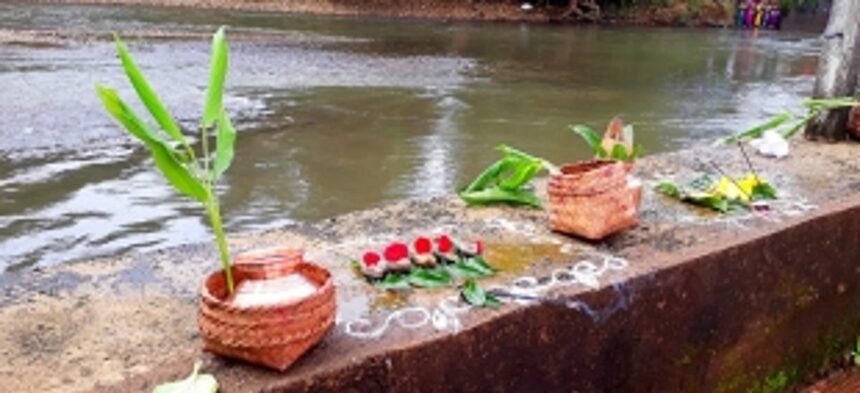
It is a day of fasting for the women for the well-being of their husbands and the family. Rajani further explains, “This ritual begins in the morning as women from both sides of the Kotrachi Nadi gather along the bank of the river. They carry a Dhali, small cane basket containing a copper pitcher (Kalash), flowers, gandh (sandal paste), pinjar (vermillion), haldi (turmeric) plant, betel nut and leaf (Khavche paan) and agarbatti.”
She says, “At the site where they perform the Pooja, cow dung paste is spread on the platform to purify the place. Five stones collected from the river are kept over mango plant leaves and Pooja is performed as similar to at home by lighting agarbatti.” The Dhali is marked with Swastik symbol that signifies luck and prosperity. Along with the Kalash, Dhali also contains coconut, two betel leaves, 1-5 Agado leaves, mango leaves, turmeric plant and a rupee coin.
Later, after exchanging greetings, all the women on both sides stand on the river bank holding the Kalash. One of the elders in the village (Gaunkar) announces to the women to collect the sacred water in the Kalash. Five times water is filled in the Kalash and after taking one sip of water, all the participants return to their residence. On their way, they have to strictly follow one aspect, they must not utter a single word till the time Gauri Kalash is installed in their house. Gauri is kept on the Chauranga (Paat), a flat wooden plank, next to which a lamp is lit (Divli).
Two types of Naiyvedya Prasad are offered to the deity, either only fruits as in Velus or varieties of festival dishes as followed by the villagers from Charavane, Dongurli, Golali, Thane, Hivre, Pall and Riven. Five types of fruits are offered to the deity placed on turmeric leaves which are later distributed to all, informs Rajani.
Well-known cultural expert Rajendra Kerkar explains, “Gauri Pooja is performed in different ways during Ganesh Chaturthi in Goa. Some communities celebrate it as Hartalika, Parvati Pooja a day before or on the first day of Ganesh festival. During the monsoon season, water flows from the mountain (Parvat) which also brings clay along with it. Gauri Pooja is basically Bhumi (earth worship) Pooja. Bringing Gauri home also signifies her visit to her husband’s place. Houshi, offerings that are prepared and fruits that are mostly grown during this season are given as Prasad.” Besides Goa, such practice of worship is also prevalent in the neighbouring states of Karnataka and Maharashtra, regions bordering Goa.
After offering Naiyvedya in the afternoon, Houshi or Houso made from fruits from Matoli and panchakhaj (sweetened grated coconut and jaggery) is offered on a turmeric leaf to all the houses in the area, Visharad notes.
“For me, going to the river was very exciting to accompany my mother to bring Gauri home when I was very young. And, one never knew how the day passed, full of activity from Gauri Pooja to the distribution of Houshi. But, my favourite moment will always remain, going back to the river for Gauri Visarjan (immersion) when everyone was offered Bhaji-Bhakri (chapati) as Prasad,” recounts Ritambara, Visharad’s sister. After the eventful fun-filled day, Gauri was immersed late in the evening in a family atmosphere by all.
Such festivals give an insight into one’s cultural past and associated legendary tales, which villagers of Velus are keeping alive for posterity in their old traditional ways.