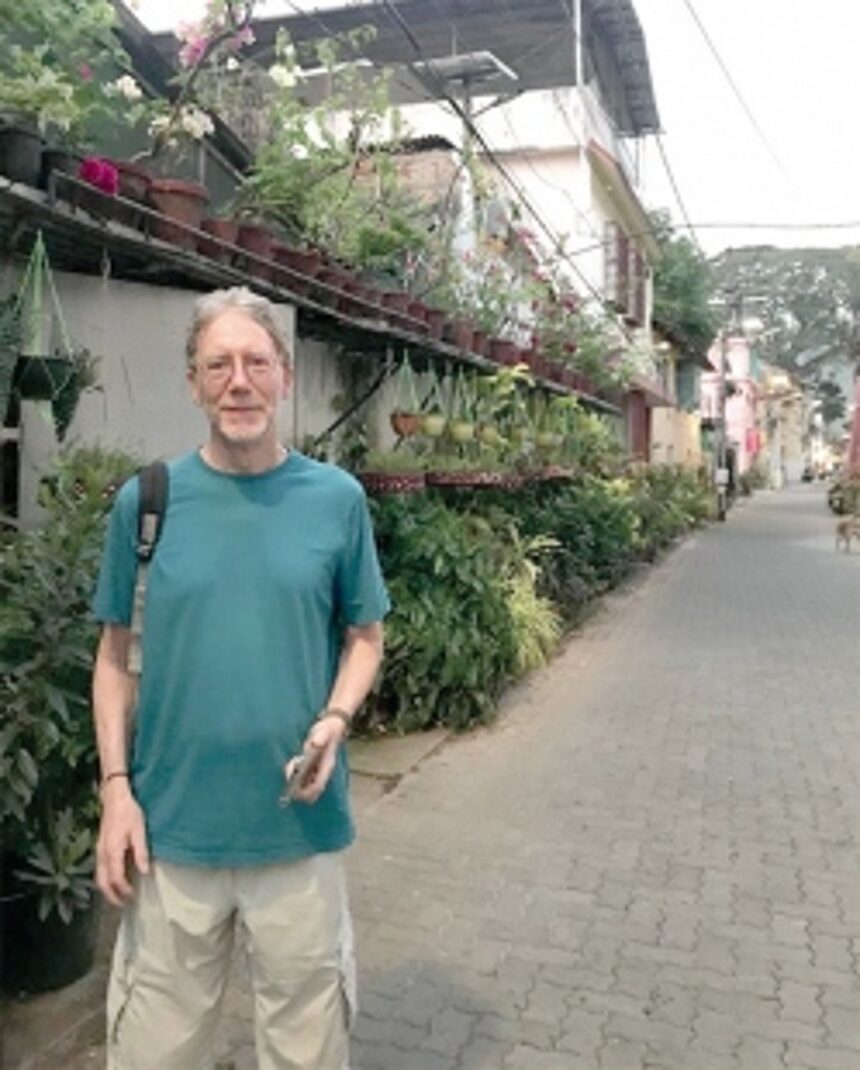
week. His love for Goa is evident, he has been coming to Goa since the time the
Candolim road was not tarred, and cows could roam easily on the roads. He still
stays considerable amount of time in Candolim, but he is planning to shift to
serene south Goa soon, from the now turned ‘Mini-Mumbai’ Candolim. Otherwise,
he lives in Highlands
of Scotland.
Recently, he
launched his book ‘Elvis in Kabul’ in Carpe Diem Art Gallery, Majorda. This
book is a thriller, a murder mystery that opened a can of worms. The
protagonist Gil Moncrief tried to unravel the murders in the city of intrigue
and multiple layers, Kabul, infested with corruption, kidnapping, ruthlessness
and heroin production. David weaved this intricate story from his own
experiences, from his interesting work in Afghanistan for decades, the work of
understanding the nether world of narcotics.
“People are
drawn to the use of drugs, including alcohol, for a wide range of reasons, some
simply for pleasure, others because of factors such as peer pressure and
problems related to poverty, boredom, relationships, etc,” says Donald Macdonald.
In 1999, he
was the Drug Demand Reduction specialist of United Nations International Drug
Control Program (UNDCP) in Afghanistan. There, he was managing, monitoring and
evaluating treatment, prevention and harm reduction programmes, working in deep
Afghanistan and in Afghan refugee communities
in Pakistan.
His CV is
impressive. From 2003, he has his own consultancy on international drugs and
development programs, providing technical advice, conducting project
assessment, evaluations, policy and strategy development in several countries –
Afghanistan, Egypt, Kyrgyzstan, Lebanon, Liberia, Maldives, Morocco,
Tajikistan, Thailand and Uganda. His work involves coordination and networking
with wide range of partners, be it Department for International Development
(DFID), United Nations Development Programme (UNDP), United Nations High
Commissioner for Refugees (UNHCR) and World Health Organization (WHO), as well
as international and local NGOs, other civic society groups and national
governments, in particular the ministries of Public Health and Counter
Narcotics.
Before his stint in Afghanistan and
Central Asia, he was holding teaching and research posts in sociology and
criminology at several universities, research institutes and prisons. He became
the co-director of the Scottish Drugs Training Project at Stirling University,
Scotland. He was also instrumental in managing an Action Research Project on
alcohol and other drug problems in Bushman communities in
the Kalahari.
He has
published many articles and reports in newspapers, magazines and journals
relating to his work including his first book ‘Drugs in Afghanistan: Opium,
Outlaws and Scorpion Tales’ (Pluto Press, 2007)’ and now this thriller, ‘Elvis
in Kabul’ (Book Guild 2021). In his first book, he dives deep into the
intricacies of poverty and instability that had led to an increase in drugs
consumption in Afghanistan and the recent rise in the use of pharmaceutical
drugs, and the subsequent effects of Afghanistan’s drug trade on neighbouring
countries. He mentions that his new book is a thriller version of the first
book, that is palatable for cross genres of readers, albeit with the same
intensity and sharpness.
He is rueful
that in Goa, the biggest drug is alcohol, ironically, that has gained the
social acceptance. “The effects of alcohol is far more than any other drugs.
Statistics shows that, it is not only harmful to individuals, but it eats up
the very construct of a family, a community,” he mentions. He knows, he’s from
Scotland, they are infamous for the highest per capita incidence of drug
related deaths
in Europe.
As a message
to Goans, he warns about alcohol, “It is so damaging that it destroys the basic
tenets of a community”, he hopes for Goans to take this issue seriously.
Presently, alcohol kills 2.6 lakh Indians every year, WHO reports.
“Goa should
develop a comprehensive and effective drug policy and strategy for both the
supply of and demand for drugs that includes government agencies and civil
society partners such as NGOs, community groups, churches, families and drug
users themselves,” he observes. It is a deep rooted issue, he says, “It should
be noted that there is no simple solution to the drug problem, no quick fix, it
is a complex and varied issue. For example, the US and the UK, still have
serious drug problems despite decades of spending considerable amounts on
seeking solutions.”