The feast of Our Lady of Mount Carmel, celebrated annually on July 16, holds profound significance for the Carmelite Order, emphasizing their deep spiritual connection to Mother Mary and their heritage.
In Goa, this feast is joyously observed across various Carmelite communities like the Carmelite Monastery in Margao, Divine Springs Retreat Centre/Our Lady of Fatima Chapel in Xellim, Carmelite Seminary in Mapusa, Emmaus Wellness Centre in Mapusa, and Cloistered Carmel Monastery in Chicalim. Additionally, Apostolic Carmel communities and the Carmelite Religious of Trivandrum (CCR) join in this heartfelt celebration. Many faithful in the Archdiocese of Goa and Daman hold a deep devotion to Our Lady of Mount Carmel and the Brown Scapular, with churches like the one in Arambol and chapels in Ponda, Telaulim, and Anvottem-Curtorim dedicated to her. Carmel College in Nuvem and schools in Arambol and Curtorim bear the name of Our Lady of Mount Carmel.
The origins of this feast date back to around 1386, commemorating the protection and blessings bestowed upon the Carmelites during challenging times, notably during the ecumenical council of 1274 when their existence was questioned.
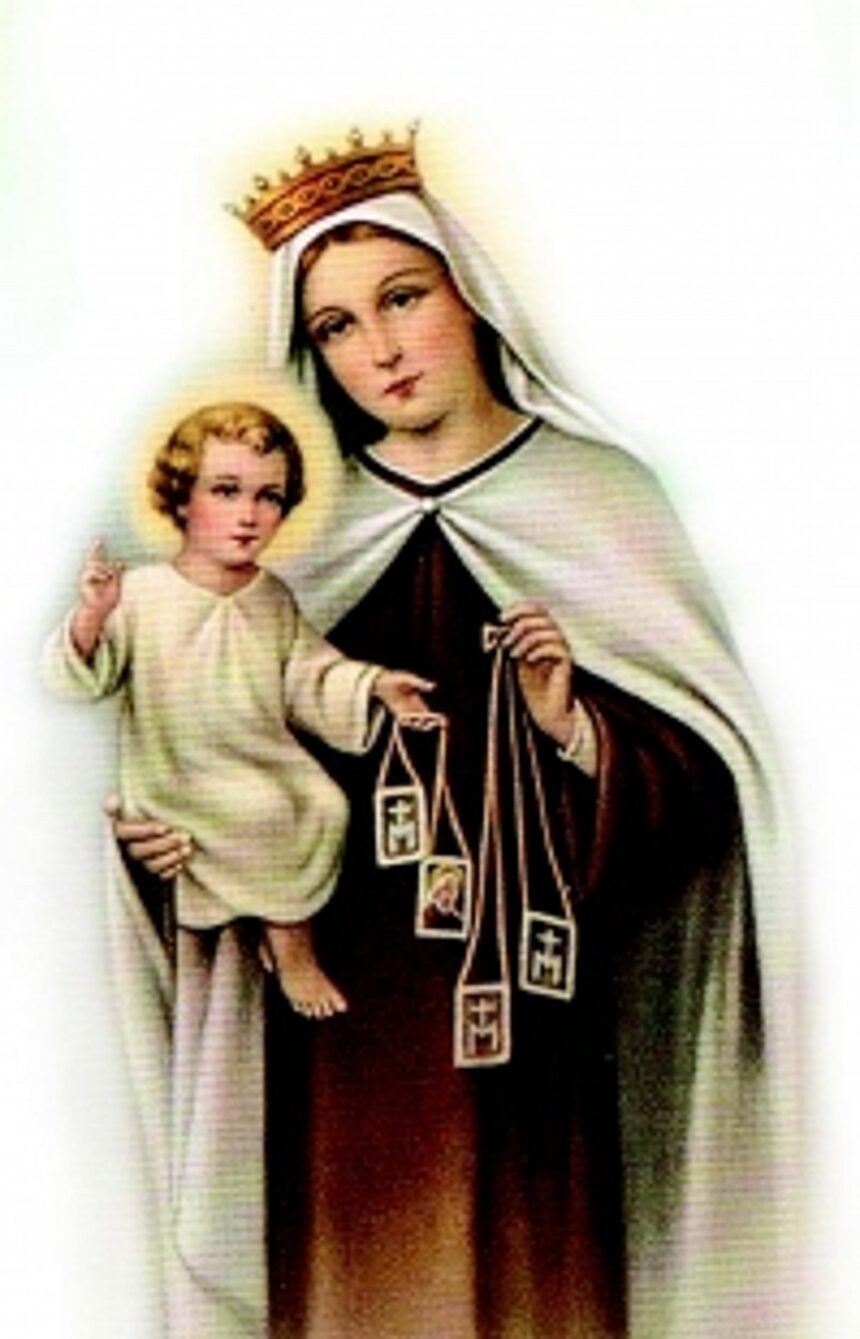
Central to Carmelite devotion is the Brown Scapular, symbolizing membership in the Carmelite family, consecration to Mary, and a commitment to embody her virtues. Traditionally, monks wear a lengthy scapular over their shoulders, chest, and neck during work hours, reminding them of the ‘sweet yoke’ of Christ and recalling Gospel teachings. Laypersons aspiring to join the Order wear a symbolic scapular instead of the full habit or long scapular.
The Scapular of the Carmelite Order typically bears an image of Our Lady of Mount Carmel on one side and the Order’s Coat of Arms on the other, featuring a mount with three stars for the Carmelites and a mount with a cross and three stars for the Discalced Carmelites. While religious men and women wear the long scapular, members of the Secular Order of Carmel wear a smaller one known as the ‘little habit.’
For all Carmelites, the scapular holds deep spiritual significance as a sacred Marian symbol. It is a sacramental, not a sacrament, instituted by the Church as a sign of devotion and a plea for grace.
The Brown Scapular serves as:
• A constant reminder of God’s love through the Most Holy Trinity, Jesus the Word Incarnate, the Church, and our Mother Mary.
• A gentle push to turn to Mary to experience and reciprocate God’s boundless love, emulating her theological and moral virtues, and promoting devotion to her.
• A promise of privileges bestowed by the Virgin’s presence, guiding believers in daily life to avoid harm, engage in spiritual and corporal acts of mercy, and offer peace and intercession.
Popes and church documents have consistently endorsed the use of the Carmelite scapular, paralleling their endorsement of the rosary. Pius XII explained that wearing the scapular is akin to adopting the spirit of a 13th-century knight who found courage and assurance in battle under the gaze of his lady. Pope St John Paul II, in his message to the Carmelite Family in 2001 marking the 750th anniversary of the scapular’s bestowal, concluded with these words: “I have also worn the scapular of Carmel close to my heart for many years!”
The Scapular of Carmel is revered as the ‘Armour of God,’ symbolizing spiritual protection and Mary’s maternal care for those who wear it devoutly. Throughout history, saints and blessed members of the Carmelite family, such as St. Teresa of Avila, St Thérèse of Lisieux, and St Teresa Benedicta of the Cross, cherished the Brown Scapular as a tangible sign of their devotion to Mary. Their writings and experiences reflect deep spiritual connections to Our Lady of Mount Carmel, embodying virtues of faith, humility, and prayerfulness.
Blessed Isidore Bakanja (1885-1909), a humble labourer from Congo, exemplified this devotion. Baptized by the Trappist Fathers of Belgium, he received a Scapular of Mount Carmel and a Rosary. Isidore courageously taught his faith, even when pressured by an atheist Belgian official named Van Cauter to renounce his beliefs and remove the Scapular. Refusing to compromise, Isidore endured martyrdom, forgiving his persecutor and praying for him at the moment of his death. His steadfast devotion earned him the title of Blessed by Pope John Paul II in 1994, a testament to his commitment to the Rosary and the Scapular of the Virgin of Carmel.
While the scapular is not a magical charm or guarantee of salvation, it symbolizes a conscious choice to follow Jesus through Mary, fostering a deeper relationship with God in daily life.
In essence, devotion to Our Lady of Mount Carmel and the Brown Scapular is a cherished tradition in the Church, inviting believers to emulate Mary’s virtues and draw closer to Jesus Christ, the source of all grace and salvation.
(Br John Malvino Alfonso is a member of the Order of the Karnataka Goa Province of the Order of the Discalced Carmelites based at Avila Jyothi, Carmelite Seminary, Peddem, Mapusa)