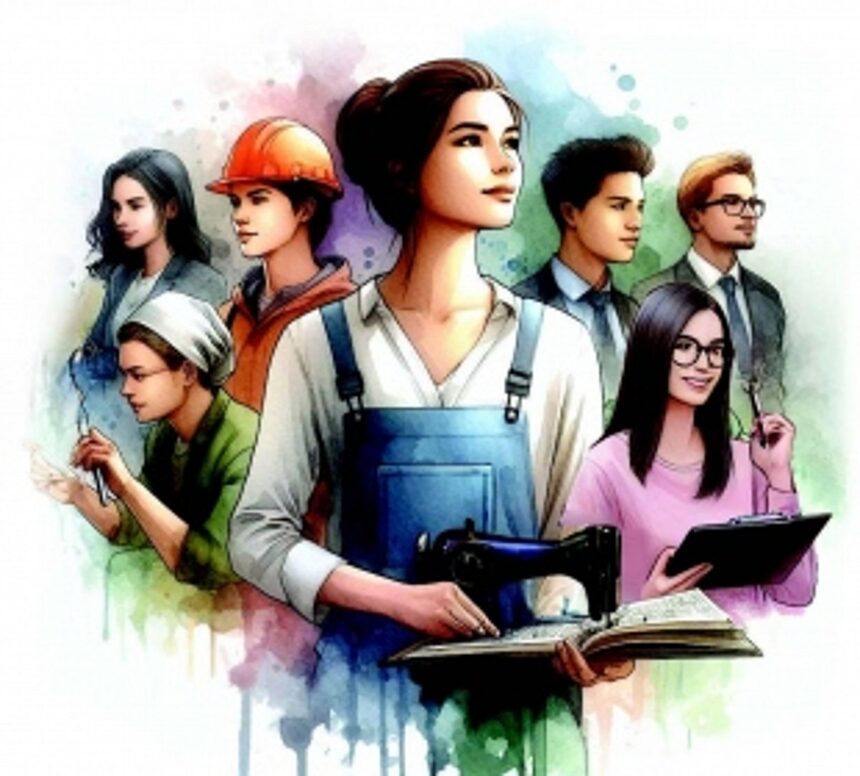
Young people are almost three times more likely to be unemployed than adults and continuously exposed to lower quality of jobs, greater labour market inequalities, and longer and more insecure school-to-work transitions. In addition, women are more likely to be underemployed and under-paid, and to undertake part-time jobs or work under temporary contracts. One reason for youth unemployment is structural unemployment, a mismatch between the skills that workers in the economy can offer and the skills demanded of workers by employers. Structural unemployment affects all regions around the world and it impacts not only economies but also hampers the transition to equitable and inclusive societies. Skills development is a primary means of enabling young people to make a smooth transition to work. Skills and jobs for youth feature prominently in the 2030 Agenda for Sustainable Development, and SDG target 4.4 calls for a substantial increase in the number of youth and adults who have relevant skills.
In December 2014, the United Nations General Assembly declared July 15 as World Youth Skills Day to celebrate the strategic importance of equipping young people with skills for employment, decent work and entrepreneurship, as well as for addressing global challenges and advancing sustainable development. The theme for World Youth Skills Day 2024 is ‘Youth Skills for Peace and Development’. It highlights the crucial role that young people play in peace building and conflict resolution efforts. It aims to highlight the importance of equipping youth with skills to build a peaceful and sustainable future.
Technological advancements and shifting labour market dynamics increasingly call for agile and adaptable skill sets. It is crucial that young people are empowered to navigate these changes effectively. Technical and vocational education and training (TVET) is well placed to meet these demands by reducing access barriers to the world of work, ensuring that skills gained are relevant, recognized and certified, promoting green skills and practices, and offering skills development opportunities for youth who are not in education, employment and training.
For colleges and training institutions in Goa, the challenges is pretty big. Fr Andrew Silveira of the Fr Agnel Higher Secondary School, Pilar says they have the National Skill Development (NSQF) programme. They have students being trained in Apparel made ups and home furnishing course and Electronics. There are around 25 students in apparel made ups and home furnishing and around 30 students in the electronics course. He says there was a great demand for skill development. He adds, “Our students who did well and passed out from the institution can open up their own business. The teachers are very motivated and teach them very well. They guide the students. If the students take up their work seriously they can even open up their own outlets.”
One of the students in the course, Rhea Gonsalves, says it was a very good course. She says, “It was very experimental and it was a great experience. We have around 50 students in the course. You gain a lot of knowledge. It was very good for me. I will leave college in three years and then decide my next plan of action.”
The importance of enhancing ones skill sets was emphasized by Fr Ramiro Luis of St Xavier’s College, Mapusa. He says, “We have a lot of programmes where the students’ skills are employed in theatre, music and dance. These events are distributed through the year. It keeps the students focused.” He informs that an emceeing workshop would be held sometime next week. Around 20 young students interested in emceeing would take part in the workshop to be conducted by a senior emcee. They could take it up as a business later on. The college also held music jam up sessions regularly. All skill based programmes are held throughout the year. There was also a pop up bazaar which was being held for two years now. Students could sell their produce in these places. It also helps develop their business acumen. Fr Ramiro says they would not be conducting anything on July 15, the day itself, but it is an effort to enhance the skills through the year.
For the employers of tomorrow, the battle for talent is an intense affair. Viresh Vazirani is the CEO of an organisation that helps companies gain more awareness, says that there was a trend of people regularly shifting jobs. This was not the trend 30 years ago when people worked to maintain basic necessities. Now only those who were interested in a hard core career development took up a job. That has been a shift. This means they tend to jump jobs quickly. Many would jump without grasping the basics of the job. It was rare to find people who waited for more than two years in a job. People try to build up multiple skill sets. The quality he looks for is the ability to adapt. He says, “New advancements have meant that the time to revert on a project may have reduced dramatically. I am interested in someone who is aware of the software’s and can revert in a day or two. It is important to upgrade your talent and stand out.”
Another prospective employer, Kula Shekhar Kantipudi who is the CEO of a reality company in Panjim says it is important for colleges to impart soft skills. He says, “Many young people cannot have long conversations with clients. Apart from the sales spiel many of them may not be able to understand the clients’ needs. Sometimes they may not be ideal for the project being discussed. It is important to advice. Colleges need to impart these skills. Even the engineers have to talk to contractors and labourers. They will have the technical knowledge but the soft skills have to be learned.”
The importance of skills development cannot be emphasized enough and that is something which is gaining even more importance as the years go by.