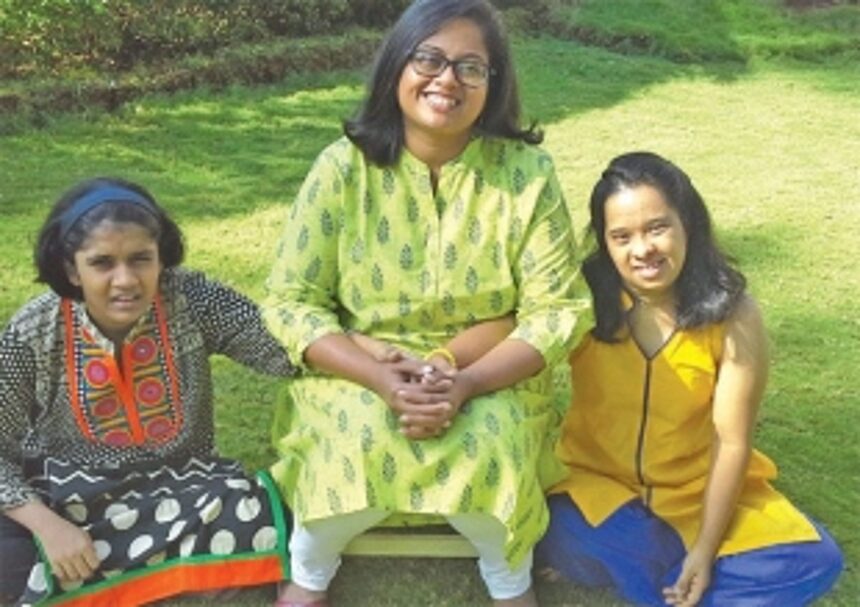
After
completing her bachelor’s degree in
Psychology and Sociology, a bachelor’s in Education (Special Education) and a
certificate in Curative Education and Social Therapy, Liane Da Gama, originally
from Verna, decided to return to her hometown to make a difference for the
community of people with disabilities in Goa. She founded Atmavishwas, a
vocational centre for young adults with intellectual disabilities between the
ages of 18 and 30 years that currently offers training in skills like paper
work, jewellery making, candle making, embroidery among others. Along with the
education, she is nurturing self confidence, which will go a long way in
helping them to face the world. With the strength of two special educators, a
class assistant and a parent, the centre presently has eight students.
Liane Da Gama throws light on the centre, library and
how it can benefit society at large:
HERALD CAFÉ: What
motivated you to come down to Goa to open the centre?
LIANE DA GAMA: After
initiating Atmavishwas Mumbai, I went off to the US for two years to further my
training. There I was inspired by the community and the philosophy and realised
that every person has the right to training and independence. In Mumbai, due to
space constraints, we couldn’t expand any more. My ancestral home in Verna was
calling to be utilised and hence I came to the decision to move to Goa. We also
hoped to start a Residential Community for people with disabilities and Goa
seemed to be the best place to do that.
HC: What were
your perceptions about Goa and it’s social mindset before opening the centre
and what is the reality?
LDG: When I moved
to Goa, I had no pre-conceived ideas about the social mindset or environment,
as I wanted to be able to adapt to the requirements and needs of the population
here. The social mindset of Goa was different from where I grew up but I didn’t
let that influence me. Unfortunately, some of the perceptions did turn into
reality, but those shackles are slowly loosening and society is becoming more
open-minded and inclusive.
HC: Who can enrol
in the centre, library and café? Do shed some light on the courses offered and
teaching techniques used.
LDG: Atmavishwas
is for young adults with intellectual disabilities between the ages of 18 and
30 years. The library and café are open to the public and everyone, with or
without disabilities can enjoy the facilities. We currently offer ‘home based
skills’ training as it gives our students the opportunity to learn and be self
employed after training with help from the families.
The
basic technique that we use is a personalised education program while looking
at the ‘ability’ of the person and then including them into an activity. An
assessment at the time of admission and information from the parents gives us a
fair picture.
We
at Atmavishwas believe that every human being, irrespective of ability or
disability, has the right to learn and be educated. In this way, we give life
skills training and offer opportunities for experiences. Our teaching is mainly
in a 1:3 teacher student ratio. Our method is mainly practical and
experiential. We believe in going out into the world to experience learning.
HC: Has the
number of students increased over the years? How comfortable are parents to
acknowledge the efforts of the centre?
LDG: The growth in
terms of the number of students has been very slow over the years and this has
been our major challenge. We hope that many more families of young people with
disabilities avail our services in skills training. The move from school to
vocational education to work is an important aspect in everyone’s life. The
parents, past and present, have acknowledged the efforts of the centre and do
believe that change has been initiated in their child. The parents of our
students are our greatest advocates.
HC: With your
years of experience, how do you relate to the students?
LDG: I relate to
my students like I do with everyone else around me – they are the same. I
listen and have learnt to learn from the needs of my students. I believe in the
integrity of a person and I try to find that true being behind all the challenges.
I believe in giving them the best opportunity possible, so that they may shine
and unfold to the best of their ability. Each person has an inherent talent and
through experience I have learnt that once you tap that, there is always
forward movement in development. If we tend to stick with only things that are
difficult, we might overlook a positive aspect. After my training as a social
therapist, I believe that social inclusion is the most important tool for a
person to develop. My students make me a better person. My younger brother with
Down’s Syndrome has been my best teacher and through that I have learnt that
education is about give and take, not just one way.
HC: After
completing the course, what is the next step for the students?
LDG: We hope that
the students are able to create small micro businesses, either singly or with a
small group and become independent. We provide assistance as required to
facilitate this. I wish that my students are able to hold themselves in
society, so that they are accepted as an integral part of the community.
HC: What future
plans do you have for the centre?
LDG: We have decided to include more
employable skills in our skills training set. We have just initiated a pilot
project in Food Production and Hospitality Training. We hope to make this a
fully fledged course by the next academic year. We also have an Organic Garden
where we would like to start a Gardening Training Course for people with
disabilities. This is therapeutic as well as a good employment opportunity. We
do sincerely hope to be able to encourage more families to make use of the
facilities and services that we offer.
The Village House Café:
The Village House Café was opened recently with the vision of equal employment possibility. The café is headed by Chef Dev Magar, and Savio da Gama and Angel are training along with him at the café. The café is open from Tuesday to Saturday, 10am to 5:30pm.