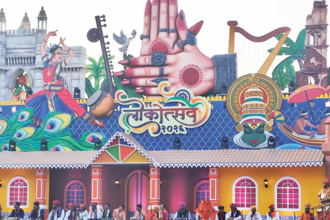
Like the earlier editions of Lokotsav, this year too West
Bengal plays an integral part of the cultural and handicraft festival. Cultural
treasures of the state are present for everyone to experience, from the
artworks of the artisans from Bengal to the breath taking folk dances like PuruliaChhau, BaulFakiriand Natuathat are being performed at the
Kala Academy, Panjim.
“The dancesBaulFakiri
and Natua, basically send the message
that one need not look for God elsewhere, but within the human body. The Bauls
and Fakirs are conveying the message of peace through their music. The Bauls
are minstrels whose song and dance reflect the joy, love and longing for
mystical union with the divine,” says lead dancer of the Natua performing arts,
BirenKalindi from West Bengal.
Another dance form is PuruliaChhau,which
is a vigorous form of dance drama, drawing its themes from the two great epics –
Ramayanaand Mahabharta. Masks and elaborate headgears are the ornamental
apparels of Chhau dancers. It is distinctive by its acrobatic use of the body
and the elaborate masks worn by the dancers. Powerful movements, immense
concentration and release of energy are other features of this dance form.
In handicrafts too, Bengal has distinctive arts; one is Pathchitrawhich is showcased at this
year’sLokotsav. MohimChitrakar and PutulChitrakar, two artisansspecilised in
this art, spoke to Café. “We have our community in the Pingla village which has
300 households who are carrying forward our art from generation to generation.
Our community is fully promoting this art,” says Mohan, adding, “Pingla is situated
in West Medinipur district. Patachitra
and Pater Gaan are unique cultural
traditions of Bengal. They narrate stories of Hindu Gods and Goddesses.”
AnkitaBiswas, consultant from banglanatak dot com, further
adds, “These painters generally have happy stories to narrate. Pater Gaan is the song which is sung
while narrating the story of the goddess through the painting.”
The Bangla Qawwali is a popular music style which is
preferred by many, another aspect of Bengali culture being showcased at Lokotsav.
The Bangla qawwali originates in Greater Persia, Iran, Kherson and Baghdad.The qawwali
tradition gained a new identity in Bengal at the shrines of Muslim saints. In
Bengal, the qawwali songs synthesised with the philosophy and music of various
traditions, such as Vaisnavakirtan and Baul songs, to produce a new genre of
qawwali called Bangla Qawwali.
Besides the art and culture of West Bengal, Lokotsav 2016
showcases folk dances like Bihu from
Assam, Siddhi Dhamal, Mewasi, KervanoVesh
from Gujarat, Manganiar, Kalbelia,
Puppeteers and Bhavai from Rajasthan,SingiChham, Thangta, PungDholCholam,
Cherrow, Gotipuasambalpuri dance from Orissa,Panthi from Chhasttisgarh, Lawani
from Maharashtra, Bharya from
Punjab, Ghoomar from Haryana and Goan folk dances. All these mentioned
dances are attracting a great audience that is also looking forward to a special
programme by a Sri Lankangroup and Russian group.