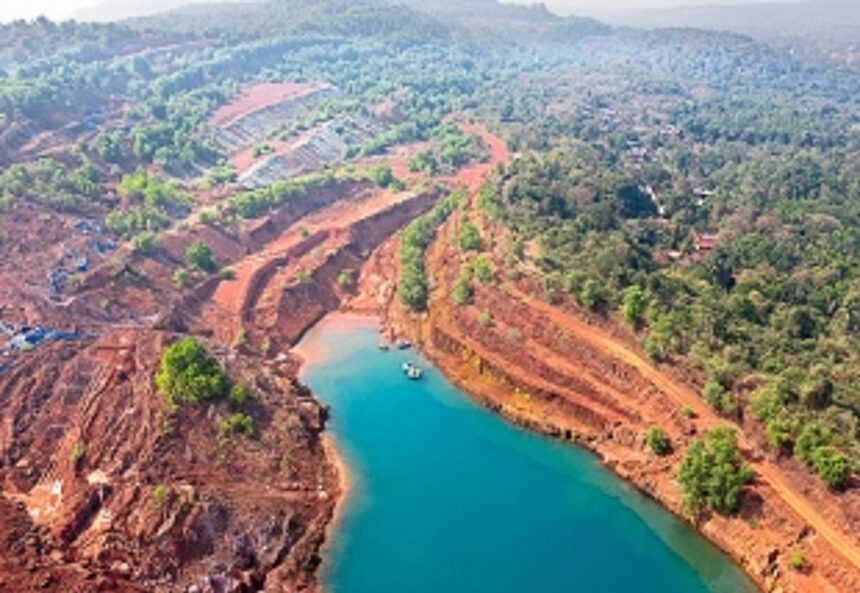
In a land away from Goa, people are taking note of the changing landscape of Goa through photo artist Payal Kakkar’s solo exhibition, ‘For Ground’ at Shridharani Gallery, Mandi House, New Delhi. With three bodies of work, ‘Goa: Mangrove forests, Khazans and Iron-ore mining’, ‘Singrauli, Madhya Pradesh’ and ‘Salt pans of Kutch and Sambhar Salt lake’, Payal’s photographs play on the senses of artistry and the crude reality.
Payal focused on the mangrove forests, iron-ore mines and Khazan lands of Goa, few of the places that are visibly showing signs of the effect of destruction by humans and nature. She describes her photo of the khazan land as sunbaked under the direct rays of sun look like an abstract painting against the green pigment from algae on brackish waters of wetlands.
“All projects are ongoing and for all the sites that I have photographed, in keep photographing each of the three bodies of work within a few months. I live by the khazans lands in Corlim, Old Goa. That was my first foray into doing photography and in 2019, I started with that and it is still ongoing. I still find that the khazans are the whole ecology and environment. The khazan in itself as a landscape is changing. As I keep photographing them, and over a few months, adding up to a few years now, I have developed a series of the way the landscapes have changed. It’s not like a time lapse but you can see a considerable difference in the landscape,” explains Payal.
She further adds, “The mangrove forests and the khazans are changing so quickly within a few months and I feel that that’s not the right way to go. I’ve even had a chat with Claude Alvares of Goa Foundation and he said that the khazans are a must for the other Goan lands also to remain the way they are. Otherwise everything is going to go under water, with the climate change that’s happening. And if we do not reengineer the facades and the way we use them, it will be very difficult to protect the lands from climate change.”
Climate change is a huge factor that runs among two of her works, Goa and Gujarat. “Climate change is not because of India but the whole world participating into it. That’s how the climate throughout the world is changing. What happens if it rains on odd months, too many cyclones are happening etc. If we don’t take action, then we are basically saying ‘welcome climate change, please destroy us’ and we’ll be welcoming climate change with open arms,” she says.
Though the exhibition is in New Delhi, Payal received tremendous response to the photographs of Goa. “People feel very special for Goa. Everyone would have come to Goa once in their lifetime. When they see this aspect of Goa, besides the beaches and the parties and all, they also want to do something about it and they feel strongly connected towards it. I have had so many people come and ask me what can we do about it? How we can participate in this? I advise them to do something on their level. You can segregate your garbage, buy less clothes and recycle. You can reuse and grow more trees and definitely use less cars. At a personal level, many of us can do so many things. If my work inspires you to do that, I think I’ve done my job,” says Payal.
Within the limited space of the gallery, Payal had to divide her display between the three themes of her exhibition. She has three huge bodies of work featuring seven works of Goa, eight works on Kutch and Rajasthan and 12 works from Singrauli, Madhya Pradesh, which is the coal mining capital of the country.
Elaborating on Singrauli, she says, “For this series, I captured how the extraction and the displacement of these indigenous people living in the forest. I photographed these sects, basically, people who’ve already been displaced and how they’ve been pushed into poverty lines. They are committing suicides as they are depressed, and are not able to live in the city. They were having a self-sustained life earlier in the forest, because they lived in harmony with the forest. Now living in the city is like a jerk for them, because it’s a very different lifestyle and the expectations to live in a city than the free life in the forest. I focuses on just the people who have been displaced ten years ago and people who are in the process of being displaced. I’m covering their protests and how they are coming out of the forest. There’s also people who have been earmarked that they will get displaced in time to come.”
For the exhibition, Payal has used the aerial photographs of the salt making in the salty marshes of Sambhar Lake, Rajasthan. However, it came with the challenge of extreme heat and wide open spaces. “I travelled to Gujarat in March 2022 because we have to photograph salt pans at a certain time as they come up at a particular time of the year. I had to go in January, February or March as it is salt requires a temperature of 26 degrees to be made. April starts getting very hot and it gets harder to photograph in the open landscapes and salt reflects the light and in turn creates heat,” explains Payal.
Payal completed her Master’s in environmental protection from Indian Institute of Technology Environment and uses a Canon 5D Mark III, a DJI Mavic 2 Pro drone and a GoPro to take videos. However, what’s more important than the equipment is her experience, “There’s a lot of research that goes into these projects. I worked in the field of environment for 10 years which helped when I was doing the study on Khazans. I am a self-taught photographer and I started working from my heart in 2012.”
“The gallery is in Mandi House and because the exhibition is on environment and climate change, it is attracting at least a 100 odd people every day. The exhibition is not about showing destruction. I’ve tried to capture the attention of the viewer to the beauty of my artworks, to evoke an emotion into them, to do something for the environment. It’s like a call of action and statement for hope for them to do something about it. And I’ve had an immense reaction from people who come. Since this is one of the premier galleries in Delhi, it has been buzzing with people and I had a fantastic response from 11 am to 8 pm,” says Payal.
After three exhibitions in Goa, Payal’s work ‘Children of the Landfill’ was selected in ‘Portrait’ category of Photographer of the year, 2022 (IPOY22) by Indian Photo Festival (IPF). She was also a participating artist of the exhibition ‘In Search of an Oasis’ which was exhibited in Open Spaces, India Habitat Centre, New Delhi, United Nation House, New Delhi and Museo Camera, Gurugram. “I was one of the commissioned photographer of climate change mitigation program of Swiss Agency for Development Cooperation (SDC) in India for ‘In search of an Oasis’. I photographed climate change mitigation programs in Rajkot and Bhuj.”
Payal has been living in Goa since 2014 and she is still searching for the right answer to why she decided to call Goa her home, “My father had brought this property in Corlim, which I live in in 2008. I inherited this property in 2014. Since then, I’ve been living there. I’m still searching for the reason but I think it is my khazan lands, my mangroves, the sight of buffaloes that roam around the fields in the monsoon rains and the frogs that croak in my garden. I miss my home when I am away,” concludes Payal with her heart yearning to return to Goa post the exhibition.