Team Café
Prawaas – The Journey within… (Marathi)
By Abhivyaktee, Goa
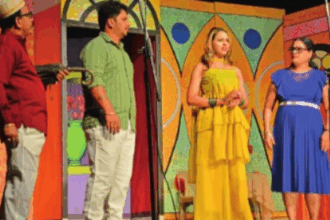
Adapted into the Goan backdrop, the play
‘Prawaas’ is based on Athol Fugard’s ‘The Road to Mecca’ and takes place in the
home of Miss Angela, an elderly widow whose work as an artist led to her
increasing estrangement from her neighbours. The play opens as Angela’s young
friend Shubhangi, a social worker from the city, arrives on the behest of
Angela’s adopted son, Mohit. Angela’s more conventional neighbours regard her
work—and undeniable eccentricity—with suspicion. Angela has no visitors besides
Oswald who is Mohit’s music teacher at an institute run by the local church and
her gardener Gaonkar.
Oswald is making arrangements for Angela to
enter a home for the aged and as the play unfolds, the conversations and
conflicts among the three characters serve to explicate their positions and the
effects their choices have had on their relationships and their lives. The
play’s plot turns on whether Angela will agree to enter the home for the aged
which becomes a symbol of all the restrictions on her independence that she has
battled for so many years, and her eventual refusal to sign the admittance form
represents her recognition that her inner journey has simply taken a new turn.
Shubhangi sets out on her own journey more confident now after this meeting and
subsequently Angela’s journey also sees light with Mohit’s desire to be a
Horticulturist which kindles fresh hope for her. Angela finally finds the
missing element for her Guernica inspired mural.
Putrid Prologue (Hindi)
By ‘Raaga’ – an association of art,
education and social welfare, Patna
The play revolves around a unique tradition
of Bihar, where men impersonate women, dance in front of an all-male audience
and fulfil the hidden fantasies of the public. The play centres on the internal
and never ending lust of the human body which leads to victimisation of another
fellow human being voluntarily or involuntarily, in some form or the other.
His marriage accentuates his distaste of
the strange format of entertainment where he was constantly becoming an object
of lust for the male gaze. He tries to reinvent himself in a new avatar to attain
freedom from his past, but his body is unable to attain the salvation he is
looking for, as he has been transformed from being a victim of male sexuality
to one of the female sex. The same tactics his male admirers applied to woo him
in his transgender state are the ones he is now using to win women in his all
male form. In both cases, it is his body that is being objectified, used and
abused and there is no outlet from this trap.
Ek Diwas Mutthhakade (Marathi)
By Vasantrao Achrekar Sanskriti Pratishthan,
Kankavli
The play is divided into two parts. The
first part comprises a dialogue between two men. The conversation proceeds in
classic Alekar style with hilarious non sequiturs, digressions, unexpected
questions, tangential responses and wacky accounts of past events. Fathers are
characterised by the term ‘guide’ as in – a path shower. Clips from Dev Anand’s
film ‘Guide’ projected on the backdrop add a quirky dimension to this exchange.
The second part of the play, a monologue by
the older man, is in complete contrast to the visual richness of the first
part. If the ‘mutthh’ is the young man’s link with his mother, the cooking
counter is the older man’s link with his deceased wife. It is the source of all
the problems of existence that his wife once dealt with quietly which have now
come to haunt him. As he deals with the minutiae of daily living, his wife’s
hidden life acquires a concrete shape. The cooking counter now represents the
absent centre of his life.
Rudra (Konkani)
By Varadhast Creation, Keri
The story of the play takes the audience
80-90 years back in time. The play demonstrates the social well being, the
traditions and the overall environment of that period, effectively. The subject
of the play is women-oriented. The clash between love and morality is brought
to the forefront by the writer of the play. The concepts of culture and freedom
are visually represented and what emerges is the colossal downfall. The term
‘downfall’ is usually associated with people who are regarded as super humans or
those of gigantic stature – bigger the stature, bigger the damage. However, the
downfall of a common man also possesses the potential to touch the hearts of
the audience and make them restless. ‘Rudra’ is a story of a common man, woman
rather, and instead of depicting the story of an individual woman, the story
depicts the story of the women all over.