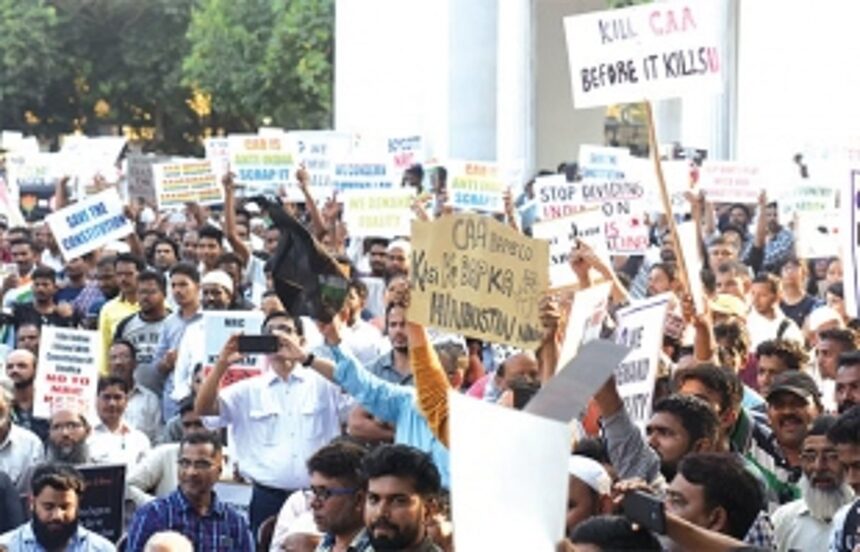
The nationwide anti-CAA/NRC/NPR protest calls have made it to church pulpits in Goa. In sermons preached
across some parishes on Sunday, priests urged parishioners to join Friday’s
“public gathering” to “save democracy–save constitution”, at Lohia Maidan,
Margao. It has been called by the Council for Social Justice and Peace (CSJP),
the social-work wing of the Archdiocese of Goa, together with the Goa unit of
the National Confederation of Human Rights Organisations and Concerned Citizens
of Goa.
“When people have been living in this land
for generations there is no need for someone to prove that they are citizens of
this land,” one parish priest told the congregation in Margao.
The sentiments of most Xaxtikars were
along these lines
Backing the anti CAA call which by
extension is now an anti NRC/ NPR call, by the CSJP, eminent Margao based
Cardiologist Dr. Francisco Colaco says the role of the Church is not to only
preach from the pulpits but to galvanize its people into peaceful protest and
non-violent action. “We have to stand in solidarity with those affected.”
Neither surprised nor shocked by the
clarion call, businessman and author Datta Naik, says “everybody is against the
CAA, especially minority groups, and it is only obvious that the Church will be
too”.
Writer and one of the leading lights of
the Konkani Bhasha Mandal, the young Anwesha Singbal too feels the Church has
stepped often into social issues and has every right to do so. The CAA issue
needs to be unitedly tackled by all like-minded citizens, she feels.
Striking a slightly different note, though
backing the anti CAA movement, advocate and writer Radharao Gracias says the
issue needs to be addressed but the Church by directly participating is playing
into the hands of the BJP. “The purpose of the CAA is to polarize on religious
lines. The Church participation will give the BJP additional ammunition.”
Sai Palondikar, former deputy chairperson
of Ravindra Bhavan, points out that it’s the word ‘religion’ itself that is the
issue. “I think every religious body should oppose the CAA, because it involves
leaving out one religion. As a refugee policy it is fine, but when it excludes
a religion then it’s a worry for a democratic country.”
Margao based prominent writer Valmiki
Faleiro refuses to comment on the CSJP call. But he makes a distinction between
the CAA, the NRC and NPR and asks if this was indeed a priority for India. He
says he sees nothing wrong with the CAA as it is humanitarian and offers refuge
to Hindus from three countries in their own homeland. But he has misgivings
about NRC and NPR. “India can ill afford such things at this time when
priorities should be on other fields, such as the economy.” Most Indians not
having documents and the question of what will be done with illegal migrants
are also issues.
Pointing to the timing of the CAA he says it should not have
been shortly after the controversial Ram Mandir verdict, which has led to
reactions against Modi, Shah and the BJP. “Reactions would have been very different
had this Act been brought out by Manmohan Singh under UPA 1 or UPA 2,” feels
Faleiro.
Defending and defining the role of the Church in Goa, priests
Savio Fernandes, Victor Ferrao and Jose Rodrigues, say the religious body has
always been with the people.
“All matters relating to life and society are of concern to the
Church. By intervening at this point the Church is confronting
unconstitutionality and injustice. The Church stands for equality for all. This
is a Christian obligation,” says Father Fernandes, executive secretary, CSJP.
Father Ferrao, a professor at the Rachol Seminary, says, “Nobody
is apolitical. Right from the time of Goa’s Liberation the Church has been a
part of all public agitations, from the ramponkar (traditional fishermen)
movement, to the Konkani agitation. The Church isn’t doing it for its own
cause, it is standing by its people; it is joining this agitation to defend the
Constitution.”
Father Rodrigues, parish priest of Grace Church, Margao, says,
“The Church works for the people. It is in tune with the hopes,
demands,aspirations and sufferings of the people. Where there is injustice it
will raise its voice.”
Gracias, on the other hand, feels the “need for an organization
of Catholics, independent of the Church, a sort of a parallel to the RSS” to
address such issues. “The Church has been active on various issues in the past
and I must say not with particular success. It would do better to back up a
secular organization on such issues rather than be a direct participant through
its own surrogate, as in this case,” he says.
Palondikar believes every institution has its own structure and
rules and “everyone has the right to speak; even the RSS”. Everyone has the
right to their own say and it’s our responsibility to listen to them all. “You
don’t have to agree, but you must listen.”
How
will South Goa’s neo-saffron turncoat MLAs react ?
So will this rally get people off their fence-sitting and force
them to take sides and will it make it difficult for Congress MLAs, especially
from South Goa, who joined the BJP, to face their people?
Singbal believes it could since the Church in Goa is a “strong
body and its views are treated with seriousness”. She strongly feels that “any
move that can create a consensus amongst the people is much welcome in today’s
times where opinions and dissent are strangulated at every step”.
Father Ferrao feels it may get people to join the ongoing
struggle. As for the MLAs, he feels their silence will speak. “They will have
to make their stand on this issue clear or the people will understand
andchoose,” he says.
Father Rodrigues is definite the effort will bear results.
“After all they (MLAs) betrayed the hopes of the people when they joined the
BJP and then instead of looking after the people they turned their backs on
them. Their agenda stands exposed.”
Gracias, a former MLA himself, says, “I would expect it would be
difficult for defecting Congress MLAs from Salcete to win on BJP tickets next
time around irrespective of the Church involvement.” Colaco feels the “turncoat
MLAs will eat humble pie if only there is a paradigm shift in the way the Goan
electorate has been voting until now. Hopefully there will be.”
LOOKING
AHEAD
Father Savio Fernandes hopes CSJP’s idea will enable people to
take a stand for justice. “Our target is the people on the streets and the
parishioners whom we serve. Hopefully the political class will listen to the
voice and the aspirations of the people,” he says.
But Palondikar doesn’t think the Church or any other body can
influence anyone politically. “I think only 4-5% of people are not able to
think for themselves. Everyone else will make a choice based on their own
beliefs. So, I don’t think this is going to affect any politicians because at
the end of the day this is politics of opportunity.”
As
for getting people active, Dr Colaco wants the movement to go towards a fusion
of people with common ideologies for a just and inclusive Goa. “It’s admittedly
the tougher part because we are so easily divided.”