Twenty one years ago, Ponda-based Sonia Shirsat was a chirpy
teenager and a member of Junior Chamber International (JCI). She was a college
student at GVM’S Gopal Govind Poy Raiturcar College of Commerce and Economics
in Ponda where she was studying Commerce, and participated in social projects
through JCI to strengthen her soft skills. She was constantly travelling in
India and abroad for conferences and seminars and loved participating in
singing competitions in English, Hindi and Konkani. A year later, she
participated in the French Nightingale competition by Alliance Francaise Goa.
“When I was in the top five in the
competition, I had to apply for admission to VM Salgaocar College of Law,
Miramar, for the new academic year. I informed the management that if I win the
competition, I will have to travel to France for a month in October, during my
first term exams. My question was whether to get admissions that year itself or
skip a year. They informed me to complete the admission process and clear all
eight subjects in the second term. I went on to complete my LLB, LLM and I even
taught for four years at the college,” says Sonia, India’s most acclaimed
Fadista singer.
Daughter of late Dr Shashikant Shirsat and late Maria Alice
Pinho e Shirsat, Sonia was exposed to music and Fado by her mother but she
found her own way of falling in love with the genre. In 1993, her mother
visited Portugal and returned with three CDs of Fado music by the ‘Queen of
Fado’ Amália Rodrigues. The music would be played on repeat throughout the day
in the house. “The music played in the background and I didn’t take much
interest in learning the songs or the lyrics. The first time I participated in
Vem Cantar, I didn’t even sing a Fado, I sang the winning ballad, ‘O Pastor’.
We didn’t speak Portuguese in the house as most of our conversation was in
English and on my mother’s side, if someone spoke to me in Portuguese, I would
reply to them in English. I understood the language but I could only hold small
conversations,” she explains. Sonia is also an awardee of the Ustad Bismillah
Khan Yuva Puraskar by Sangeet Natak Akademi, New Delhi.
The turning point in Sonia’s life came in 2003 when she was
selected for the Fundação Oriente Scholarship to Portugal. She travelled with
her mother to the Land of Fado and interacted with maestro Antonio Chainho.
“There is a huge difference in growing up listening to CDs and then actually
experiencing the live performance with the music. There is music in every
pocket of the city of Lisbon and it opened my eyes to Fado. There are several
festivals and competitions and even museums dedicated to Fado in Portugal.”
Sonia has sung in 14 languages, and she has been called the
Ambassador of Goan Music to the World. She has played an important role in
major national as well as international events that have been held in Goa
including singing the theme song for the third Lusofonia Games in 2014. Besides
Fado, she has lent her voice to various Konkani albums and live performances.
Fado is a form of traditional Portuguese music dating to before
the 19th century. In 2017, she reached out to Goans and started the Project
Fado de Goa in association with Taj Hotels to carry on sessions to train people
about Fado and sing as well. She continued with the classes till 2020, a month
before the lockdown. “We had batches in Mapusa, Panjim, Vasco and two batches
in Margao. I had students from the youngest being eight years old to 82 years
old. There were many families too like parents with two children, siblings,
parent and child and even grandfather and granddaughter. It was a lovely
bonding experience for me as well as for the students as they got to learn Fado
together, right from learning, practising and even answering their exams,” says
Sonia, who has trained over 300 students through the years.
“The popularity of Fado among the youth has increased especially
among the non Portuguese speaking audience, there is more interest is listening
and learning. Earlier, Fado was associated with the Portuguese rule in Goa but
now it is associated with Goa as a genre of music. Even in Portugal, Fado has
still retained it melancholy but has diversified and deviated from the
traditional rules. There are many young singers like Gisela Joao and Sara
Correia,” she adds.
Her last international concert was in Bethlehem and Jerusalem in
2018. She was invited to perform Fado in the Holy Land by the Portuguese
Ambassador to Palestine Dr Rui Baceira, Institute Camões and the Bethlehem
Music Academy and was accompanied by noted Goan musicians Orlando de Noronha
(Portuguese guitar), Dr Allan Abreu (12 string guitar) and Carlos Meneses
(Viola de Fado). Her next national concerts will be a tour of New Delhi with
three concerts at Ashoka University on October 13, Embassy of Portugal in India
on October 14 and The Quorum on October 15.
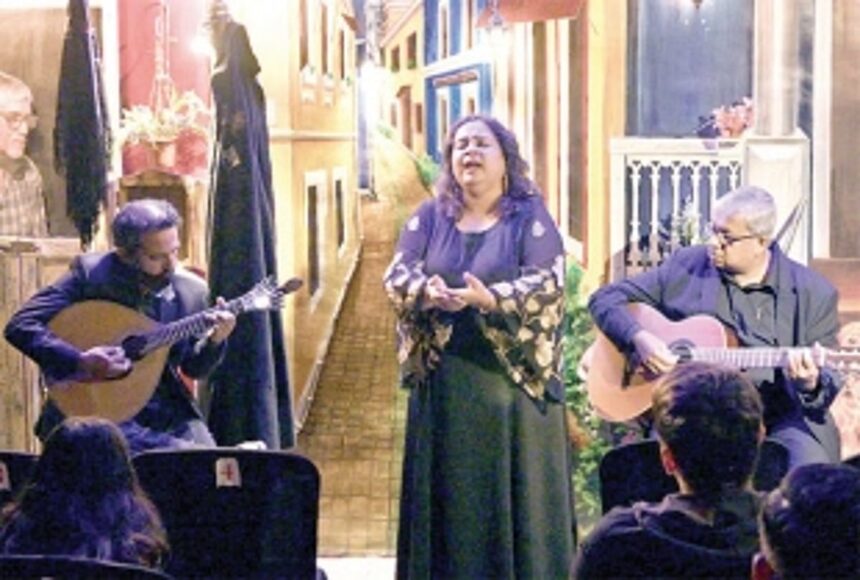
In Goa, music lovers can get to hear the magic of Sonia’s voice
at two regular venues, “Once a month, we have a Fado performance with dinner at
Alfama, Cidade De Goa, Vaiguinim Beach which will open in December and twice a
month, we have a performance at Madragoa, Panjim,” says Sonia. Madragoa is India’s
first Casa do Fado e Mando, a home of Fado and Mando set in the ancestral home
of Orlando de Noronha in Panjim. Sonia’s next riveting performance will be on
October 8 at Madragoa at 7pm, accompanied by Orlando de Noronha on Portuguese
Guitar and violin, Carlos Menezes on guitar and Emmanuel de Noronha on violin.
Her
advice for those who would like to pursue Fado is, “First and foremost, listen
to a lot of Fado. There are so many singers and songs to listen to on the
internet. Start practising singing,” says the Goan Queen Of Fado.