The magic of Goan artistry is being showcased in an exhibition at the Museu do Oriente in Lisbon. Called “Histories of an Empire”, it has been compiled from a small part of the “Távora private collection Sequeira Pinto’’ by Luso-Oriental Decorative Arts. Carlos Augusto Pulido Valente Monjardino, Chairman of the Board of Directors of Fundação Oriente, said this exhibition was very significant and one of its kind both nationally and internationally.
Interestingly, the scientific commissioner of this exhibition is Nuno Vassallo e Silva, the grandson of the last governor of the Portuguese State of India, General Manuel António Vassallo e Silva.
The pieces gathered by the passionate collector for thirty years, gives everyone an understanding of the tastes of the author and the circle of his relationships and influences. It also covers the most diverse Luso-Oriental stories, spread over several centuries.
Goa, as an importing and exporting center for various types of pieces produced locally, partnered with Lisbon to supply coveted products that came from strange and exotic places. They were marveled in the west, commissioned by royal families and wealthy nobles, not only for personal enjoyment but also for display, symbolizing wealth and power. These beautiful gems which were sold in Asian, European and world markets and acquired by wealthy individuals and collectors, will soon gain even greater visibility when exhibited in museums.
These rich artistic productions, inspired or not, predominantly by European models and prototypes, resulted from the marriage of several pieces starting with Portuguese, Goan and influences gathered along the route of merchants and merchants. Rui Oliveira Lopes said “One cannot speak of an influence of European art in Asia, nor of a cultural hegemony of Europe over Asia, but of a process of convergence and transculturality, which characterized by the fusion and creation of a new cultural and artistic phenomenon”
Any scrutinizing traveler seeks to discover new ideas and answers to important questions. As Pedro Dias explains, it is not only animals and plants that travel in the Portuguese maritime adventure, it also takes place in the journey of forms, aesthetics and techniques.
The author said the sculpture in wood or stone, which was from Portugal, marked the Indian production of these materials and in furniture, the Portuguese models of chairs were adopted by the emperors at the court of Grão-Mogol. The chairs, produced in large quantities in the Sindh and Cambaia areas, were exported to Goa and from there to the rest of India, East Asia and Lisbon.
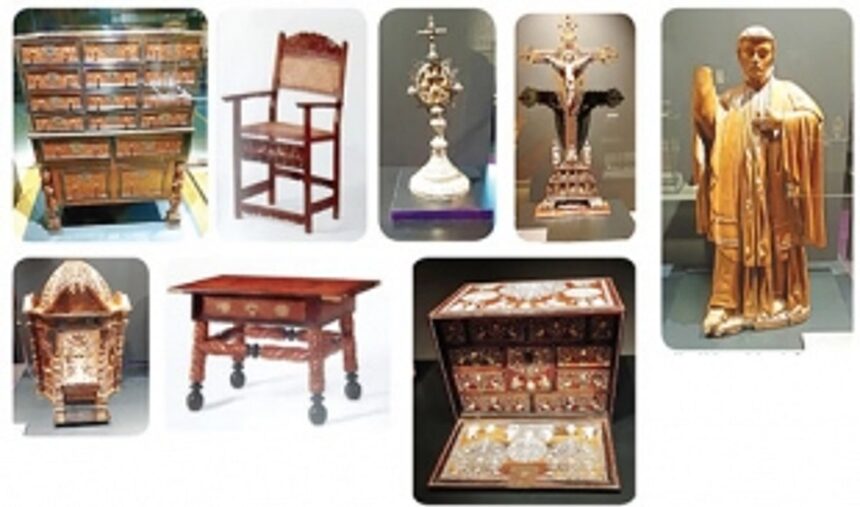
This exhibition center has Goan office pieces, a desk, a fan, a sacristy chair and tables.
According to Rui Oliveira Lopes, Goa was the largest center for the production of sacred art, used in missionary campaigns and also to supply European orders. Indian artists, he said, were responsible for carrying out the works of carving, gilding, sculpture, textiles, jewelry and, several times, even painting. This nucleus has Goan pieces of oratory, oratory with Calvary, chalice, tabernacle, chalice ward, peace-bearer ward, the sculpture of St. Francis Xavier and St. Ignatius of Loyola.
Nuno Vassallo e Silva provided valuable information about jewelry and precious objects stating “The art of Asian goldsmiths has always fascinated the Portuguese, and later the rest of Europe. The coming to Lisbon of Rauluchantim, a native of Caraim das Ilhas, head of the Goa goldsmiths, where he stayed between 1515 and 1519 to work for D. Manuel is the most celebrated case.”
He said the workshops in Goa executed works in rock crystal, gold, rubies and sapphire, maintaining especially from the end of the 16th century onwards, the most active market for precious stones from the whole of Asia.
This exhibition highlights the fact that cultural and artistic manifestations have no homeland because when they are dazzling, they mingle with the experiences of other peoples, countries and nations, giving rise to a singular whole, where each one has its share of property and, not being exclusive ownership of a single entity, can be claimed by all.