The
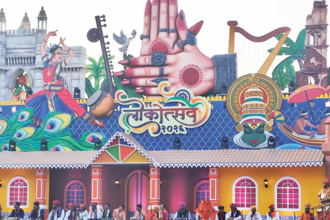
World Culture Festival 2016, which was held on
March 11, 12 and 13, 2016, was a celebration of The Art of Living’s
35 years of service, humanity, spirituality and human values. The
festival was organised by Sri Sri Ravi Shankar to celebrate the
diversity in cultures from across the world.
Amidst
it all, our culturally diverse state was not a mere spectator but
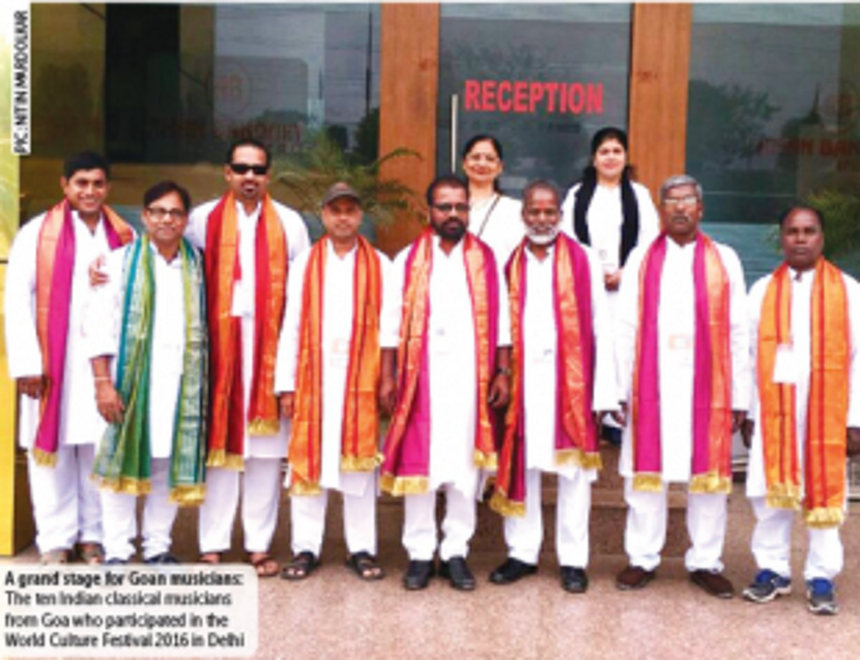
also participated in the event; a ten-member group comprising two
sitarists, two ghumots musicians, one pakhawaj musician, two shehnai
musicians, one harmonium player and one tashe artiste made their way
to Delhi to perform at the festival.
Nitin
Mardolkar, an Indian classical musician, and Kanta Gaude, Goa State
Culture Awardee for Folklore, were approached to be part of the
event. “We heard about the festival from the Art of Living chapter
here in Goa. We got our group of musicians together and gave an
online audition almost a month before the event. Once we were
selected, they sent us the music notes that we had to practise for
the performance,” says Nitin, who was awarded Best Music Director
for the film ‘Dista Toxem Nasta’ at the Goa State Film Festival
in 2000.
Nitin
Mardolkar from Mardol played the harmonium, Sushma Velinkar from
Velim and Nandini Chari from Panjim played the sitar, Ranjit Verejar
from Savoi-Verem and Padurang Parwar from Sanguem played the shehnai,
Tulsidas Parwar from Bandora played the dhol, Venkatesh Parwar from
Keri-Priol played the tashe, Nilesh Singbal from Varca played the
pakhawaj and Raju Iyer and Kanta Gaude from Mardol played the
ghumots.
“We
performed two different ragas on each day. The event always began
with the Art of Living official song which was performed by every
musician present for the festival. The ragas included Bhupali,
Vrindavani Sarang, Dess, Kafi, Malakas and Puli. We were given notes
to practise together. It is not possible for nearly 8,500 musicians
to get it right on the spot. We had a day-long practice session on
March 10, 2016 so that we could perform well on the opening and
following days,” adds the harmonium player.
Though
the weather played spoilsport for the event, the musicians from Goa
saw the brighter side of the performance. “It rained only on the
first day but the weather was pleasant and cool in the night. All the
participants were happy and enthusiastic to continue performing,”
says Nilesh. “We used to leave our rooms by 11am and then head to
the venue. Once there, we had to enter the area by 2pm with high
security arrangements and before 5pm we had to take our places on the
stage. We were there till 10pm, the end of the performance,” adds
Nilesh.
Interestingly,
with musicians coming in from nearly 80 countries, the stage boasted
of 200 sitarists and 250 harmonium players but just two ghumot
players – Raju Iyer and Kanta Gaude. The ghumot is a very unique
musical instrument from Goa, not found elsewhere. “We were sitting
with musicians from different countries which gave us an opportunity
to mingle. I was seated with harmonium players from Japan and the
United States of America,” explains Nilesh.
“The
event was marvellous and a once-in-a-lifetime experience as there
were lakhs of people in the audience and the stage had nearly 22,000
dancers and performers and 8,500 musicians with almost 25,000 on
stage at a time. Each performance was held just once and not repeated
the next day,” he says looking back on the event.