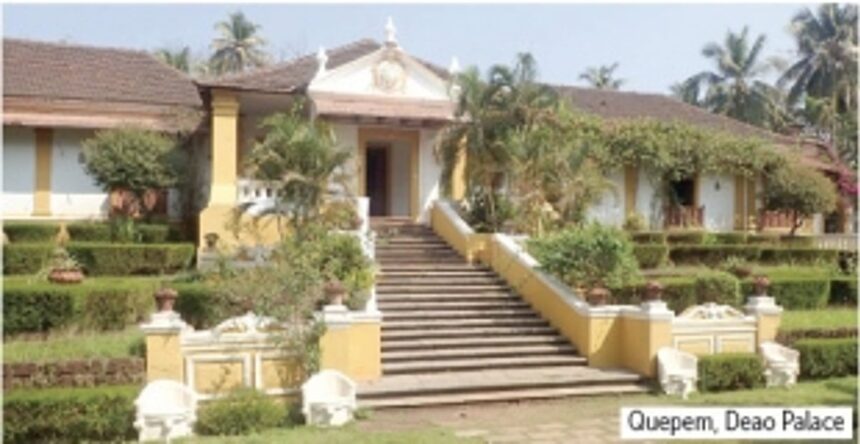
Ornamentation being
the essence of Goan traditional architecture, it has its very own language
defining the houses- intricate, artistic, and gleaming with beauty. The
traditional Goan architecture used windows as an expression of art, made with
‘nacre’, mother of pearl; oyster shell windows were an intrinsic and enigmatic
character of the traditional upper–class dwellings. Laterite stone were widely
used along with wood, metal, and tiles of different patterns and varied styles.
‘Manor houses of Goa’ signify the deeply embedded roots of civil architecture
with the Lusophone world’ according to Vishvesh Kandolkar, an architect and a
member of the scientific committee for the Manor Houses Colloquium, this year.
This international
colloquium is a project by the Casa Senhorial Portugal, Brasil & Goa, and
will be hosted by the Instituto de História de Arte, FCSH, Universidade Nova de
Lisboa, Portugal, in partnership with Fundação Casa Rui Barbosa, Rio de
Janeiro, Brazil from February 13 to 16. One of the main goals of this
colloquium is to extend the study of manor houses to Goa and its territory and
share the development of this research with the Brazilian and Portuguese teams.

The scholars,
researchers, and architects who are part of the colloquium will be presenting
their research and discussing it in the presence of a moderator for each day.
The exchange of ideas, perspectives, and opinions regarding the themed lines of
the colloquium which include Patrons and artists-Traditions and rituals;
Distributive programs: functional and symbolic nomenclatures of each space;
Study of fixed ornamentation-ceilings, tiles, carvings, plaster, textiles,
floors, chimneys, windows and doors, integrated furniture; Furniture and
equipment in their specific functionalities.
Vishvesh Kandolkar,
an architect and senior faculty member at Goa College of Architecture says,
“This colloquium will be followed by an exhibition restricted only to the
attendees, which will give a sneak peek at the civil architecture of the past.
Though manor houses claimed authority and supremacy, giving a status in
society, the credits are to be equally given to the builders and the community,
who put in so many detailed expressions and efforts in creating these historical
houses.” The sixteenth and seventeenth centuries were prominent eras for the
manor houses having their significance, these houses are rarely to be seen,
especially in India considering Goa’s rooted connection with the Lusophone
World. According to him, the remaining manor houses need to be documented and
preserved as far as elements of architecture, significantly its interior
revolved around these houses as it has a historical analytical overview which
has its needs to be preserved.
Paulo Gomez, the director
of Fundação Oriente says, “Exploring the convergence between Goa, Portugal, and
Brazil, having architecture as its central aspect, the colloquium will also
enable a scope for new solutions, new research, and new studies.”
The international
colloquium will be inaugurated on February 13. The panelists for February 14
will include Domingos Tavares, Nelson Porto, Claudia Duarte, Renata Martins,
Carla Oliveira, Mayur Thakare, Joaquim Rodrigues dos Santos, Isabel Soares de
Albergaria, Alexandra Gago da Camara, Teresa Costa Campos and Hilda Frias with
João Vieira Caldas as the moderator.
On
February 15, the moderator will be Raquel Henriques da Silva with Joaquim
Rodrigues dos Santos, Vishvesh Kandolkar, Helder Carita, Ana Pessoa, Ana Lucia,
João Vieira Caldas, José Belmont Pessoa, and Maria de Lourdes Bravo da Costa as
panelists. The last day of the colloquium, February 16 will have panelists
Fleur D’Souza, Fernanda Bicalho, Rui Carita, Marzie Malta, and Raquel Henriques
da Silva, moderated by Ana Lucia Vieira.