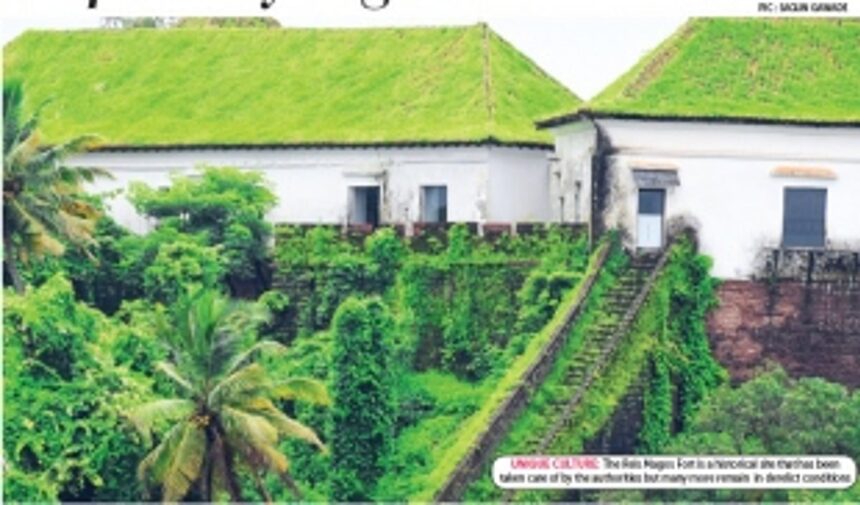
The Chief Ministers intentions of preserving and refurbishing sites of historical importance may be well meaning but does the state has a poor record of preserving its heritage assets.
Prajal Sakhardande eminent historian and academic had a lot to say about the state of affairs. He said as “I feel a large number of historical sites and monuments are awaiting notification by the Goa State archaeology Dept as well as the ASI (Archaeological Survey of India Goa chapter). For example, the historic Margao Camara building of 1778 located near the Holy Spirit Church Square.
Similarly, the file for the Brahmanimaya temple in Taide in the vicinity of the Tambdi Surla temple is still pending. We at the Goa Heritage Action Group have completed 20 years of our existence this year and all these 20 years we have struggled tirelessly to get the Heritage Regulations in place again to no avail. The violations taking place in the CRZ of natural heritage is far too glaring. We at the History Lovers Group have been trying hard to get the Betul fort notified. The Viceregal palace in Vasco etc n several such history markers awaits notification as a heritage site. The Old Goa Master plan has to be put in place. Conservation is not rebuilding the monument anew. Again I feel conservation is not being carried out following the conservation norms. Now it’s scary to ask for conservation as monuments are completely altered ensuring their historicity and heritage character is completely erased. Look at the forts and temples and churches are looking modernised. It’s disgusting”. Prajal said he had appealed for repairs to be conducted on the Minerva bridge of Campal Panaji which was constructed in 1829. He had also urged them to ensure that the look of the period not be defiled. He bemoaned the fact that the portfolio of Archeology was treated as a soft portfolio. Parajal however commended the efforts of the Archaeology dept in conserving the historic Saptakoteshwar temple of Narve in Bicholim taluka.
Heta Pandit Chairperson Goa Heritage Action Group brought up the importance of knowing what was it that they were conserving. Presently the ASI has 21 sites on its list in Goa and the state archeology department has 50. She said “We are supposed to have a plan which is mandatory but if you read the heritage policy it is obvious they are not serious. No survey or inventory has been conducted. No stock-taking, if we don’t know that then how are we going to preserve. Whatever has survived is due to the actions of individuals and despite the government. Take the case of double-tracking; there are heritage houses on both sides of the tracks. Has any evaluation been conducted? The heritage policy does not reflect anything on the ground.”
Father Freddy Braganca, Executive Director of the Centre for Responsible Tourism said it was a pity the state felt tourism was all about the seashore and parties at clubs. Heritage he said was just not promoted. Fr Freddy said “A lot of heritage places need to be restored. Some of the really old sites are in ruins. The culture of the place is hardly depicted like the dances of Goa. There are people in this state who have completely different cultures that are not promoted. These cultures will slowly die out. ”
However, like everything in life, there will also be people with views antithetical to the generally held views so far articulated. Varad Sabnis archeologist at the archeology department felt the state was doing absolutely fine. He said the state had an identity because of its heritage. Varad said “We have respect for our heritage like everyone else does in the rest of India. However, everyone should share equal responsibility for the protection of historical sites. We have to take it upon ourselves to stop people when they are defacing these sites. It is very disheartening. Yes, there are limitations sometimes of finance and sometimes of human resources.”He however, maintained that the absence of awareness had to be tackled. This he felt could be tackled by the education system which would bring about a change in the awareness levels and make their jobs easier.
This is a very emotional subject that has to be dealt with at various levels. This is the past of a state with a very rich history and it will have repercussions on how it will be perceived in the future.