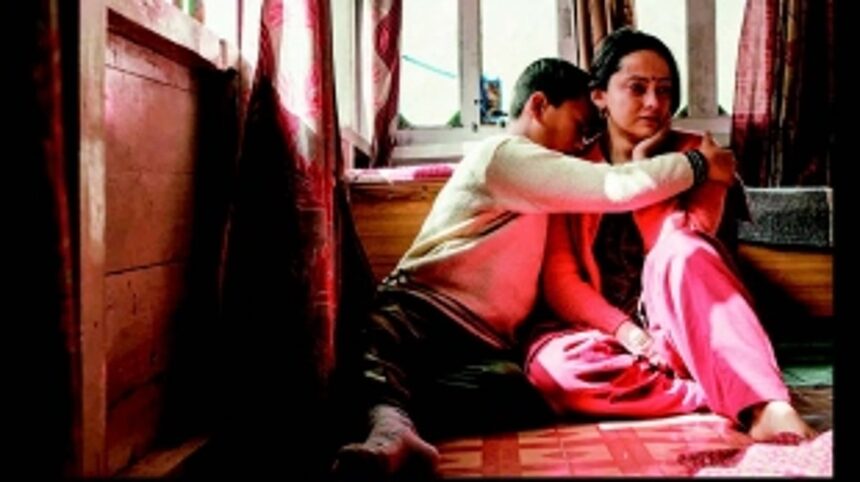
A family of
three, Leela, Raju and their son Abbu, live in a small beautiful village deep
in the lower Himalayas. Abbu struggles with his secret gender identity while
Raju is stricken by loss and failure.
Despite enduring an abusive marriage, Leela is trying to
find a way to deal with survival issues. But amidst this chaos, when she
discovers the feminine inclinations of her son, instead of rebuking him, she
subtly accepts him but asks him to live like her.
This is the central plot of the film Chupi Roh (Stay Quiet),
which deals with gender issues and domestic abuse with a lot of sensitivity.
Speaking about the film, which has been selected under
Indian Panorama (Non-feature Film) section, director, Disha Bhardwaj says, the
inspiration for the film came from a conversation she had with her mother back
in her village.
“During Covid, I had a conversation with my mother about
different issues that we never spoke about when I was growing up. During the
course of our conversation, we spoke about her school batchmate, who was a bit
different, having little feminine inclinations,” Bhardwaj says.
He was pressurised into getting married and later he
committed suicide. My mother will be 70 in a few years and this was the first
time I heard her speak about him as she tried to understand what must have gone
wrong at that time,” she says.
This inspired her to tell a story through her film on this
sensitive subject in a rural space to give representation to such stories,
without becoming judgmental whether it is right or wrong.
Although the film’s protagonist is the son, but actually,
the highlight of the film is the mother’s character, who is strong yet caring.
“The mother, Leela is a strong woman, and also very
accepting, who is on one hand bearing the brunt of her husband’s toxicity and
abuse, but also empathising with his emotions, which are an outcome of his
frustration caused by his disability. At the same time she understands her son,
who is very young and exploring his gender identity,” she says.
And when she is confronted by her son for suffering in
silence, she does not wish to escalate the matter.
“It is a very difficult situation for Leela, trying to
maintain a balance in her everyday life. That is how she functions. Even when
she tries to understand her son’s gender identity issues by accepting the
situation, she knows that it won’t be accepted in the society because of the
taboo attached to it and that he might be bullied. Hence she tells her son
again – Chupi Roh!” the young director says.
Her film has triggered a lot of conversation amongst her
peer group and others who have seen her film.
“They have come to me and spoken about their experiences or
about their friends and family. So, this film in a way does represent the
emotions of people in the LGBTQ spectrum, including children. But I really want
to say that the child is not a transgender. He is still very young and
exploring his inclinations,” the director says.
“If a kid wants to put on nail paint, or a head scarf let it
be. It does not necessarily mean the child is transgender and hence parents
should not start pushing the panic button rather, understand their child’s
needs,” she says.
“Being an ally, I feel that we should be more open towards
the whole spectrum of LGBTQIA+ people because their issues are important. It
does not take much to be kind & to understand. If somebody likes to explore
something, let them do it instead of shaming them,” Bhardwaj says.