The invite to
the Goa launch of Rajdeep Sardesai’s book ‘How Modi won India’ describes him as an “illustrious son
of Goa”.
A
land which he can, in a sense, call his own because of his roots, has probably
not witnessed the nationwide upsurge against the Citizens Amendment act and the
proposed National Registrar of Citizens.
But
the Goa launch, perhaps the first after these wave of protests, compels us to
look at the book, its title and its contents with a more nuanced perspective.
It is ironical that a book on how Modi won India is being introduced to Goa,
when it is felt by a section- at least a much bigger section than when the
elections were held and Sardesai wrote his book- that the foreword for Modi’s
downfall has been written by the manner in which the anti CAA and NRC protests
has been handled.
If
this narrative is played out, stands the test of time and indeed spirals into
something which the Jodi Number 1 of Indian politics, Modi and Shah, cannot
control, then the foundation stone for another book post 2022 could already
have been laid.
At
the same time, the Goa launch (though the book has been in the market for a
while now) will help us understand straight from the author, the bedrock on
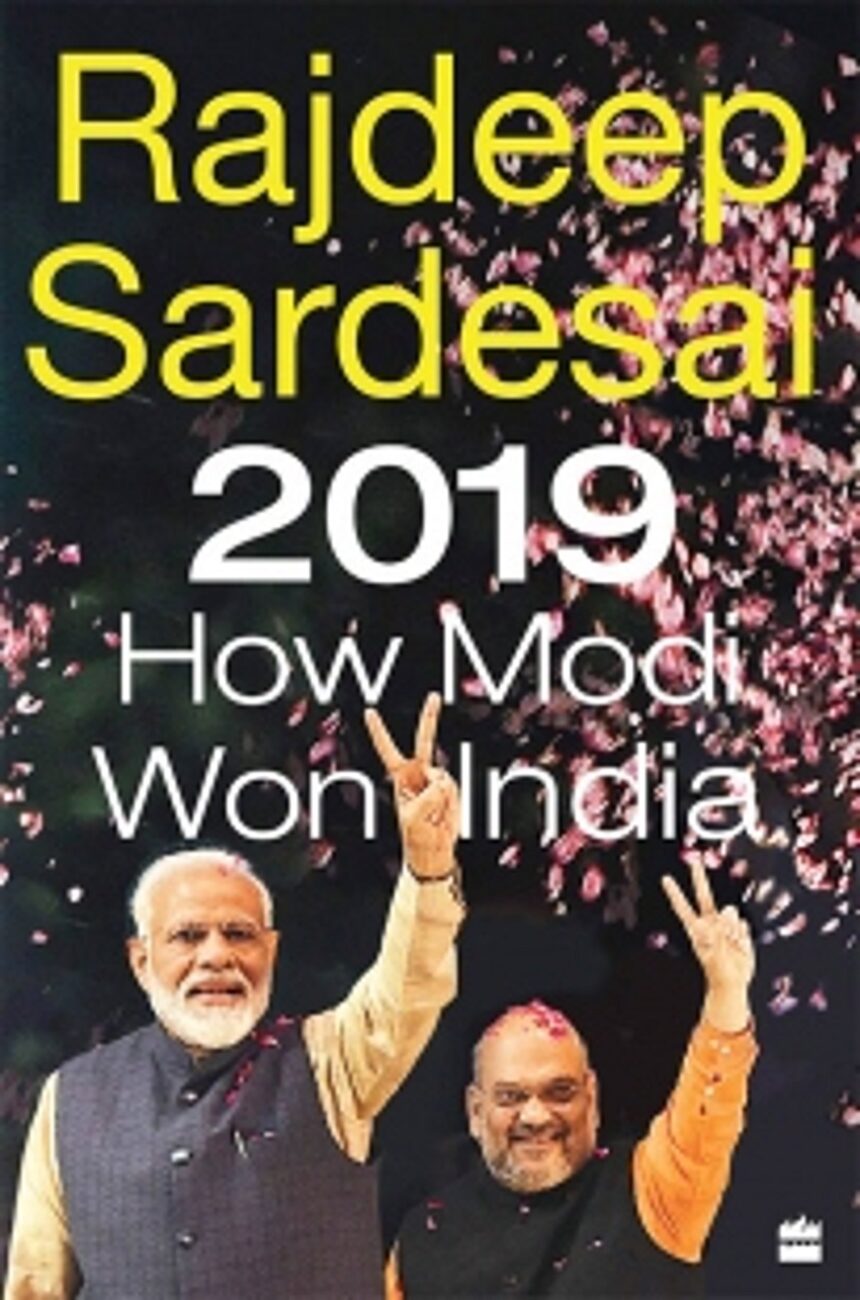
which Modi won. Sardesai, to his credit foresaw, by his choice of the book
cover, which had both Modi and Shah, the shape of BJP’s future politics.
Instead of one show stopper, which won 2019 for them, the journey to 2022,
would be undertaken by the duo, with the man hitherto in the shadows, Shah-
emerging to even take centre stage. The cover therefore had both of BJP’s
icons- the vikas purush ( the man of development) and the hindutva samrat ( the
champion of hindutva), without perhaps figuring that the synergy could also
become a Molotov cocktail.
2019,
How Modi Won India tells us the 13 M’s, 2 W’s and 1 GK- acronyms- which shaped
BJP’s success. The book has been described as “A fascinating look at the key
personalities, strategies and turning points in what was a historic election
victory”.
Psephologist
turned politcian Yogendra Yadav contributed to the first 4 M’s to explain BJP’s
electoral success- Modi, machine, media and money, but Sardesai goes on to add
9 more M’s. They are messaging, marketing, mobile, middle class, millenials,
(anti) muslim majoritarianism, muscular nationalism, Masood Azar (the Pulwama
attack terror mastermind) and mahagathbandhan.
The two W’s which
played a part are welfarism and WhatsApp detailing how the BJP machinery used
this messaging map in a targeted manner to influence opinion, while GK stood
for garib kisan (poor farmer).
Importantly, it can
be argued that each of these factors especially the middle class, and garib
kisan, which led to Modi’s succss can be relooked at, even before half his present
term his over, in the light of the widely discussed purported failure of the
economy and a downturn on employment.
At the same time, it
will be naïve to suggest that he or the BJP has lost all ground, Maharashtra
and Jharkhand notwithstanding. The ‘There is Modi Only’ (TIMO) factor, is
prevalent in party and government, though Amit Shah has begun to share space on
many issues. Moreover he continues to be the only key messenger.
The
book should also not just been seen as one on just Modi but a book on the new
India. No political machinery or machiavellian poll strategy can work unless it
has consumers. The book looks at this new consumer, who has given Modi’s
political business such a strong bottom line. Author Sardesai has long been the
enfant terrible of the BJP troll army, and perhaps of the party as well. To be
able to plough through this minefield and do a nuanced journalistic job, gives
gravitas to a profession, whose credit worthiness is heading in the same
direction as Modi’s economy.