Elsa Angel Rose
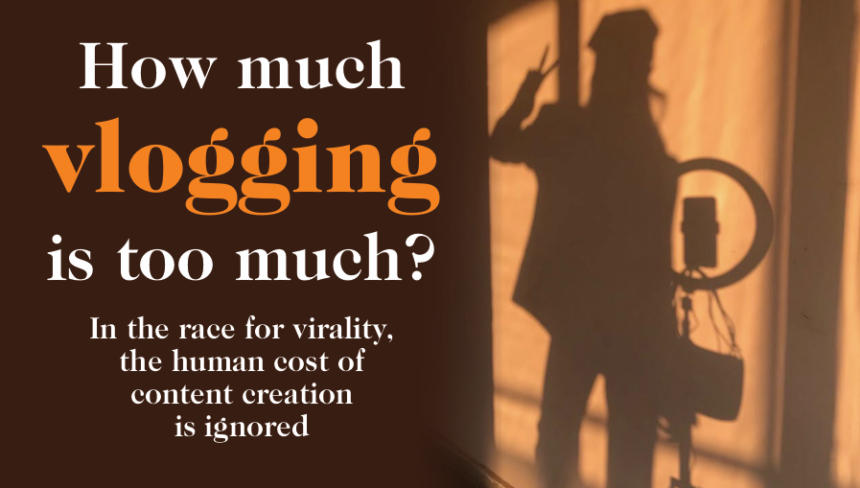
How much vlogging is too much? What if too much vlogging ends up taking a person’s life? A recent incident from Kerala has sparked a debate like never before. A 35-year-old social media influencer, Shimjitha Musthafa, posts on Instagram a video recording of a 42-year-old man and her travelling in a KSRTC bus (Kerala public transport), in which she purports that the man was groping her. Following the social media post, the man ended his life by suicide. The family of the deceased Deepak U filed an FIR against her. Shimjitha has been taken into police custody on the grounds of abetment of suicide (Non-bailable offence). In such a scenario, not aligning with who was right or wrong precisely (Let the justice system decide), what draws one’s thoughts is how vlogging and just posting it on social media ended up in a person committing suicide. Recording videos of sexual predators who make life difficult for women has become more of a self-defence option. But even if one records a video (to keep as evidence), isn’t it ideal to present it to the police and other justice ensuring mechanisms rather than immediately uploading it for the entire world to see? (that too, even before the justice system confirms who the actual victim and the accused are) Social media is, without a doubt, a double edged sword; one can expect both taunts and trophies. And yes, it is quick to judge.
WHY IS RESPONSIBLE VLOGGING NEEDED?
Regardless of whether a person is an accused or a victim or anything else, doesn’t everyone have the universally accepted concept of ‘Right to privacy’? Content creators should certainly create content, but should it be by invading the privacy of other individuals So?, what should be an ideal way to create content? Do we not require a more ‘Responsible vlogging?’ “Vlogging turns unlawful when it captures or publishes identifiable individuals or private premises without consent, particularly where a person can reasonably expect privacy or where such content is used for commercial gain,” said High Court Advocate Eeshan Usapkar, Mapusa. The right to privacy in India is a fundamental right under Article 21 and applies equally to both real-world interactions and digital platforms. Consent is very important in any matter. If consent is not respected or obtained from the concerned person, the repercussions are not very laughable. Advocate Eeshan explained, “Consent is essential because it recognises a person’s right to decide how their image, activities, or property are recorded and shared. Filming or uploading content without consent can expose the creator to civil action and, in certain cases, criminal liability, especially where the recording is intrusive or monetized.”
“DO NOT RECORD” MEANS DO NOT RECORD
Goa and the people here always get first-hand experience of breaches of privacy. If one can visit the Fontainhas during peak tourism months, frustrated owners and neighbourhoods are an everyday sight. You can see tourists and natives fighting whenever any traveller chooses to keep their legs on the newly painted houses of Goans for a picture, or every time they peek through the windows of the natives’ houses to see Goan architecture and more. Cecille shared, “I think when there is a section of society that says, Please do not do certain things in our locality, I think it should be respected. There are signboards in Goa saying, ‘Please do not record.’ So when someone is putting out a message like that, I think people should abide by it and respect the privacy of the citizens in that place.” Advocate Eeshan explained the consequences in such situations, “When visitors record photographs or videos despite clear ‘Do Not Record’ signage, it clearly amounts to a violation of privacy. Such conduct may attract action under Article 21 of the Constitution, provisions of the Information Technology Act, Civil law remedies, and local municipal & heritage conservation regulations. If they enter into any premises without consent, then they can be criminally prosecuted for trespass.” The right to record cannot override the right to privacy. Know when not to press ‘upload.’
NOT EVERYTHING NEEDS TO GO VIRAL
Many content creators in Goa are aware of and abiding of the law. They are not in a race for virality but accountability and ethical content creation. Fashion and beauty Content creator Rhea D’souza shared her views, “I try to remind myself that virality is a bonus, not the goal. Before posting anything, I ask whether the content aligns with my values and the kind of creator I want to be known as.” She added, “I avoid posting anything misleading, harmful, or purely sensational just for numbers.” Spreading unchecked or unreliable information through social media is a trap for oneself. Political activist cum content creator, Cecille Rodrigues, shared, “I make sure that when I’m documenting something, there must be proof. Either I’m showing the proof, or it’s been published in a newspaper, or there is something in writing that I can show people; I’m not just talking in the air.” Developing a thick skin is the only way to be active on social media. Being an authentic, true self will help; respecting the privacy of others, fact-checking the content you present, also helps. Ceccille shared, “Whatever you stand for is what you stand for; you won’t be able to make everyone happy. You will have people commenting on you. Over time, I’ve learned to be strong and to understand that this shouldn’t affect me. It bothers me, but sometimes it doesn’t affect me. I just ignore it.” Once a video is out on social media, it innately open to all kinds of judgments, and active members of social media are cognizant of it. Rhea shared, “People will judge you whether you’re doing something good or something bad, so that’s not something you can really control.
“DO NOT RECORD” MEANS DO NOT RECORD
Goa and the people here always get first-hand experience of breaches of privacy. If one can visit the Fontainhas during peak tourism months, frustrated owners and neighbourhoods are an everyday sight. You can see tourists and natives fighting whenever any traveller chooses to keep their legs on the newly painted houses of Goans for a picture, or every time they peek through the windows of the natives’ houses to see Goan architecture and more. Cecille shared, “I think when there is a section of society that says, Please do not do certain things in our locality, I think it should be respected. There are signboards in Goa saying, ‘Please do not record.’ So when someone is putting out a message like that, I think people should abide by it and respect the privacy of the citizens in that place.” Advocate Eeshan explained the consequences in such situations, “When visitors record photographs or videos despite clear ‘Do Not Record’ signage, it clearly amounts to a violation of privacy. Such conduct may attract action under Article 21 of the Constitution, provisions of the Information Technology Act, Civil law remedies, and local municipal & heritage conservation regulations. If they enter into any premises without consent, then they can be criminally prosecuted for trespass.” The right to record cannot override the right to privacy. Know when not to press ‘upload.’