Scooping
hollow a holy book and hiding diamonds in its heart. Draining orange juice out
of a tetra pack and stuffing it with narcotics. Filling a walking cane with
baubles. Gold bars as lunch inside a tiffin box. Stashing expensive watches in
the crank case of a car. In Panjim’s Indian Customs and Central Excise Museum,
I was picking up cues, tricks that smugglers use to bring contraband and
hoodwink law, using not only cars, carburettors and canes, but even rectums as
smuggling coverups. Such ingenuity.
Housed
in a heritage building that was constructed in 1600, the two-storied, one of
its kind museum is divided into galleries. Behind thickened glass panes of the
Battle of Wits Gallery, a white Premier Padmini car is stuck in the wall, its
bonnet open and goods hidden in the carburettor. On the wall hangs a
sepia-toned photograph of the eight men who had stuffed 510 tolas of gold in their rectum and were arrested at
Amritsar Rail Customs Station on June 10-11, 1956. In another blown-up
photograph are 25 carats of diamond and 1,057 watches camouflaged in a car that
was seized at the Puducherry border on May 7, 1954.
The
Numismatic Collection has Harappan coins, Portuguese Xerifina (the word is a
derivative of Arabic asharfi), gold and silver coins. In the Seizure
Gallery and Wildlife Gallery, seized antique statues and idols, ivory,
rhinoceros horns, elephant molars, a carved monolith are displayed. Arms and
ammunition used by customs and excise department (do not miss the wooden revolver)
are also on display.
I
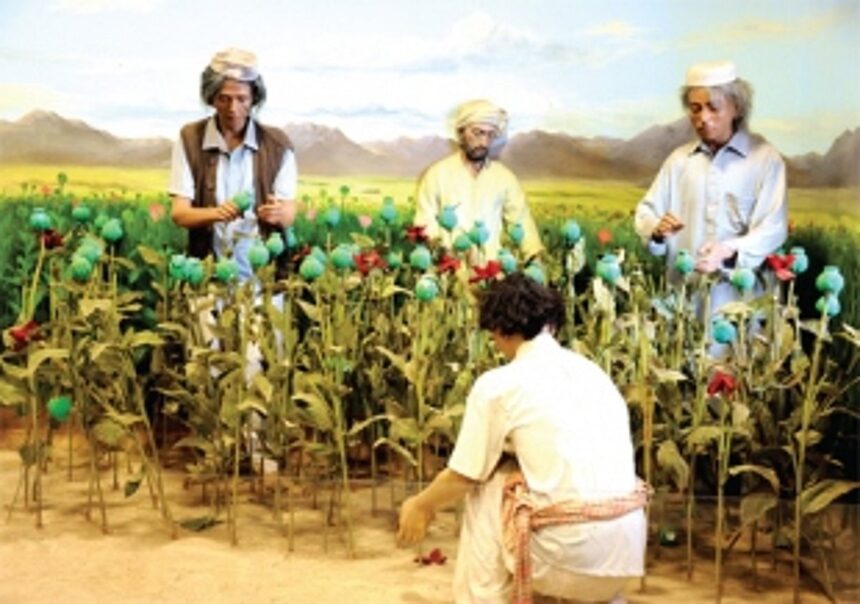
moseyed up the varnished staircase to look at a scrap of land loaded with opium
poppy and implements used to derive the reddish-brown heavy-scented drug. In
another corner are clay scientists in a Customs/Excise laboratory peeping into
microscopes and running seized gold through machines to check its purity. The
Central Excise Gallery also has a Salt Hedge that was built by the British
along the country to collect salt tax and prevent salt smuggling. There are
mannequin custom and excise officials in their ironed uniform and sculpted
Mahatma Gandhi bending to pick salt with his band of followers.
Much
before the Blue Building (it was originally white) was constructed, the
Portuguese had set up a customs check post on the Mandovi river in 1479. In the
16th century, horses, tobacco, slaves and spices were the common trade items
while pepper was a royal monopoly. In 1770, export and import duties were set
at 6% and 9%, respectively. The Museum documents and displays the evolution of
Indian customs and excise from the Harappan trade seals and ancient ports to
taxation tenets of Kautilya’s Arthashastra, Akbar’s Ain-i-Akbari, cotton
being the first good taxed under British India and the modern-day taxation and
customs laws.
I
stepped out of Indian Custom and Central Excise Museum into a macadamised
street. Centuries ago, there was nary a street. River Mandovi kissed the first
brick of the Blue Building. Tobacco was brought in sculls and horses on larger
boats. That day in Goa, I learnt about
chicanery and the bravado of customs and excise officials. The battle of wits
goes on.